| 6. Ushnishavijaya
|
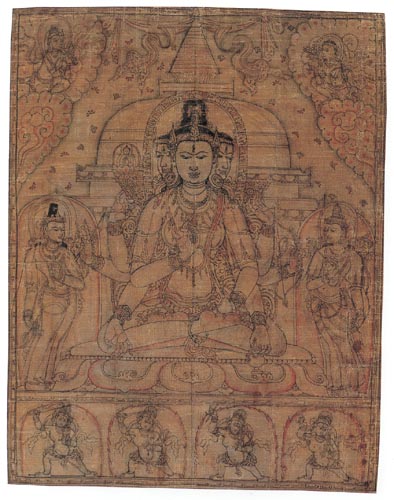
6.
Ushnishavijaya
Eastern Indio or central Tibet(?), 11th-12th century
Distemper on silk
Without mounts: 22
9 x 17.8 cm (9 x 7 in.)
The Kronos Collections
|
The eight-armed Indian goddess Ushnishavijaya is one of three deities associated with longevity and the fulfillment of earthly desires. The other two are the White Tara and Amitayus. Ushnishavijaya combines aspects of three goddesses (hence her three heads), each associated with a sadhana (wish). Here she sits on a single lotus seat in front of, but metaphorically within, a stupa (reliquary mound), which is dictated by her iconography. Poised in the clouds at the top corners of the thanka are vidyadharas (garland bearers) holding pots of vegetation (the one on the upper left may hold durva grass, whose exceptional durability is associated with aspirations for a long life). The sky is filled with gently tumbling flowers. In many respects the image follows the basic canon for the depiction of the goddess and her entourage. Her mudras and attributes are all present in the standard order, and she is flanked by the bodhisattvas Avalokiteshvara, to her right, and Vajrapani, to her left. However, her left head is usually horrific rather than pacific, and her lotus seat should rest on a moon. The four deities of the cardinal directions, who should be guarding the four quadrants over which they preside, are instead assembled below: Achala (east), Takkiraja (south), Niladanda (west), and Mahabala (north).
The stupa, with its low dome and multistoried base, compares generally with stupas portrayed on Pala stelae
and manuscripts of the eleventh century and on tenth-eleventh-century miniature clay votive tablets.1 The antefix at the corner of the building is a feature commonly seen in thankas. In most
eastern Indian manuscripts antefixes represent small flags placed at the corners of buildings (often against a curved molding which, in the Tibetan versions, seems to assimilate them.)2 However, there are instances, in the Boston Museum of Fine Arts covers and in Bengali sculptures (for example, an Avalokiteshvara from Tapandighi), where such antefixes occur.3
On the reverse of the thanka is a long umey (Tibetan cursive script) inscription in red ink in the shape of a stupa (see fig. 49). The head of the deity is centered under the harmika (the section above the dome), and the body is enclosed within the main mass of the stupa. Superimposed in black script are mantras that consecrate each of the deities in the painting, including the vidyadharas.
The composition and overall feeling of this small thanka relate it most closely to the Kronos Amoghasiddhi (cat. no. 4). There is a similar sense of the monumentality of the central figure in relation to the auxiliary ones and of a continuous space throughout the whole picture. The four guardian figures (although theoretically iconographically distinct) are mere images of each other, exactly as in the Amoghasiddhi. The artist's drawing is skillful in the use of details to define the forms they adorn. Some of these, for example, the subtleties of the tribhanga, are not as successfully conveyed as in the Amoghasiddhi, perhaps because of the great difference in scale. Other details, such as the scarves fluttering from the top of the stupa, the flowers twisting in the breeze, and the flowing volumes of the principal figure, are beautifully rendered. Some of the goddess's jewelry, particularly her crown with three large spearlike elements and the wide bracelets with raised borders, are similar to those seen in the Ford Tara (cat. no. 3). As noted earlier, pacific deities dominate in the group of early thankas, and representations of Ushnishavijaya are not found again until the fifteenth century. This is the earliest painting on silk in the Bengali style that we know of. The golden color of the fabric might have been meant to mimic that precious material.
Once again we are dealing with a picture that has extremely close ties to Pala styles and that, apart from its Tibetan inscription on the reverse, has no clearly definable Tibetan pictorial elements. The drawing of the central deity is less suave and fluent than that of the finest Pala examples, but this does not rule out an Indian origin. Our knowledge is insufficient to determine absolutely where it was painted.4 SMK
1. Pal and Meech-Pekarik 1988, fig. 25a; Tucci, Stupa,
1988, p. 76, fig. a; and Seattle 1990, pl. 156. [back]
2. See Pal and Meech-Pekarik 1988, figs. 23ab, for a pair of book covers
from the Los Angeles County Museum of Art, said to be from Bihar, 1150-1200, but
probably from Bengal. [back]
3. Seattle 1990, pl. 237. [back]
4. According to James Watt of The Metropolitan Museum of Art, the mounts
appear to be fourteenth century, judging from the silks. [back]
|