
|
1. Head of Bodhisattva Pakistan Gandhara period 2nd- 4th century Grey schist height 32 cm |
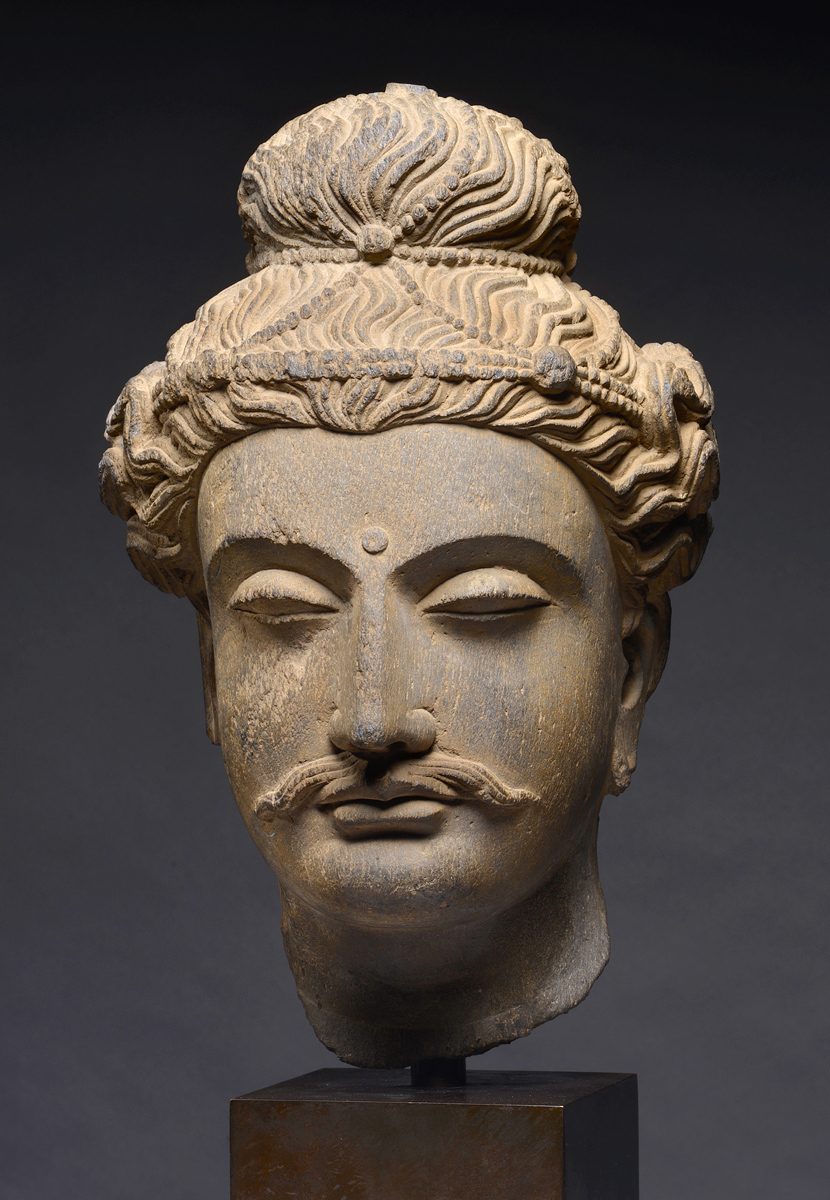
The Gandhara ‘school’ in Northeastern Afghanistan and Northwestern Pakistan was a remarkable conglomerate of Greco- Roman stylistic characteristics and Indian Buddhist iconographic and philosophic elements, during the first centuries of the Christian era. Initiated by the campaigns of Alexander in the 3rd century BCE and followed by the Greco-Roman cultural aftermath in greater Bactria, many traits of the classical Greek culture melted with the Central Asian Kushan andNorthern Indian Mathura aesthetic ideas at the beginning of the first millennium CE. The Buddha was represented as a god in an idealized ‘classical’ human shape, and so were the Bodhisattva figures, venerated like saintly beings deferring nirvana, in order to help human beings on earth to attain enlightenment. In that period Bodhisattvas were represented as princes with the attire of a Central-Asian nobleman. This Bodhisattva head sculptured in grey schist has all the characteristics of ‘classical Gandharan’ art. The oval face, the straight nose, the balanced and symmetric definition of the face, the wavy hair, all refer to the Greco- Roman basis. Added to these are the Asian traits such as the moustaches with curled tips and the hair decorated with strings of pearls. On top of that, there are the Buddhist symbols like the half-closed eyes, the urna (the slightly elevated dot on the forehead), the ushnisa (the topknot on the skull) as well as the elongated earlobes. The heavy-lidded, long slanted, almond-shaped eyes under the perfectly curved eyebrows with sharp ridges, enforce the feeling of tranquility and introspection. The well-formed lips crowned by the moustache and the rounded chin give this face also a firm but benign masculinity. Although known for its naturalistic composure, Gandhara sculptures also show the tendency to reduce the realistic human traits to its essentials, which produces a kind of over-all spiritualty, a Buddhist meditative touch, like in this case. The hairstyle requires some additional explanation. In this early type of Gandhara art, the hair locks are still wavy and tied together in a chignon. Some Bodhisattvas have long curls of hair in the neck, hanging over the shoulders. The wavy hair will eventually evolve into a more Indian representation of snail-like curls arranged all over the skull. The decoration of the hair has its own evolution as well. In earlier examples of the Bharhut and Sanchi bas-reliefs, noblemen and princes show a turban with a decorated plaque on the front, attached with strings of pearls. This Indian turban element was applied as an elaborate diadem in Gandhara Bodhisattva sculptures - sometimes showing a little Buddhist figure, stupa, flower or ewer in its center, as a symbol, depending on which Bodhisattva was represented. The usual alternative was a more restrained decoration, orderly arranged in a web of strings of beads with gems at each joint. Our Bodhisattva head is a perfect example of this characteristic. Some scholars will remark that this typical hair decoration should be assigned to the Bodhisattva Maitreya, the Buddha of the future. Among some similar Bodhisattva heads in private and museum collections, this head can be compared with the head of a third-century Bodhisattva sculpture in the Metropolitan Museum in New York (discussed in Behrendt, Art of Gandhara, New York, 2007, p.55, fig.44). Provenance: Collection Mr. J. Sherrier, London, before 1984. Private collection, London, 1984-2018. Literature: I. Kurita, Gandhara Art, II, The World of the Buddha, Tokyo, 2003, p.15, fig.17. K.A. Behrendt, The Art of Gandhara, The Metropolitan Museum of Art, New York, 2007, p.55, fig.44. K. Tanabe, Gandharan Art from The Hirayama Collection, Tokyo, 2007, pp. 94-95, fig. II-7. |