
|
10. Jina Neminatha India, Mount Abu, Rajasthan Solanki period 12th century White marble height 74 cm |
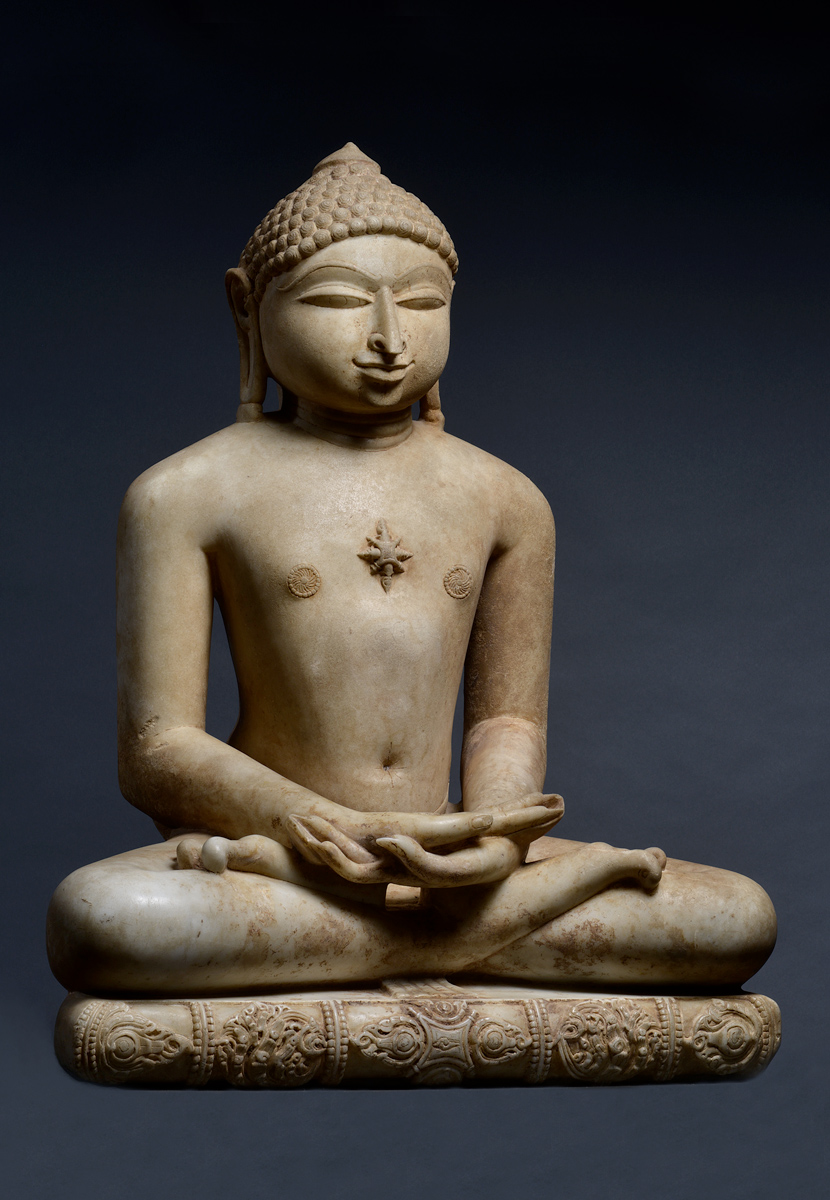
Jainism is an Indian doctrine of salvation, preached by Mahavira, a contemporary of the Buddha. His teachings are stricter and more ascetic than Buddhism and the number of his followers is also relatively limited. The basic principle is the intention of ahimsa, not to harm any living being. A schism, mainly on practical conventions, split the followers into Shvetambaras, ‘clad in white’ and Digambaras, ‘sky-clad’ or naked. According to Jain tradition, there have been 24 Jinas or Tirthankaras, so-called ‘conquerors’ who attained Liberation, moksha. Mahavira was the last or 24th and lived from 599 to 527 BCE. His predecessor, the 23rd, was Parshvanath who lived almost three centuries earlier. Both are historic figures. The 22nd Jina was Neminatha. He is believed to be a contemporary and even a cousin of the Hindu god Krishna and his brother Balarama. The Jina would have been ‘ten bowshots tall’ and lived for one thousand years. Like in the famous story of the Hindu god Rama who was the only one able to stretch a heavy bow, Neminatha was capable of lifting an enormously heavy shell. Therefore, his cognizance is a conch shell. He is also known as Arishtanemi, arishta being Sanskrit for wheel and nemi for the nave. The Tirthankara reached Liberation on Mount Girnar in Gujarat, which is still an important pilgrimage destination for Jains. The present marble sculpture shows Neminatha in a meditative position. Iconographically this particular sitting posture is somewhere in between the well-known padmasana (with both feet resting on the opposite thighs, with the soles facing upward) and ardhaparyanka (one foot resting on the thigh, the other foot on the seat with sole up). Accordingly, resting the right foot on the left shin-bone is rather common in Jain sculptures. The Jina places his hands in the meditation mudra. He has a slim waist and broad shoulders. His head is covered with concentric rows of little curls and crowned with a small, conical, pinnacle. Looking at the meticulously rendered details makes this sculpture extremely fascinating. The highly polished marble causes the figure to radiate. The large bows of the eyebrows accentuate the horizontally very wide eyes with incised pupils. The nose of this sculpture is extraordinary though consistent with the iconographical prescriptions: ‘long and pointed like the beak of an eagle’. This feature is extremely rare in a sculptural form, while it is fairly common in Jain miniatures and paintings. The mouth, with full lower lip, has raised corners which creates the Jina’s gentle smile. The rounded chin is marked by a circular line and highlights the broad, rounded, cheeks. The elongated earlobes hang down, separated from the shoulders by a little pellet. Like the eagle’s nose and the swollen chest, the three folds in the neck are a mark of perfection. The jewel on his chest is a shrivatsa, a star-shaped auspicious symbol. The nipples are shaped like whirling circles. The hands, incised with a round flower in the palms, are slender with slightly raised fingers and long pointed finger nails. They are carved in a very realistic way, just like the feet with their naturalistic shape and bent toes. The cushion is profusely decorated with floral motifs, beaded strings and the cognizance of Neminatha: the conch shell. Only a fine line along the curve of his stomach, as well as the pleated fabric, appearing from under his right ankle on the cushion, subtly indicates that this Jina sculpture belongs to the Shvetambara sect of Jains, those dressed in a white cloth. If a sculpture can be called sublime and perfectly executed, this Jina Neminatha fulfills all these conditions. Provenance: Collection Spink & Son Ltd., London, before 1989. Private collection, London, 1989-2019. Literature: Indian art, Victoria & Albert Museum, University Press, Oxford, 1977, fig.19. P. Pal, The Peaceful Liberators, Jain Art from India, Los Angeles County Museum of Art, London, 1994, p.140, fig.27. M. Brand, The Vision of Kings, Art and experience in India, National Gallery of Australia, 1995, p.76, fig.50. J. Van Alphen, Steps to Liberation: 2500 Year of Jain Art and Religion, Antwerp, 2000, fig.64. Detail: close-up |