|
12. Buddha Aksobhya Tibet ca. 1300 CE Bronze with copper and silver inlay, and semi-precious stones, Traces of blue pigment height 48 cm |
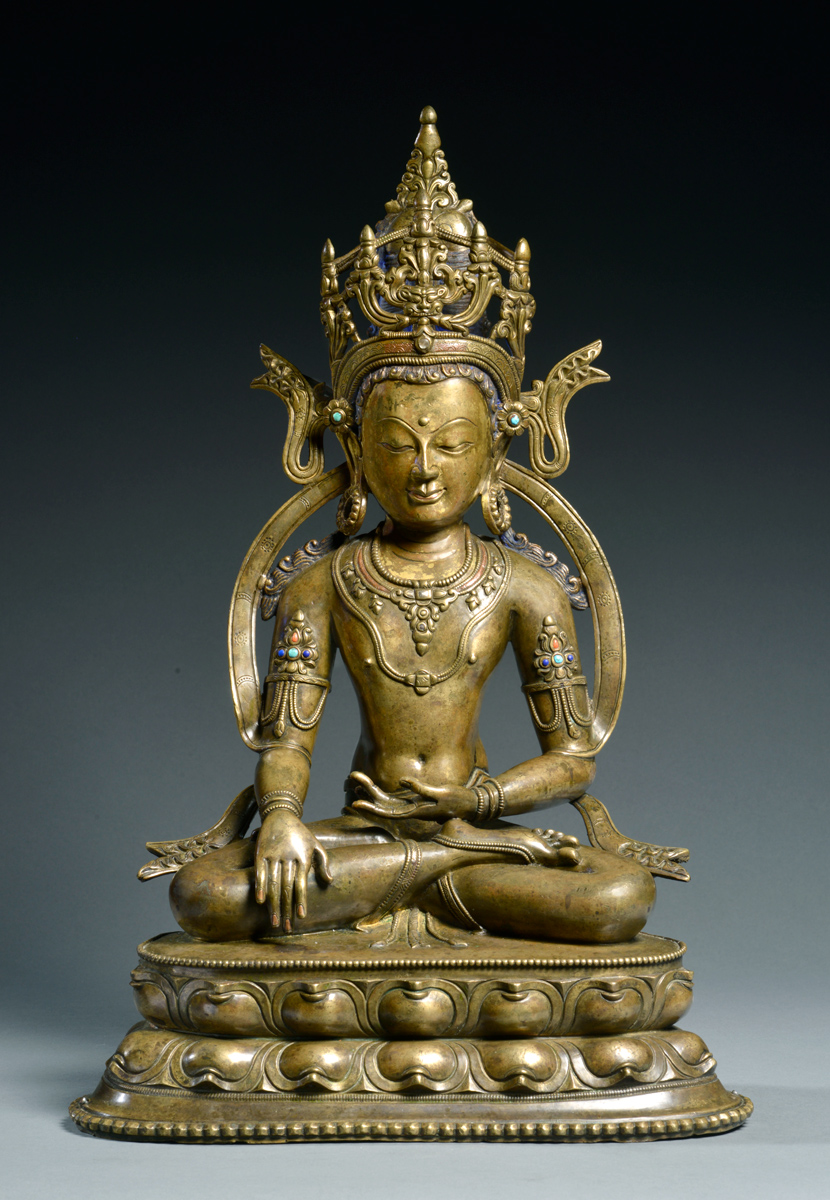
In early Tibetan Buddhism, five transcendental or Dhyani Buddhas are believed to have emanated from the primordial Adi Buddha. They are also called Cosmic Buddhas presiding over the five directions. Aksobhya is the Buddha of the East. His symbol is the vajra or thunderbolt. His name means ‘unshakable’ or ‘unperturbable’ and he is the embodiment of vijñana, pure knowledge and intelligence. His iconographical posture is similar to that of Buddha Sakyamuni. The gesture of his right hand marks the difference with the other Dhyani Buddhas. This hand points downwards from his right shin, almost touching the double-lotus bases. The bhumisparsha gesture refers to the calling of Mother Earth as a witness to Buddha’s victory over the demon Mara, his last obstacle to attain enlightenment. Therefore, Aksobhya is also the eradicator of the affliction of anger, one of the main hurdles on the way to enlightenment. Following the destruction of the Buddhist institutions in Northeastern India at the end of the 12th century, Buddhist monks and artisans fled to Tibet and Nepal. Most probably the Tibetan artisans emulated Pala aesthetics and gave them a Tibetan interpretation. This fabulous bronze contains all the defining features of the first pure Tibetan style, flourishing in the 13th- 14th centuries, after a period of formation in the late 12th century. An examination of the stylistic elements confirms the characteristics of this unique period. Aksobhya sits in vajrasana ‘diamond or thunderbolt’ position with interlocking feet and upward-facing soles. Wearing only a dhoti, with beaded hems falling over his shins, his torso remains bare. But an abundance of decoration and attire, adorn him with the princely wealth of a Bodhisattva. The edges of the dhoti are visible around the narrow waist under the deep navel. He wears anklets and armlets of beaded strings. His upper-arm bands are worn high-up and decorated with a triangular foliate pattern, encrusted with turquoise, lapis lazuli and agate. Tiny tassels and pearled garlands are hanging from the armbands. Multiple necklaces adorn his chest. The inner one has a matching triangular pectoral with a rectangular silver gem; one string contains small pending flowers, while the strip in between is inlaid with copper. The outer necklace makes a U-shape. The tender contemplating face is highlighted by the recurring incised curves of the arched brows, the downcast eyes being inlaid with silver, and the fine mouth with dimples at each corner. His hair is piled up in a tall chignon topped by a lotus bud finial and colored with blue pigment. Curled and large locks of hair are still visible at the edge of the forehead and on the shoulders. Most impressive is the proportionately huge tiara with five foliate leaf-plaques, inter-connected with beaded strings that also acted, technically, as re-enforcing struts during the casting. The front panel shows a kirtti mukha, a hybrid monsterface. The diadem is incrusted with a crystal gem, inlaid with copper and incised with concentric circles. Two blooming flowers, with a gemstone in the center, embellish the diadem, while its two ribbons sweep up above the ears, ending in an elegant fishtail pattern. The elongated earlobes are pierced with large, round, beaded rings. One of the most remarkable characteristics is the sash that describes a wide arch from the back of his head, touching the ends of the locks of his hair at the shoulders, encircling the arms at the elbows and ending in a fluttering fishtail, similar to the diadem ribbon-tips. Incised with a ‘cat-paw’ motif, it describes an aureole-like contour over Aksobhya’s body. Along with this arching sash, the tiara ornamentation, the fleshy toes, the elongated and delineated fingers, the copper inlaid nails, the broad shoulders, the tapered waist and the relatively big head, this spectacular bronze shows all the qualities of only the very best 13th-14th century Tibetan bronzes. Considering its richness, encrusted gems, the use of different metals and perfect thin casting, this Aksobhya was undoubtedly commissioned either by a monastery or wealthy temple. It still contains all the sacrificial material, sealed off with a base plate. Provenance: Collection, Mr. M. Hürlimann, Switzerland, acquired in the 1960s. Private collection, Switzerland, 1993-2019. Published: Koller Auktion, catalogue, 89/3, Zürich, 26-27 November 1993, frontcover-lot.12. Literature: M. Hürlimann, India, London, 1967. W. Zwalfs, Buddhism, Art and Faith, British Museum Publication, London, 1985, p.134, fig.184. P. Pal, Art of the Himalayas, Treasures from Nepal and Tibet, New York, 1991, fig.62. U. Von Schroeder, Buddhist Sculptures of the Alain Bordier Foundation, Hong Kong, 2010, p.43, pl.18. G. Beguin, Art sacré du Tibet, Collection Alain Bordier, Sully-la-Tour, 2013, p.159, fig.82. Detail: close-up |