
|
6. Head of a Cosmic Buddha Central Java 9th century Andesite stone height 30 cm |
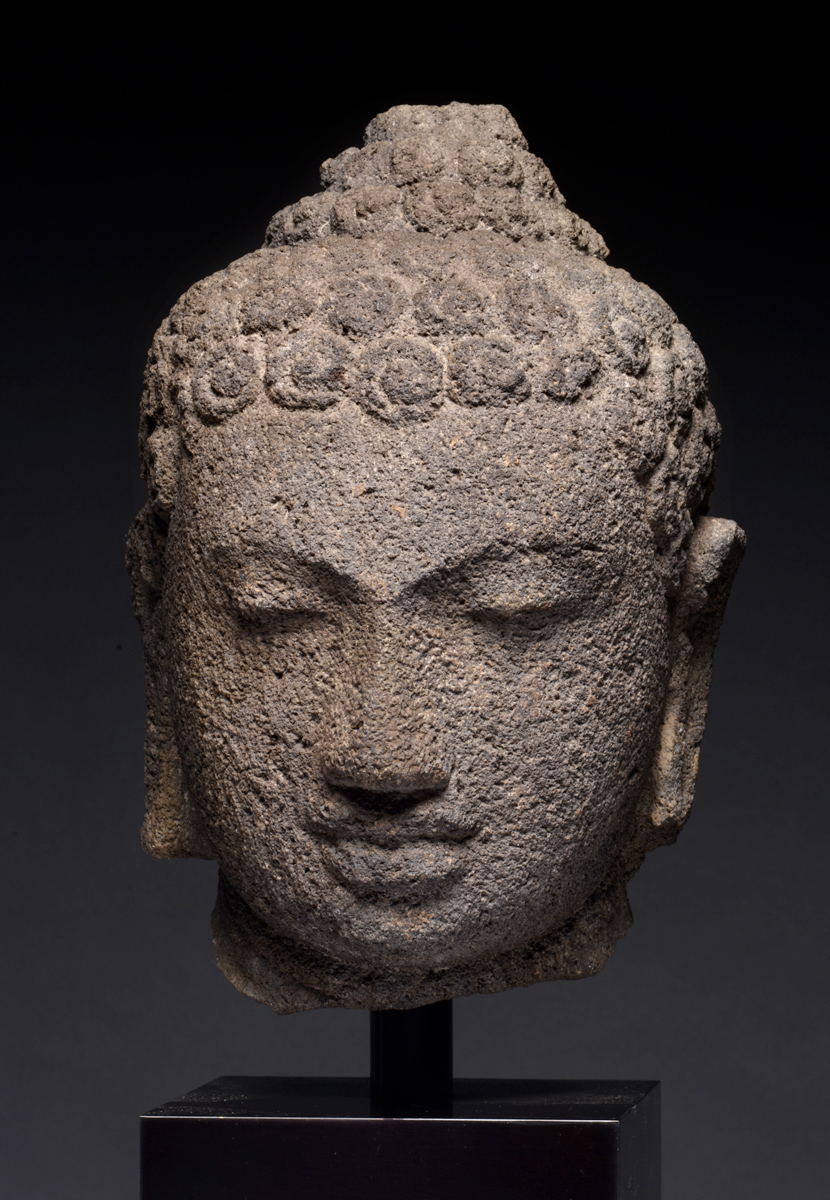
This Buddha head in volcanic, Andesite stone is an admirable example of the highest artistic craftsmanship attained under the Shailendra Dynasty of the 9th century in Central Java. The world-famous Borobudur temple, containing over 500 Buddhas, is generally accepted as the norm of how the Buddha should be ideally represented according to classical Indonesian standards. But other temples share this character as well, among them, Kalasan, Sewu, Saijiwan, and Plaosan. The present head is exemplary in all respects: the well rounded over-all impression, the soft treatment of the hard and porous stone, the downcast eyes under the gently arched brows, the firm nose, the mouth with its tender smile, the pendulous earlobes and the rows of large snail shell curls that ascend from the broad forehead to the top of the crane. The head is crowned with a conical ushnisa of three more rows of these spiraling curls. Although most 9th century Buddha heads in Central Java, at first view, appear the same, there are numerous variations possible in expression, such as, the width of the face, in the indication of the urna or, as in our example, the omission of it. A clear distinction can be found in the shape of the hairstyle and the size and number of rows of curls. In his study ‘Entering the Dharmadhatu: A study of Gandavyuha Reliefs of Borobudur,’ 2012, Jan Fontein reveals several stylistically very comparable Buddha heads with the same rounded shape of the head and the large hair curls surmounted by a threelayered ushnisa. Still, the serene expression of bliss remains the main characteristic of these fascinating sculpted Buddha heads. It is therefore also fascinating and surprising that the many metal sculptures from the same period in Central Java, Indonesia, seem to be of a different spirit and style. These are clearly based on imported bronze examples of the contemporary Indian Pala sculptures. As Susan Huntington stipulates in Leaves from the Bodhi Tree, The Art of Pala India (8th -12th centuries) and Its International Legacy pp. 208-212. They are “iconographically most variegated, stylistically sophisticated and jewel-like in precision,” They represent the Tantric Vajrayana school of Mahayana in the style of the contemporary Indian Pala Dynasty. The Javanese stone sculptures of the Shailendras, however, are more connected with architectural monuments and seem to follow an earlier style, directly derived from Gupta sources and mixed with indigenous aspects. Why this difference in style between stone and metal sculptures occurred remains enigmatic. Perhaps it was the personal choice of the ruling kings to embellish their buildings separately from the often portable and smaller bronzes that served tantric customs and rituals. Provenance: Collection Mrs. C. Oei, Indonesia, acquired between 1950s-1960s. Literature: S. L. Huntington and J.C. Huntington, Leaves from the Bodhi Tree: The Art of Pala India (8th-12th Centuries) and Its International Legacy in Journal of the Royal Asiatic Society, vol.3, n°2, July 1993, pp.208-212. P. Pal, A Collecting Odyssey, Indian, Himalayan, and Southeast Asian Art from the James and Marilynn Alsdorf Collection, Chicago, 1997, p.104, fig.126. M. Nies, Immortal Image. Art of India, the Himalayan regions, Indonesia and Southeast Asia, catalogue, Antwerp, 2001, pp.10-11. M. Nies, The Future Buddha. The Cultural Heritage of Asia, catalogue, Antwerp, 2009, pp.22-23. |