
|
7. Vajrasattva Central Java 9th- early 10th century Bronze height 13,5 cm |
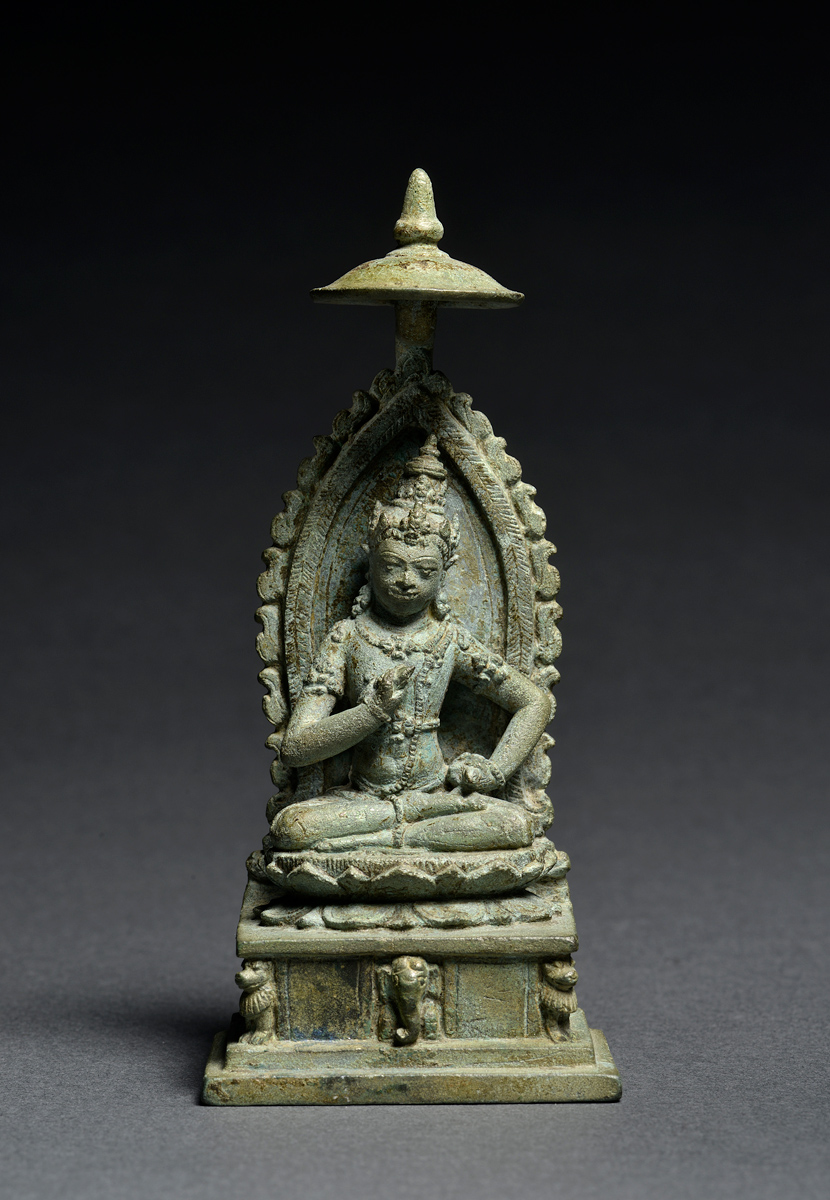
Scholars of Indonesian art have pointed to the differences in style and content, between stone sculptures and bronzes, when Buddhism became prominent in Central Java by the end of the 8th century. While stone sculptures may have served mainly in an architectural environment, bronzes would have been used not only in temples though mostly in a ritual context, which was of the Tantric Vajrayana tenor. As a result, stone sculptures are not only bigger in size than the average bronze, but seem stylistically based on older Gupta characteristics, while bronzes clearly show a strong influence from the contemporary Pala art. In the stratification of the many Buddhas of Tantric Buddhism, Vajrasattva is an Adi Buddha or Primordial Buddha, in contrast with Transcendental or Jina Buddhas and Manushi Buddhas who resided on earth, such as Buddha Sakyamuni. Vajrasattva’s name and representation is full of essential notions: ‘The being, sattva, of the thunderbolt, vajra.’ He is holding the vajra in his right hand in front of his chest and the bell, ghanta, in his left hand, down to his thigh. The vajra denotes the ‘Absolute,’ the male principle, and symbolizes compassion. The bell is a female attribute and denotes ‘Samsara’ (the endless circle of rebirth) symbolizing transcendent wisdom. Separately they symbolize emptiness, shunyata, as well as wisdom, prajna. As a pair, both attributes denote enlightenment. Therefore, Vajrasattva is so full of meaning. Although classified as a Buddha, Vajrasattva is depicted as a Bodhisattva. The present bronze shows a plethora of attire: a necklace and armbands with a common motif, anklets, stomach band, sacred cord, earrings, a bejeweled diadem and conical headdress. He sits in the sattvaparyanka posture with the right leg on top of the left. His seat is a double lotus on a rectangular throne which is supported by lions at the corners and an elephant in the middle. He is sitting against a backdrop of a mandorlatype of aureole with a raised rim of a fishbone-design and a flaming contour, prabha. The pointed top is crowned with an umbrella finial, chattra. Despite being stylistically so close to the 9th- 10th century Pala examples, the Javanese sculptors had their own interpretations. The facial expression is typically composed of rounded forms, rather bulbous eyes, a broad nose and thick lips. The body is slightly thrust to his left while the head tilts slightly to the right as a counter movement. The lotus petals are thick with engraved details whereas Pala lotus petals are thinner and shaped by hand. The rectangular base is uncommon in contemporary Pala bronzes, as is the solid halo, which, in Pala bronzes, usually remains open. This exquisite small bronze of Vajrasattva is a wonderful example of Central Javanese artistry around 900 CE. Provenance: Collection Mrs. C. Oei, Indonesia, acquired between 1950s-1960s. Collection Mr. F. Sanders, the Netherlands, 2019. Expertise Report: Registered in Documentation Centre for Ancient Indonesian Art, J. Polak, Amsterdam, the Netherlands, 2019. Literature: J.E. Van Lohuizen-De Leeuw, Indo-Javanese Metalwork, Linden Museum, Stuttgart, 1984, p.38, fig.2. P.L. Scheurleer & M.J. Klokke, Divine Bronze, Ancient Indonesian Bronzes from AD 600 to 1600, Leiden, 1988, p.83, fig.31. |