|
8. Shiva Chandrashekhara India, Tamil Nadu Chola 11th century Bronze height 57 cm |
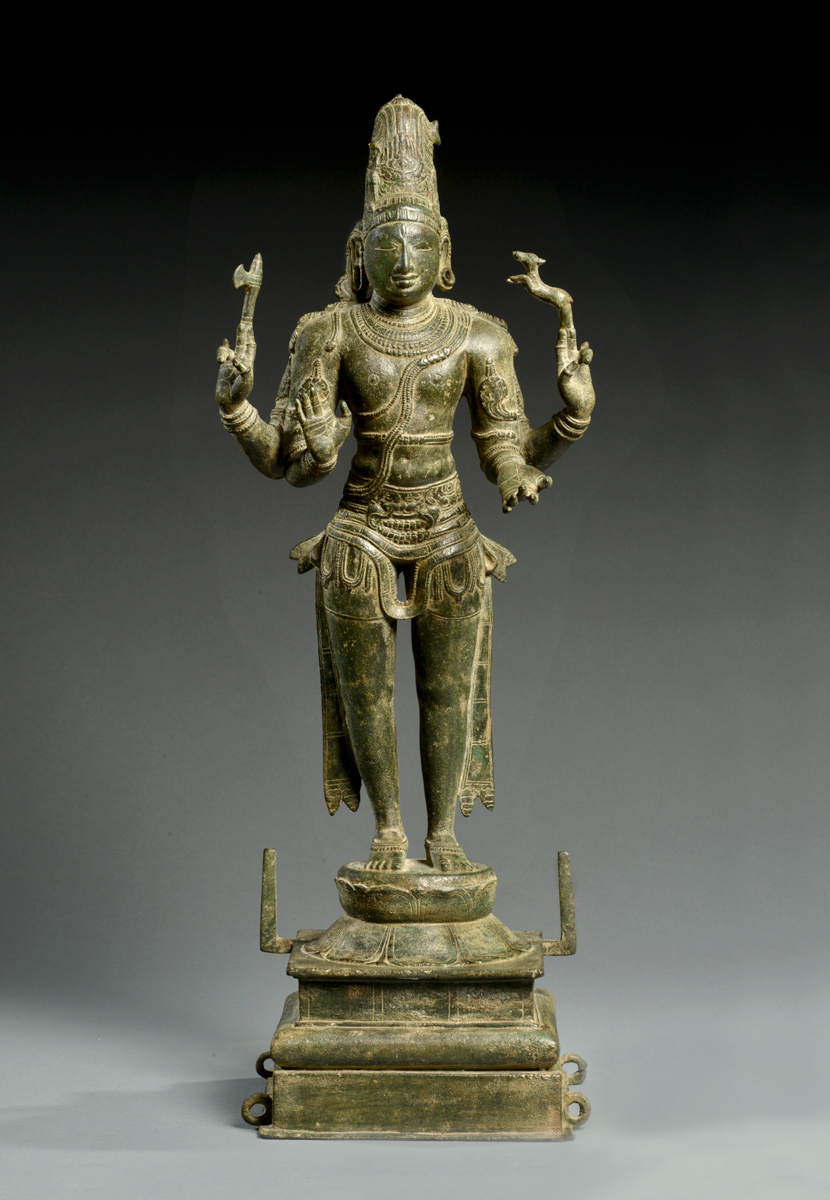
In the classical Hindu concept of the divine trinity or trimurti, Shiva is generally mentioned as the ‘destroyer’, next to Brahma, the ‘creator’ and Vishnu, the ‘preserver’. They stand for three tendencies (guna), being sattva (virtue, truthfulness), rajas (energetic activity) and tamas (disruption, darkness). Apart from this rather frightening denomination, Shiva is also well known through the iconic image of ‘Nataraja’, the lord dancing in a cosmic circle of fire. Being perhaps the most indigenous of all Hindu gods, Shiva embodies all aspects of life: the family father, the austere yoga master, the destroyer of evil forces, the androgynous half-male half-female, etc. Hence, he stands for all the three gunas. Shiva has some very benign ‘avatars’ as well, like this present Chandrashekhara, ‘crested with the moon’. Chandrashekhara stands straight-legged, firmly on both feet without any kind of bend or twist. This position is called samabhanga or samapada-sthanaka, and expresses total controle, but charged with energy from within. The belt, katisutra, and the stomach-band, udarabandha, are there to contain that inner energy, from the tapering waist to the expanding torso. The broad shoulders from which four strong arms originate, reinforce this expression of controlled power in the attractive young body of Shiva. His foremost hands display his benignity: abhayamudra, removing fear, with his right hand and varadamudra, bestowing favors with his left. The axe and antelope in his raised right and left hands reflect his former manifestation as Rudra, the Vedic hunter. Carrying the moon, candra, in the top of his matted headdress, shekhara, is literally, though modestly, indicated by the little moon crest at the left side of his high piled matted coiffure, jatamukuta. This small detail contributes to the meaning of this form of Shiva: the moon as the origin of many cyclical movements in men and nature, while in mythology being the container of the life-giving drink of immortality, soma. The amiably smiling face of Shiva bears the third eye on his forehead. His earlobes are pierced with earrings in the shape of a large ring, patrakundala, at his proper left or female side, and a makara, an aquatic monster at his proper right or male side. Locks of braided hair rest on both shoulders and partly turn into little ringlets cascading down his back in two concentric circles. The sacred thread, yajnopavita, hanging over his left shoulder, passes over the stomach band and makes a loop over his waistband. One of the four beaded strings, makes a shorter loop under his right armpit. Overlooking the more decorative and stylistic details, this sculpture shows the Chola characteristics of the 11th century. The lion-face clasp of his intricate belt is very classically executed amid the many strings and tassels that envelope the waist. The serpentine upper armlets are of the ‘ananta’-type, an inverted comma-shaped leaf, already used in the preceding Pallava-style sculptures. The small wheel-like halo, sirascakra, at the back of the head has the shape of a flower with many petals. The other embellishments like the anklets, the bundle of necklaces, the sacred thread, the arm rings, the finger rings and the sashes knotted at the belt and trailing down along the legs, are all consistent with the Chola style. The double lotus pedestal is mounted on a square base and sided by two vertical pins that once supported an aureole. The very base of the pedestal has four rings on the sides for the rods by which the sculpture was carried in procession. This tall, well balanced elongated bronze of the tenderly smiling Shiva is perfectly cast and a masterpiece of its kind. Provenance: Collection Doris Wiener Gallery Inc., New York, before 1994. Private collection, London, 1994-2019. Literature: C. Sivaramamurti, South Indian Bronzes, New Delhi, 1963, fig.61b. O.C. Gangoly, South Indian Bronzes, Calcutta, 1978, ill.52. J. Van Alphen, ‘Cast for Eternity’, Bronze Masterworks from India and the Himalayas in Belgian and Dutch Collections, Ethnographic Museum, Antwerp, 2004, pp.56-57, fig.7 Detail: back Detail: close-up |