Asianart.com | Associations | Articles | Exhibitions | Galleries


Visitors' Forum

Asian Art  Forums - Detail List
Asian Art Forums

Message Listing by Date:
Message Index | Back | Post a New Message | Search | Private Mail | FAQ
Subject:Large Chinese Agate Carving
Posted By: Michael Sat, May 30, 2009 IP: 66.245.129.8

Dear Forum Members,

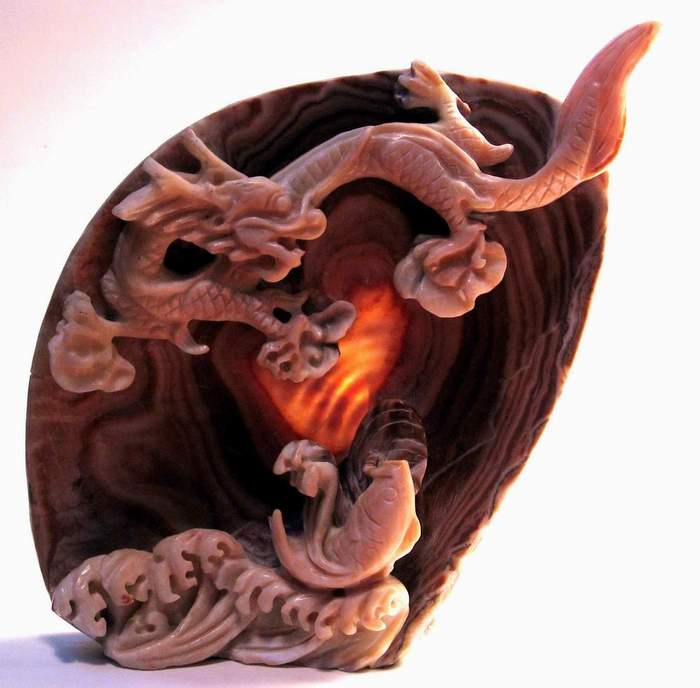
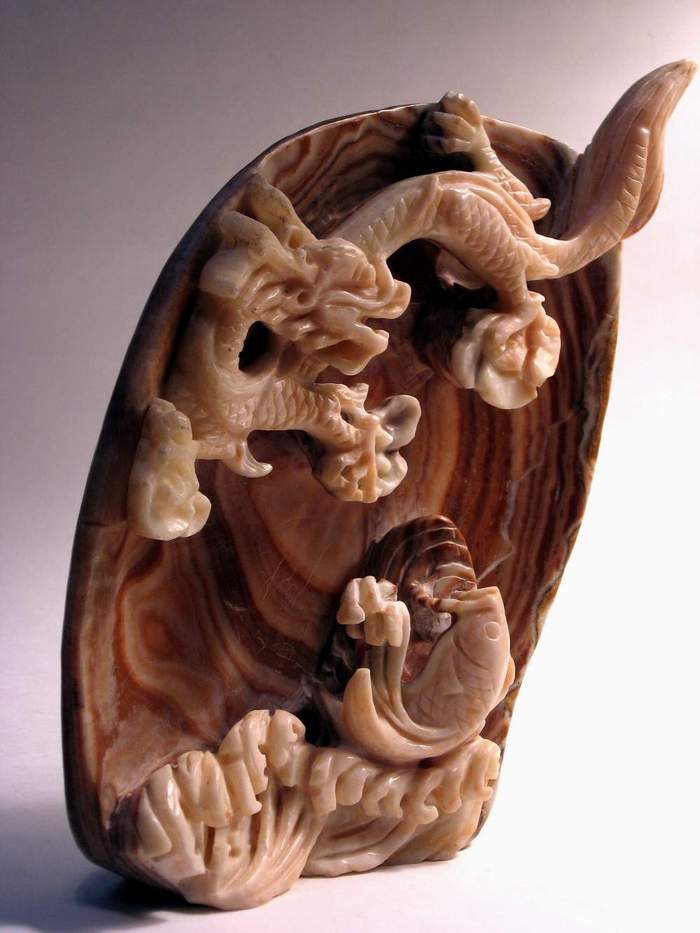
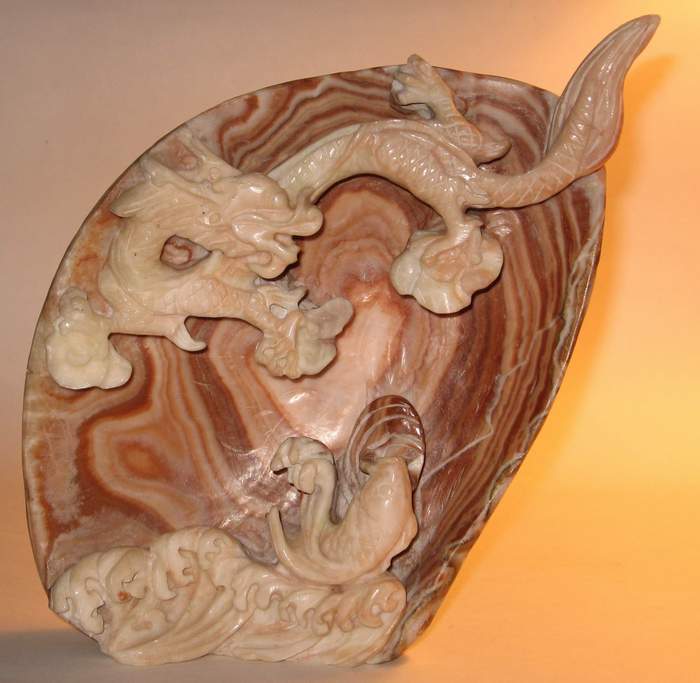
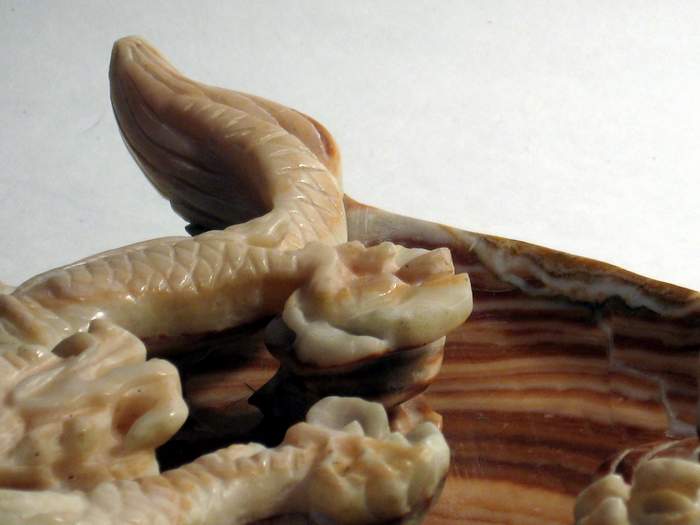
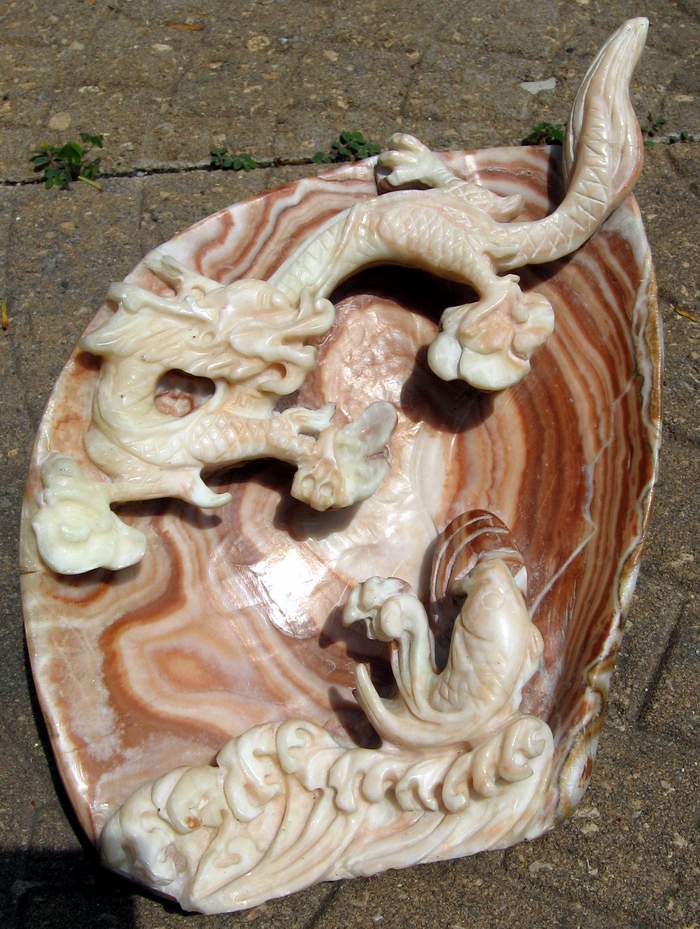
I believe this carving is banded agate; I have not been able to find a better match.

It is not too hard to scratch with a sharp surgical needle.

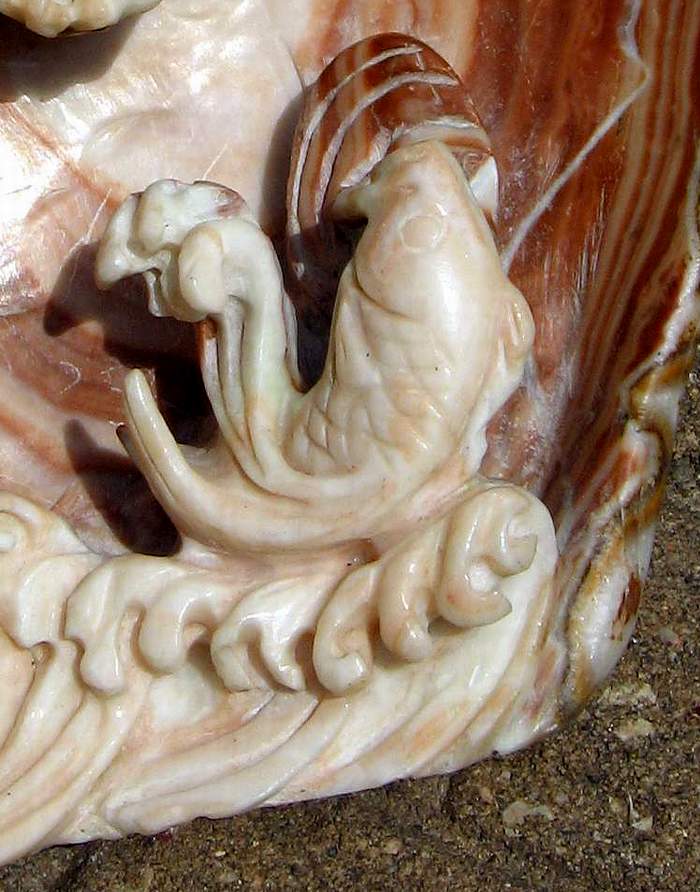
It is 9 inches tall to the tip of the dragon's tail.

I don't think it could be too old because I doubt anyone would take on such a large carving job without the use of power tools.

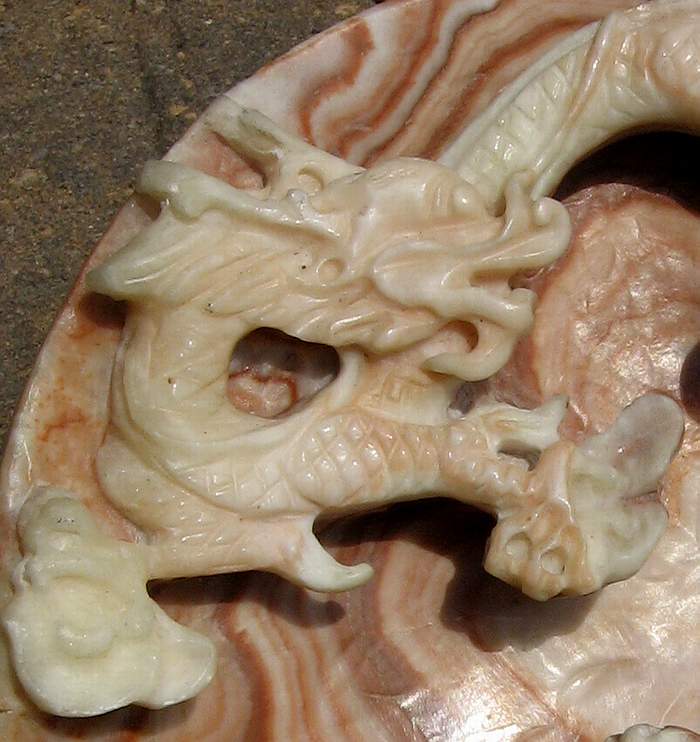
The quality of the carving is OK, not greatly detailed.

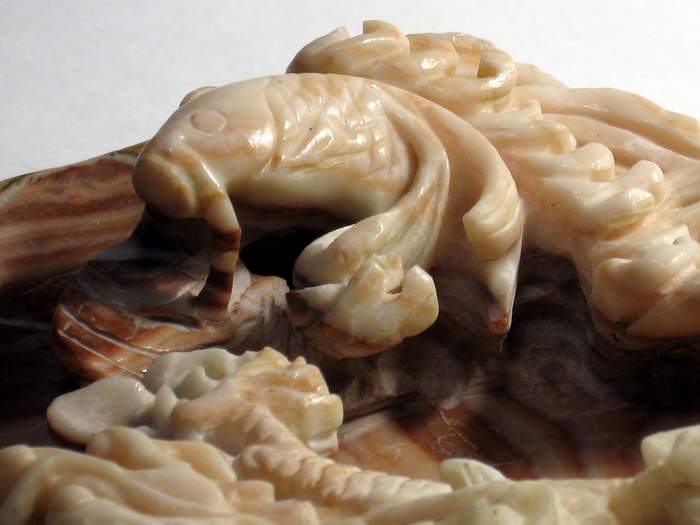
I believe the motif of the leaping carp above the spume and dragon are traditionally associated with the Imperial Examinations.

In the first picture the carving is backlit to highlight the translucent center.

What are your thoughts on this piece?

Regards,
Michael


Subject:Re: Large Chinese Agate Carving
Posted By: Michael Mon, Jun 01, 2009

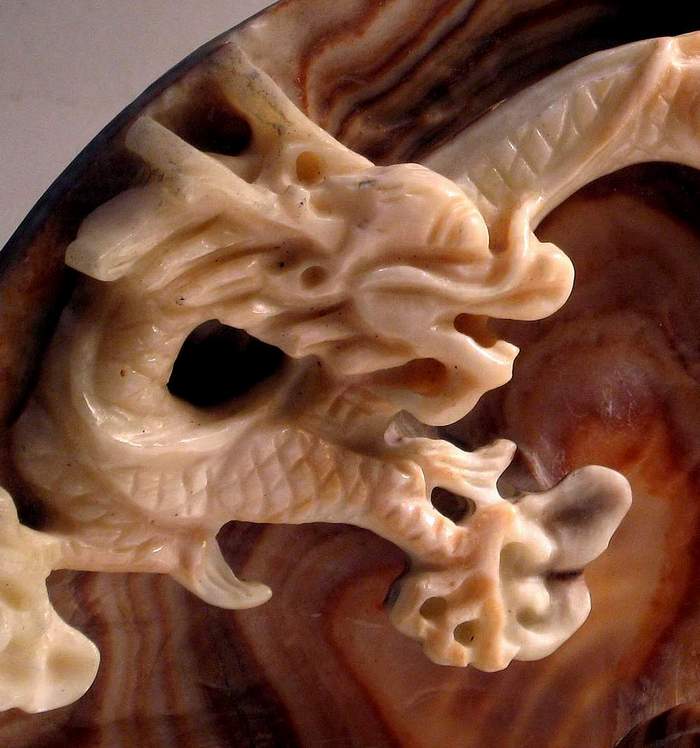
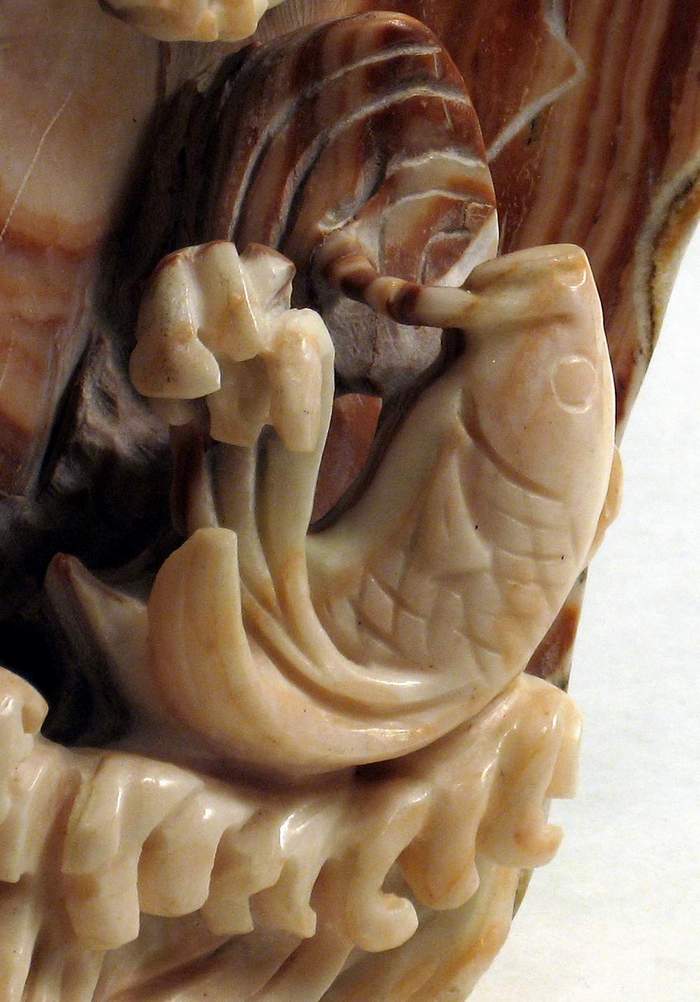
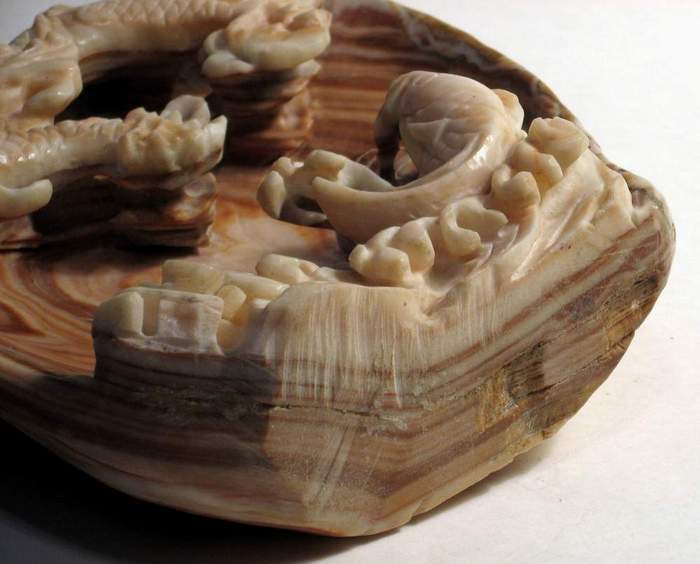
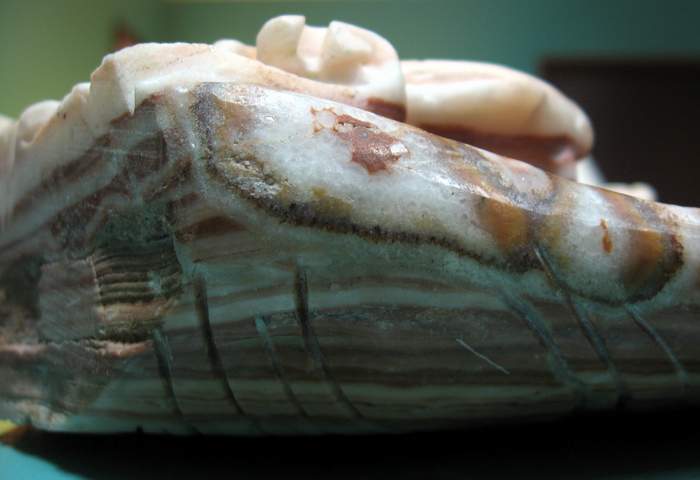
Here are some more close-ups.


Subject:Re: Large Chinese Agate Carving
Posted By: Ernest Wilhelm Mon, Jun 01, 2009

We need light shining on this item, preferably a natural light picture. From what I can see, this is not stone, as it looks poured.
Ernest

Subject:Re: Large Chinese Agate Carving
Posted By: Anita Mui Mon, Jun 01, 2009

Dear Michael

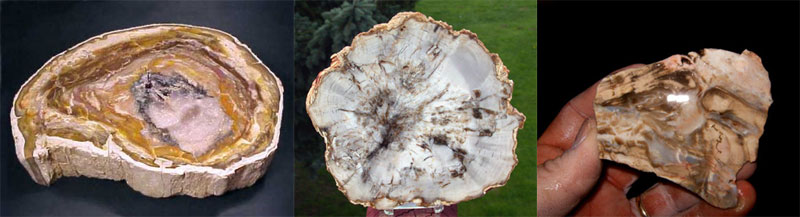
It made of petrified (fossil) wood. The main source of material in China is from Sichuan Province, and newly made.

----------------------------
Fossil wood replaced by chalcedony (cryptocrystalline quartz), sometimes also by opal, coal, pyrite, calcite.

The Petrified wood has a Mohs hardness of 5-7, depends upon the combination of the mineral replaced in the wood.
-------------------------

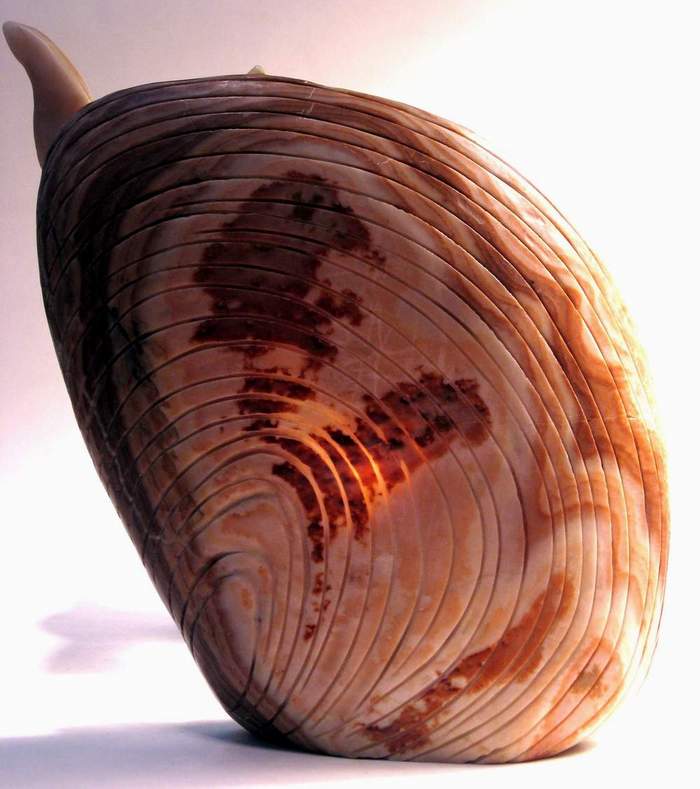
The carving depicts crab swimming upstream (in nature it goes up stream to lay eggs, like Salmon in North America) but Chinese think that crab will turns to dragon after it swims across the heavenly bridge in the river, to the north. The back of the piece is a clam symbolizes wealth.

This is a bless to a young scholar who is going to enter imperial exam, and a bless to one's new career, and a bless to one's newly opened business...hope for the best.

Have fun
Anita Mui


Subject:Re: Large Chinese Agate Carving
Posted By: Michael Wed, Jun 03, 2009

Thank you Anita for your informative explanation.

Cheers,
Michael

Subject:Re: Large Chinese Agate Carving
Posted By: Anita Mui Mon, Jun 22, 2009

CORRECTIONS:-

"Carp" means "fish" not "crab".
----------------------------------

Sorry, wrong spelling.

And thank you Ernest. You have checked vocab after it was posted weeks ago....too late, the damage have done..many people would think that "crab" will turn to dragon.

Have fun
Anita


Subject:Re: Large Chinese Agate Carving
Posted By: Michael Tue, Jun 02, 2009

Hello Ernest,

Thank you for the reply.

Yes, this is carved stone, here are some more pictures. The closest match I can find is to banded agate.

I have not been able to fins anything similar in terms of size or style.

I have found references to a carp leaping above waves and a dragon as traditional motif to Imperial examinations.

The quality of the carving is good in terms of balance and proportion and the detail is not too great.

Any leads on this piece are greatly appreciated.

Best regards,
Michael


Subject:Re: Large Chinese Agate Carving
Posted By: Michael Tue, Jun 02, 2009

Hello Ernest,

Here are more pictures taken in direct sunlight.

Please let me know if there are any other pictures to assist you in evaluating this carving.

Best regards,
Michael


Subject:Re: Large Chinese Agate Carving
Posted By: pipane Wed, Jun 03, 2009

just a guess:

Could it be Yunnan marble?

Rgds,

Subject:Re: Large Chinese Agate Carving
Posted By: Ernest Wilhelm Wed, Jun 03, 2009

My friend, those pictures are better, and therefore I go with Anita, she got it right!
Part of the second last picture reminds me of "bacon" carvings which I have seen in museums.
This one looks quite modern.
Ernest

Subject:Re: Large Chinese Agate Carving
Posted By: Michael Thu, Jun 04, 2009

Thank you for your replies, they all make sense.

Ever since purchasing this from a person who inherited it with no knowledge of it's history or origin, I've been extensively searching the Internet for another without finding anything remotely close.

Can anyone supply a lead, reference, or link to another like this?

Cheers,
Michael

Subject:Re: Large Chinese Agate Carving
Posted By: pipane Wed, Jun 17, 2009

Sorry, but this is certainly not made of fossil wood...aspect doesn't match...(I collect fossil wood too ;))).

Hardness seems much lower, Calcedony hardness is around 5-7, this is actually quite hard material, much harder than glass...

Can it scratch glass? Can glass scratch it?


Subject:Re: Large Chinese Agate Carving
Posted By: Michael Thu, Jun 18, 2009

Hello Pipane,

Thank you for your informative post.

Yes, using the sharp corner of glass from a picture frame it easily scratched this stone leaving a white line.

Yes, you are correct Pipane, I own a carnelian piece that is harder than this stone.

I have never seen soapstone that looks like this and it certainly doesn't look like onyx either. What other stones are soft with layered banding?

I have extensively searched the Internet, my reference library, and auction catalogs without finding anything remotely close to this carving or stone. In appearance alone the closest match I can find is banded agate.

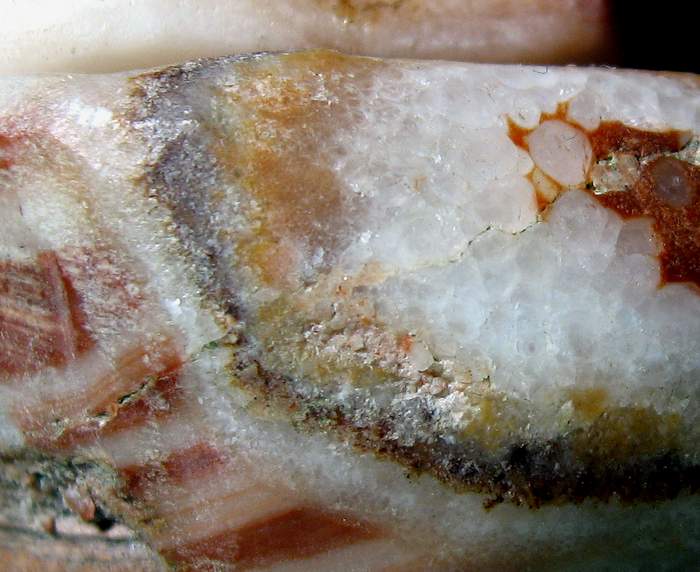
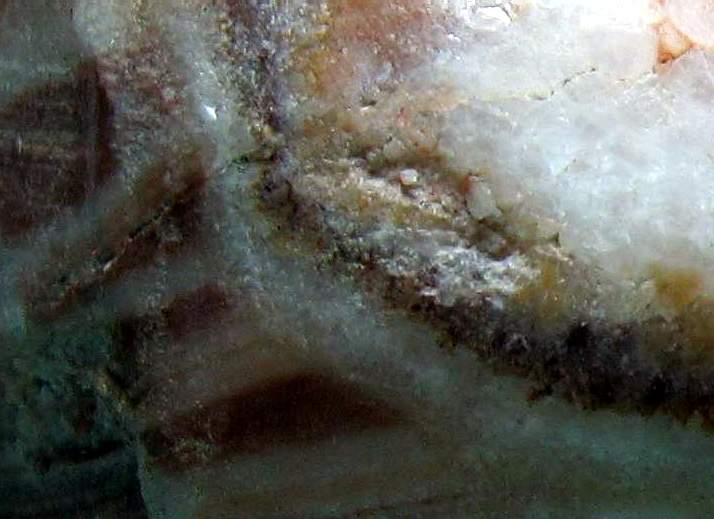
Here are close-up pictures that clearly show a crystal structure in the stone.

If this is such a common item why can't I find anything else like it anywhere?

Cheers,
Michael


Subject:Re: Large Chinese Agate Carving
Posted By: Stan Fri, Jun 19, 2009

Michael,

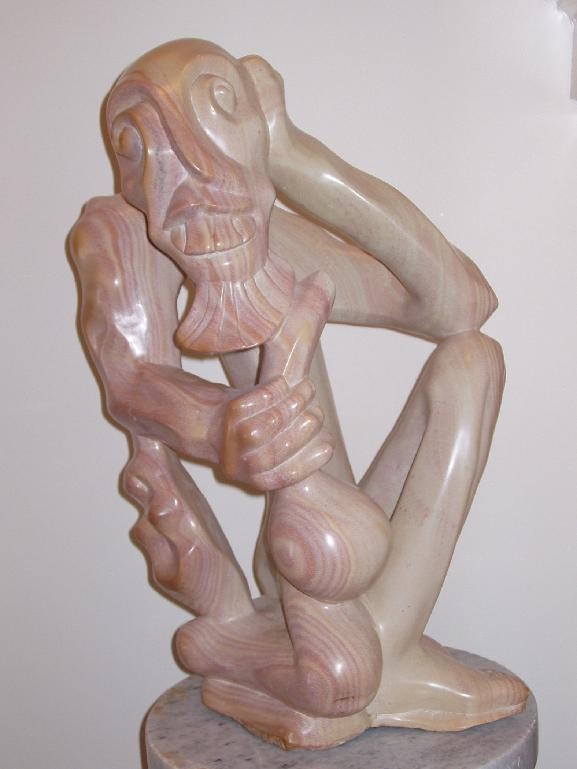
The striations in your first picture look something like Kisii soapstone from Kenya in Africa.

Below is a contemporary African sculpture in our collection.

Cheers,
Stan


Subject:Re: Large Chinese Agate Carving
Posted By: sam Wed, Jul 01, 2009

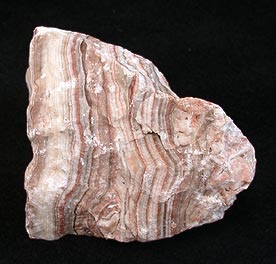
I believe this to be banded calcite. Calcite has this crystalline structure and is soft enough to be easily scratched with glass or a knife. At the site below see the image..notice the one very wide band. The carving stone had a wide band of pinkish material same as this picture shows a white wide band, Yes it is banded calcite indeed. Check to see if it will bubble if you put a mild acid on an inconspicuous place. Calcite always bubbles. Check for possible fluorescence. Sometimes Calcite does, use a black light. You can easily eliminate many minerals on your own as possibilities with a bit of science.

Subject:Re: Large Chinese Agate Carving
Posted By: sam Sat, Jul 04, 2009

here is the photo


Subject:Re: Large Chinese Agate Carving
Posted By: Michael Mon, Jul 06, 2009

Hello Sam,

Thank you for your informative posts.

Yes, I tested for fluorescence using a strong black light and there is none in this piece.

Yes, the picture you posted does look similar to this carved stone in the colors and banding.

Isn't onyx a form of calcite? This carving does not look too much like onyx though.

I've looked more for another carving like this with no success yet.

Cheers,
Michael

Subject:Re: Large Chinese Agate Carving
Posted By: Sam Tue, Jul 07, 2009

Hi Mike, Onyx is a form of Agate not Calcite....

Subject:"Onyx"
Posted By: Beadman Tue, Aug 04, 2009

The name "onyx" is rightly applied to both certain kinds of banded agates AND banded calcites (marbles). The onyx of ancient Egypt, for instance, is calcite—as is that of modern México. It is a softer stone than agate. In the chalcedony family, onyx is distinguished from agate by having more subtle banding. The name refers to the arching lines seen at the base of human fingernails.

Jamey D. Allen

Subject:Re: "Onyx"
Posted By: sam Wed, Aug 05, 2009

Sorry Jamey, Here is part of the definition from Wikipedia
The name has sometimes been used, incorrectly, to label other banded lapidary materials, such as banded calcite found in Mexico, Pakistan, and other places, and often carved, polished and sold. This material is much softer than true onyx, and much more readily available. The majority of carved items sold as 'onyx' today are this carbonate material.[1]
So Calcite is not "rightly" called Onyx it is "incorrectly" called Onyx

Subject:Re: "Onyx"
Posted By: Michael Thu, Aug 06, 2009

Regardless of what the material is, has anyone seen another similar item? I've been looking for a while now finding nothing even close.

The carp, dragon, and clam shell are Chinese motifs, and not Mexican, Pakistan, or African.

Why is it so difficult to find another carving like this?

Thanks for your posts,
Michael

Subject:Re: "Onyx"
Posted By: Beadman Thu, Aug 06, 2009

Dear Sam,

No need to be sorry!

Mineral names are FREQUENTLY controversial and subject to disagreement—even by "experts." They are also OFTEN nonsensical. Let's take the instance of certain AGATES called "onyx." The name intrinsically refers to a visual variegation of the colors of the material—it having subtle more-or-less parallel lines (that are typically not as strong and obvious as what would normally be called "agate"); or that have thin white lines in an otherwise colored base (often "black onyx"). Nevertheless, in the mineral trade it is COMMONPLACE for chalcedonies that are entirely unbanded to be called "green onyx," "blue onyx"—or whatever the color may be (many of these stones being artificially color-enhanced, as has been the practice at Idar-Oberstein, Germany, for some 200 years, if not longer). What is the sense of calling these stones "onyx"? Nevertheless, no one, or practically no one, is calling for a revision of naming practices.

On the other hand, carnelian that has white bands used be referred to as "carnelian-onyx" (or "cornelian-onyx")—which is totally accurate; yet the name is almost unheard of anymore. Go figure.

Although I refer to Wikipedia articles myself, from time to time, I would be the first to admit that MANY entries are either slanted or frankly incorrect. I would consult Wikipedia..., but I would not cite it (!).

There must be hundreds of authoritative reference works, including those of many museums, auction houses, and other institutions, that routinely refer to banded Egyptian marble/calcite as "onyx." It is not incorrect. This is an instance where a name has more than one meaning and application.

Nevertheless, you are free to restrict the name, as you see fit.

Be well. Jamey

Subject:Re: "Onyx"
Posted By: Michael Fri, Aug 07, 2009

Hi Jamey & Sam,

You both lost me, what kind of stone is this carving made from?

Cheers,
Michael

Subject:Re: "Onyx"
Posted By: Sam Fri, Aug 07, 2009

Well Jamey, Since you do not accept citations from Wikipedia, here are 4 more, Mineral zone, 2 from Encyclopedia Brittanica, and Dictionary.com
Calcite is no more proper to call Onyx than Serpentine is proper to call Jade because of the name New Jade or Pyrite is gold because they call it Fool's Gold. Educating the masses...Peace, Sam

Onyx from the mineral zone
from http://www.mineralszone.com/gemstones/onyx.html

This name is often erroneously applied to the alabaster, calcite and aragonite used in the manufacture of souvenirs and other ornamental objects sold throughout the tourist centres of the Mediterranean. True onyx is simply a black and white banded variety of quartz allied to agate. These bands being straight and parallel, onyx is sometimes known as "zebra agate" or, if the stone is completely black, "black agate". During the 1950s it was very popular as a stone for men's signet rings. It is now used for intaglios and cameos, necklaces and small pieces of jewelry.

It has a very wide provenance, being found wherever there is quartz.


Brittanica http://www.britannica.com/EBchecked/topic/429442/onyx
onyx
mineral
Main

Onyx from Yavapai county, Ariz. [Credits : Floyd R. Getsinger/EB Inc.] striped, semiprecious variety of the silica mineral agate with white and black alternating bands. Onyx is used in carved cameos and intaglios because its layers can be cut to show a colour contrast between the design and the background. Other varieties include carnelian onyx, with white and red bands, and sardonyx, with white and brown bands. The chief localities of onyx are India and South America. The name was used by the Romans for a variety of stones including alabaster, chalcedony, and what is now known as onyx marble. Onyx is one of the 12 stones mentioned in the Bible (Exodus 28:20; 39:13) as adorning the breastplate (ḥoshen) of Yahweh’s high priests. Its properties are the same as those of quartz.

Marble Onyx from Brittanica http://www.britannica.com/EBchecked/topic/429446/onyx-marble
* characteristics of marble ( in marble (rock) )

The so-called onyx marbles consist of concentric zones of calcite or aragonite deposited from cold-water solutions in caves and crevices and around the exits of springs. They are, in the strict sense, neither marble nor onyx, for true onyx is a banded chalcedony composed largely of silicon dioxide.


and dictionary.com
http://dictionary.reference.com/browse/onyx

on⋅yx
  /ˈɒnɪks, ˈoʊnɪks/ Show Spelled Pronunciation [on-iks, oh-niks] Show IPA
Use onyx in a Sentence
–noun
1. Mineralogy. a variety of chalcedony having straight parallel bands of alternating colors. Compare Mexican onyx.
2. (not used technically) an unbanded chalcedony dyed for ornamental purposes.
3. black, esp. a pure or jet black.
4. Medicine/Medical. a nail of a finger or toe.

Subject:Re: "Onyx"
Posted By: Michael Sun, Aug 09, 2009

Hello Sam and Jamey,

I'm the OP, could either of you please tell me what kind of stone this is and where you have seen another one carved like this?

Thanks,
Michael

Subject:Re: "Onyx"
Posted By: sam Tue, Aug 11, 2009

Michael. You need to help yourself here...Use the scientific methods outlined in my earlier post and you yourself can ID the stone. Try the mild acid or vinegar. Do some research on stone/mineral ID if my methods do not yield answers. Pictures are difficult to get exact answers from. Only you have direct access to the piece itself. Be your own scientist. Take care when getting "ADVISE" and double check things for yourself. As to the value of this piece...In general softer stone carvings have much less value than hard stone carvings... for all of the obvious reasons. This piece appears to have been recently carved. I saw this stone all over Tucson Feb 2009. It is of Mexican Origin. I purchased some huge eggs carved from it for resale in my store. They were very cheap and tourists like them. I do not collect soft stone carvings so that is all I can say about his except...The greatest enemy of Knowledge is not ignorance....It is the illusion of knowledge"

Subject:Re: "Onyx"
Posted By: Beadman Tue, Aug 11, 2009

Hi Sam,

Your tone is beginning to sound a bit bent-out-of-shape! Can you not accept that we disagree, in-part, on this matter? Your points are taken, as far as they go—and I largely do not disagree. But the convention of calling banded calcite or marble "onyx" is so ingrained and encompassing so long a time, to argue against it is sort of ridiculous. Are all those museums and auction houses going to change their identifications? Probably not.

Your new citations also leave a lot to be desired. One cites "Mexican onyx" itself. And, by the way, Mexican onyx is frequently dyed (and I mean "dyed"), and called "Méxican jade" (!). But this doesn't mean anyone is suposed to believe this stuff is "jade." The naming of stones is complicated and OFTEN misleading, controversial, or incorrect. About which....

The problems with naming jades are considerably more complicated than just saying "serpentine is not jade." It's NOT "jade"..., but it is "yu"—and yu is jade (in China).

"This name is often erroneously applied to the alabaster, calcite and aragonite used in the manufacture of souvenirs and other ornamental objects sold throughout the tourist centres of the Mediterranean. True onyx is simply a black and white banded variety of quartz allied to agate. These bands being straight and parallel, onyx is sometimes known as 'zebra agate' or, if the stone is completely black, 'black agate'. During the 1950s it was very popular as a stone for men's signet rings. It is now used for intaglios and cameos, necklaces and small pieces of jewelry.

It has a very wide provenance, being found wherever there is quartz."

This is just silly! The black onyx of commerce is manufactured at Idar-Oberstein, and has been for over 100 years. It is artificially-colored Brazilian agate. There is practically NO "natural" black agate from any producer on a commercial scale. The Germans export this material world-wide. The amount of artificially-produced black agate (which is NOT "dyed") must considerably surpass any "natural" black agate. In recent years, Chinese lapidaries also produce it, and must now seriously compete with Germany.

"The chief localities of onyx are India and South America."

This is only true if we include the artificial coloring of Brazilian agate to become "onyx"—(as I remarked) that is in the hands of Germans, perhaps some Brazilians (as of about 20 years ago), and Chinese manufacturers (as of about eight years ago). That India has artificially-colored agates brown and black (via soaking the material in a sugar solution, and then burning it) is undisputed. It's well known this has occurred for at least 2000 years and longer—by the billions of beads found in the antiquities and contemporary marketplaces. They also create carnelian via heat-treating local agate (that is naturally impregnated with iron impurities)—and have done so for ca. 5,000 years.

"2. (not used technically) an unbanded chalcedony dyed for ornamental purposes."

This is an extremely common mistake! The artificial coloring of agate, as pioneered by Germans in the 19th C., is not "dying" (with the exception of two specific colors—pink and violet). The process does not use dyes, but rather mineral oxides—thereby copying the processes or nature. The results are permanent—whereas dying a stone is a superficial and temporary treatment. Although there are cheap dyed stones in popular commerce, these should not be confused with the high-quality manufacture of semi-precious stones. Without these materials, there would be almost NO carnelian (apart from that of India) on a commercial scale. Likewise, other typical colors, such as brown, black, green, yellow, and blue. Germans refer to these treatments as "beizen"—a name that is difficult to translate effectively, but that essentially means "steeped in acid." For instance, cucumbers are made into pickles, and cow hide into leather by being "beizen." A great deal of this material is not "unbanded," but rather forms the banded agate or onyx of typical world-wide commerce.

The popular and condensed literature you cite is part of the problem. In abreviating this information, the authors compound mistakes—such as mistakes about "dying" minerals.

Jamey

Subject:Re: "Onyx"
Posted By: sam Tue, Aug 11, 2009

Not bent out of shape at all as I'm at the computer and not on the Yoga mat....Wish I typed with more than one finger as to respond more eloquently but I see by the length of your post and all of the unrelated info that you have a great desire to appear to be correct about something. I only seek the truth and readily admit I searched google yahoo and bing to get results to answer this question and share this with everyone here. I do not consider my ego as this is simply a quest for knowledge by a humble human. It is quite an effort to post for me and it took me many months of visits here before posting anything. I will only post when I am certain of the facts. I feel everything positive has been said that I can say about this discussion.

Subject:Re: "Onyx"
Posted By: Beadman Thu, Aug 13, 2009

Sam--Do you honestly think this was a positive response?

JDA.

Subject:Re: "Onyx"
Posted By: sam Thu, Aug 13, 2009

Jamey, You are right. There was a sentence that should have been left out. I never want a discussion itself to become more important than the people in the discussion and their feelings. We all have the right to our opinions being respected ....but not necessarily agreed on. I intend to go to bed earlier and not post when tired or in pain and to re-read all of my posts twice as to not be demeaning or insulting in them. Disagreement between gentlemen is natural but will be carried on in a civil manner by myself from now on I assure you Jamey

Subject:Re: "Onyx"
Posted By: Michael Wed, Aug 05, 2009

Thanks Jamey for your informative clarification.

So what type of stone would you call this? In appearance the closest uncarved stone I have found in pictures is banded agagte. However, this stone seems softer than the Mexican onyx my chess set is made of.

Regardless of the type of stone, I'm still at a loss to find another Chinese carving like this, nothing even close.

Cheers,
Michael

Subject:Re: "Onyx"
Posted By: Beadman Thu, Aug 06, 2009

Dear Michael,

I have to agree that I can't think of a similar-looking Asian artifact with this sort of banding. The material does not look like petrified wood (essentially, agate)—and being a soft stone, it is clearly not that. Nevertheless, there are a number soft banded minerals (I'm thinking now of brown variegations), quite a few of which are difficult to identify. Dolomite is one.

In 2005, I was visiting Rome, and was impressed by a series of busts of Emperors (and their wives) in which the head and shoulders were white marble, that had been set-into brown variegated stone, composing their highly-draped garments, that I at first took to be "banded agate"—it looking very much like the so-called "crazy-lace agate." But I have to assume it is a much softer material, and perhaps a variegated calcite (and therefore not much different from marble).

I have photographs of a few of these busts, and I will endeavor to make and post a scan here, so you can have a look. (The majority of my photos are in my desktop computer; while I am currently working from my laptop). I will endeavor to do this soon.

Cheers, Jamey

Subject:Re: Stone Carving
Posted By: Michael Wed, Aug 12, 2009

Hello Sam,

Thank you for your reply. I appreciate your not knowing what type of stone this is from photographs alone. Mexico as a source of this carving is possible I suppose, the carver was well versed in Chinese motif and style of carving.

Hello Jamey,

Thank you for your reply. Yes, dolomite makes sense as it is one of the more common types of softer stones used in China for ease of carving.

Regardless of the type of stone the motif is classic Chinese legend: the carp swimming up river to transform to a dragon.

The proverb "Chinese carp leaping over the dragon's gate" li3 yu2 tiao4 long2 men. 鲤鱼跳龙门

Lengend has it that each Chinese carp would swim up the yellow river upstream to spawn, and those who can leap the waterfall at the dragon’s gate were transformed into dragons.

What does it mean? Simply, if a person works hard at whatever he does, he could one day become successful. This proverb is used to encourage a person to persist in one’s endeavor.
In the past, a carp leaping over the dragon’s gate was used as a metaphor for success in passing the imperial exams.

These exams have their beginnings about 2,000 years ago to select the brightest brains for top government positions.

These exams were open to the public and whoever passes the exams would become a government official, thus ensuring wealth and prestige for the family.


A carving of this size and complexity is not too common, if anyone knows of another please let me know.

Thanks again,
Michael

Subject:Re: Stone Carving
Posted By: Barb Wed, Oct 07, 2009

Hi,

I believe what you might have here is "Rhodochrosite". Here are some links to learn about it,

http://www.gemselect.com/other-info/about-rhodochrosite.php

http://www.gemselect.com/rhodochrosite/rhodochrosite.php

and especially here,

http://www.bernardine.com/gemstones/rhodochrosite.htm

Remembering that the forms of rhodochrosite come in other colors as well, such as Color: pink, rose, red, white, yellowish grey, brown.

You could also have a mixture of gems in this carving, remembering the rule that "what grows together, belongs together". My thought on this is the different color that the dragons/fish have then the base of the carving has.

My suggestion is to take it to the nearest college, and let the science geo-lab/team test it for you!! They may even do it for free as a project...

Best wishes,
Barb

Subject:Re: Stone Carving
Posted By: Michael Thu, Oct 08, 2009

Hi Barb,

Thanks for the leads, I will follow up on them.

As you can see from the discussion here so far this doesn't appear to be a commonly found object or material.

I'm still scratching my head over it and haven't found anything else that looks like it.

Thanks again Barb,
Michael

Subject:Re: Stone Carving
Posted By: Barb Thu, Oct 08, 2009

Cont' from my above letter. Additionally, here are some more carvings, and info that I have found online with this stone,

http://www.flickr.com/photos/62535223@N00/2048392633/

http://www.flickr.com/photos/62535223@N00/2049182418/

http://cgi.ebay.com/Beautiful-Carving-Dragon-In-Rhodochrosite_W0QQitemZ360091502842QQcmdZViewItem

http://tucsonshowplace.net/Rhodo_Co.htm

And rough spec,

http://www.unconventionallapidarist.com/catalog/rhodochrosite-rough-17947.htm

http://store.gemsevermore.com/rhroforcaorc.html

http://www.bestcrystals.com/rhodochrosite.html

http://www.naturescollectibles.com/rhco.html

http://www.cst.cmich.edu/users/dietr1rv/rhodochrosite.htm

http://www.stonegoddess.com/Stone-Goddess-Stonetalk/rhodochrosite/

AND,

GemologyOnline,

http://gemologyonline.com/Forum/phpBB2/viewtopic.php?t=2102

This is a MUST SEE site on the wall of Rhodochrosite found.

http://www.aragonenterprises.com/

Hope this info helps!

Best Wishes,
Barb

Subject:Re: Stone Carving
Posted By: Barb Thu, Oct 08, 2009

Last but not least,

http://www.aragonenterprises.com/crafted/

These carvings will give you an idea of how this type of stone can be crafted as your dragon display/figurine is.

Subject:Re: Stone Carving
Posted By: Michael Fri, Oct 09, 2009

Hello Barb,

Thank you for all the leads, I have visited all the sites you posted and read some of the articles.

Yes, I see the similarity of the stone color, banding, etc.

The main differences I see with the examples you provided are sizes are quoted in grams, this carving weighs pounds, so it is a relatively large piece.

Next, the carved pieces are either shallow relief or very crude where the piece I own is decent quality and almost 360 degree. Of course this is up to the individual carver.

Trying to put Argentina stone with Chinese carving is tough too. Not that the stone couldn't be imported to China or a carver well versed in Chinese motif and style couldn't have carved this anywhere, my hunch is both the stone and the carving are from China.

Maybe your most important tip to me Barb is the suggestion to bring the piece to a college for exam. I completely forgot and you reminded me I know a family of Phd geologists, the mother and father who are in their 80s still live here in my town. I will contact them to see if they can identify this stone.

Thank you again for your help Barb.

Best regards,
Michael

Subject:Re: Stone Carving
Posted By: Barb Sat, Oct 10, 2009

Hi Michael,

Thank you for your replies. I was going off of color, markings, moh's scale/pressure you wrote about, and my own research on gems when answering your question. The most important thing is to take it to an expert in the field, as this is more of science then a guess. Remembering all that my uncle had taught me, prior to his passing, as he was educated in the gem world, were simple facts that I hope help you. They are; gems, stones, creators of gem-rock, and rough specimens have been transported, traded, and traveled many miles, and to other countries from the beginning of time. Even down to the kings/queens whom had gems carved into bowls/plates to eat from, quarter pots that they had by their bedsides, and stools that they sat on, that stones have been found in great quantities for many moons!! A sapphire mine that is not too far from where I live, they have an amazing story on something that happened. They had a gigantic black rock that held an old wood door open to one of the shafts for over 60 years. When they went to close down the mine after exhausting it, they pulled the rock out into the sunlight, and you would not believe what they found. It was actually a sapphire, and turned out to be one of the largest ever found in the world! They have found, and are still finding that gemstones are normally cut from very large specimens, but most are cut-down, carved, and made for jewelry, and small figurines these days as a monopoly to make more money. You can still get large specimens from dealers, just depends on the quality, and how much you pay for the uncut gem. You will also find something to be very true, is that all gemstones come in different qualities, not just one type, even down to fine diamonds.

This is a MUST SEE site on the wall of Rhodochrosite found.

http://www.aragonenterprises.com/

By all means, please let us know what they find on this carving that you have, I find that it would be most interesting.

Thanks,
Barb


Asianart.com | Associations | Articles | Exhibitions | Galleries |