Asianart.com | Associations | Articles | Exhibitions | Galleries


Visitors' Forum

Asian Art  Forums - Detail List
Asian Art Forums

Message Listing by Date:
Message Index | Back | Post a New Message | Search | Private Mail | FAQ
Subject:Dayazhai and Chu Xiu Gong Ware
Posted By: Linus Fan Mon, Jul 16, 2012 IP: 68.173.155.211

As an independent researcher studying artifacts belonging to the Empress Dowager Cixi in collections worldwide, I often encounter porcelain attributed as her personal creations. Discounting the obvious reproductions, exactly what pieces were actually used by Cixi herself? Sources on late Qing ware often lack definitive answers, claiming "thought" or "believed to be". Aside from known Dayazhai sketches, I can't find any records about Chu Xiu Gong's existence.

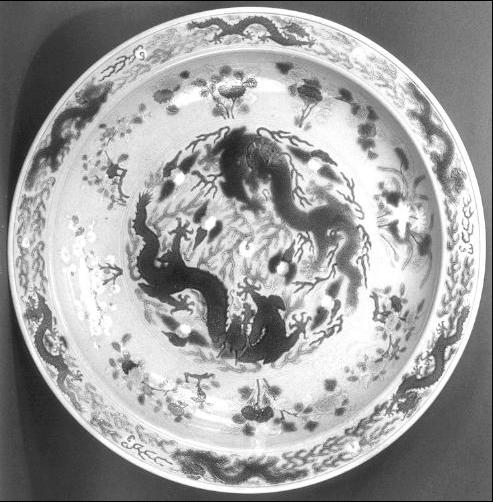
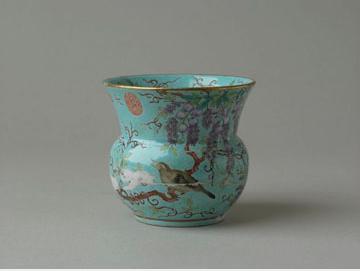
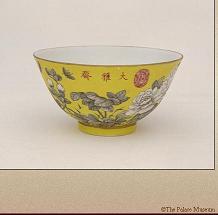
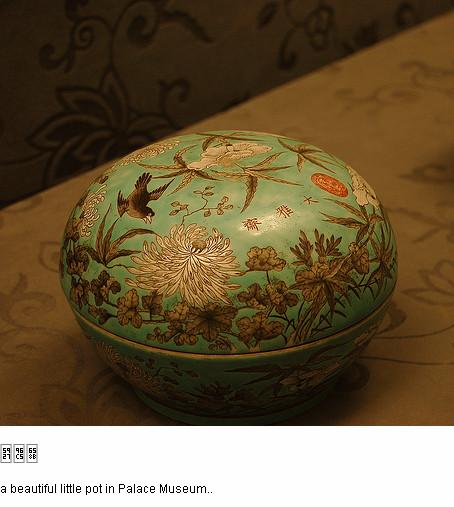
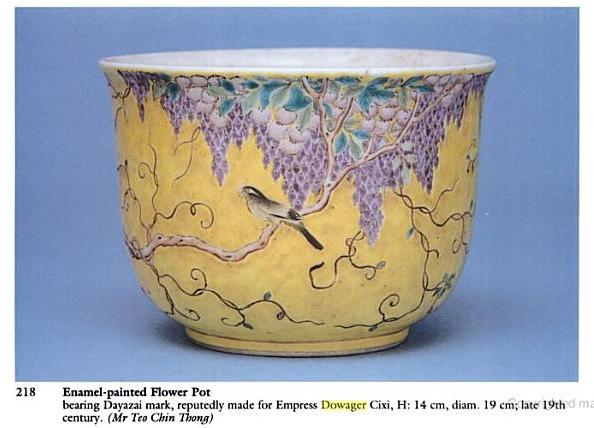
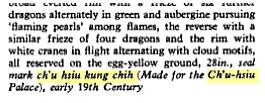
In particular, I'm examining two pieces - a yellow dish with green and aubergine dragons marked Chu Xiu Gong plus a Dayazhai zhadou jar (please see attached images). In the latter case, the item matches the spring turquoise pattern, though its quality looks debatable. Collector Ronald Longsdorf's article in the Arts of Asia stated only 2 of each Dayazhai set were destined for Cixi's table, out of the thousands reportedly made. He already accounted for 2 turquoise jars at Melbourne's National Gallery. Yet the Palace Museum exhibited another version of the turquoise zhadou, without the oval seal above the bird. Whatever the basis for comparison, it seems the jar in question can't directly be associated with Cixi. Do my colleagues agree with that assessment? Is tracing the provenance conclusively to a specific individual at court an impossibility?

Chu Xiu Gong objects remain more puzzling. While the series supposedly commemorated the empress dowager's birthday, its widely different designs have not been properly accounted for. Neither has their purpose been fully understood, some theorize the large plates held ice or fruits instead. Is there any reason to presume that yellow dish with green and aubergine dragons really adorned Cixi's surroundings? Saying it was commissioned during a emperor or empress's reign is not the same as exclusive usage by a emperor or empress. Traditionally, not every single official work was placed before the ruler, correct? I read many were just given to officials and princes at court.

Without further proof, I feel neither the dish nor jar should be included as Cixi's own accessories. Interested to hear any shared comments and expertise. Many thanks!


Subject:Re: Dayazhai and Chu Xiu Gong Ware
Posted By: Bill H Tue, Jul 17, 2012

Sounds like prime territory for comment by Tony Allen. In case it will help in the the discussion, here's a link to a color image of a dish in the same pattern that was sold in 2003 from the Weishaupt collection by Nagel in Stuttgart.

Also here's the English description of this dish from 'The Great Fortune', a Weishaupt catalog issued a year before the sale:

29. A yellow-ground dish, the centre decorated with two dragons in pursuit of the 'flaming pearl'. The cavetto is decorated with eight different flowering branches, on the rim a band with further dragons. The decoration on the reverse side repeats the dragons, above them five cranes in flight. Underglaze blue base mark in seal script "Chuxiu Gong Zhi".
Tongzhi/Guangxu epoch D 47,2 cm
A dish from the Kangxi epoch was the model.

Best regards,

Bill H.

URL Title :YellowDragonPlate


Subject:Re: Dayazhai and Chu Xiu Gong Ware
Posted By: Anthony J Allen Tue, Jul 17, 2012

Hi Linus,
The earliest Western reference to Dayazhai that I am aware of was by Bushell, writing in Oriental Ceramic Art, published in 1896. The Empress Dowager was still alive at the time, so I doubt very much that he bothered to mention it, without any foundation.

As to the Chuxiu Gong Xiu I regret I cannot be of much assistance. The color combination of green and purple (aubergine) dragons on a yellow ground, according to the palace regulations, was reserved for a 5th rank concubine. The Emperor was entitled to have ten fifth rank concubines, but seems unlikely to have achieved that quota, certainly in the Tongzhi (1861 to 1875) reign.

Some twenty years ago, while assisting the Auckland Museum recatalogue its collection, I came across a magnificent aubergine Dayazhai bowl. It had been in the collection for over 60 years, catalogued incorrectly as Kangxi (1662 to 1722). Such is the quality of the decoration, the error in dating was not really surprising.

Regards
Tony

Subject:Re: Dayazhai and Chu Xiu Gong Ware
Posted By: Linus Wed, Jul 18, 2012

Thanks Tony, I'm intrigued by your service at the Auckland Museum. Do you recall any more artifacts in the collection related to Empress Dowager Cixi? Doesn't have to be ceramics, perhaps her paintings, wardrobe, jewelry, or furniture?

I found a copy of the encyclopedia Zhongguo tao ci quan ji [The complete works of Chinese ceramics]. In the volume on late Qing, the origin of Dayazhai porcelain is explained based on original Chinese records. The series dates to circa 1874, when the Emperor Tongzhi sought to rebuild the Yuanming Yuan Summer Palace for his mother Empress Dowager Cixi and the co-regent Empress Dowager Cian. The phrase Tian Di Yi Jia Chun in connection with the gardens was traced all the way back to the period of Emperor Yongzheng. Meanwhile, Dayazhai was the documented name of a pavilion during the Emperor Xianfeng's reign. His rule also witnessed the total destruction of the Yuanming Yuan at the hands of Anglo-French invaders in 1860. Thus Dayazhai ware was commissioned as part of the restoration plans to revive glorious memories. Before the loss, Yuanming Yuan served as the home of Cixi and Cian, both were consorts of Emperor Xianfeng. However, with the dynasty facing endless internal and external crises, the rebuilding was ultimately abandoned. As a result, practically all of the Dayazhai pieces held by the Palace Museum are noted as in excellent condition, because they never had the chance to be used. After reading that analysis, it seems implausible to imagine Cixi using Dayazhai dishware henceforth.

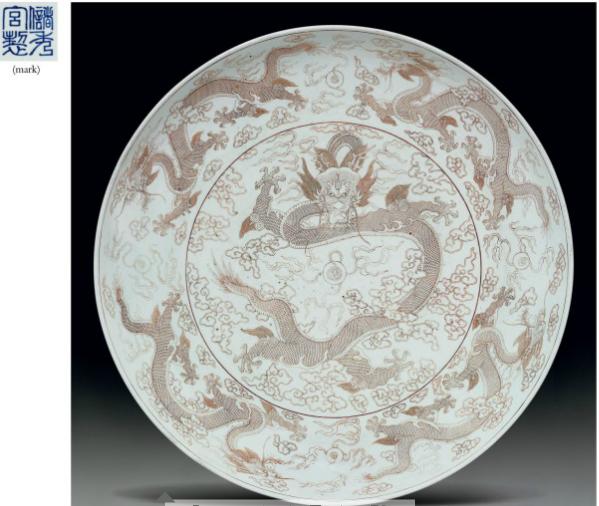
The book also contained one dish marked Chu Xiu Gong. It had the same pattern as a dish put on auction (please see attached pic). Reminiscent of the scene on imperial robes, the dragons are intricately displayed in profile and facing front, among billowing rendered clouds and flaming wisdom pearls. Such high quality work was deemed exceptionally rare. By comparison, the motifs on the yellow dish look haphazardly arranged. Splotchy dragons and pearls shown alongside a hodgepodge of leaves, branches, lotuses, flowers and cranes. The crass style looks unfitting for an imperial personage, especially for a grand sovereign like Cixi.

First time I heard green and aubergine dragons were reserved for 5th rank concubines. Even if the yellow Chu Xiu Gong dish had been officially produced, it's doubtful any lower ranks could enjoy personal creations at that time. The Tongzhi Emperor did marry 4 consorts, but they were always overshadowed. Besides Cixi, Empress Dowager Cian lived until 1881, Tongzhi's main wife Empress Alute died in 1875, and the Guangxu Emperor married Empress Longyu in 1889. Surely they would have merited special dining sets before others.

Upon reflection, I now believe it's inaccurate to link any Dayazhai or Chu Xiu Gong object directly to Cixi herself. As always, I welcome further opinions from all the readers. Interested to hear what my peers think of my newly arrived conclusions.


Subject:Re: Dayazhai and Chu Xiu Gong Ware
Posted By: Bill H Wed, Jul 18, 2012

In “A Handbook of Ceramics” (1988 edition), The New York Metropolitan Museum of Art's Research Curator for the Asian Department used Dayazhai wares as an example to point up the superiority of some categories of Late Qing porcelain. She notes that these porcelains “were crafted at Jingdezhen especially for the Western Buddha, or Old Buddha”, as Cixi was known. In a footnote to these remarks, Ms Valenstein acknowledges controversy over the 19th century dating of these pieces, citing Bushell's contemporary writings as proof that some of them were indeed produced during the 19th century.

In the Weishaupt Collection catalog, “From the Dragon's Treasure” (Vom Schatz der Drachen), 1987, Bamboo Publishing, London, author Gunhild Avitabile, offers strong arguments to place some Dayazhai porcelains in Cixi's lifetime, based on her personal studio mark being present on a gift painting given by her to a departing German Ambassador in 1905.

Avitabile assesses three of the finest examples of porcelains in the Weishaupt Collection as likely having been made in 1884 on Cixi's 50th anniversary. He calls the affinity for Kangxi prototypes exhibited by two Chuxiu Gong dragon dishes “remarkable” and concludes that hardly any other porcelain of the period is so imposing. Avitabile also narrows down the Dayazhai porcelains to two types of decoration, flowers and insects on a lemon ground, and wisteria and birds on turquoise.

It would seem to me that the task of separating period from later issues probably will require a lot of time in museums and knocking on doors of collectors to get a feel for imperial versus non-imperial Chinese wares, based on potting, glazing and painting characteristics. Everything I've read in references on the subject definitely indicates that the Dayazhai and Chuxiu Gong pieces most likely made in the 19th century also are likely to be products of the Imperial Kiln.

Good Luck,

Bill H.

Subject:Re: Dayazhai and Chu Xiu Gong Ware
Posted By: Linus Thu, Jul 19, 2012

Many thanks for the citations Bill. Their conflicting and unsubstantiated assertions perfectly illustrate the dilemma in understanding exactly which pieces were owned by Cixi herself. Seeking firsthand evidence, I looked at historical Chinese records, along with ceramics from the Palace Museum’s collection. That unassailable provenance undoubtedly offers the best proof.

Given the various Dayazhai designs still existing at the Forbidden City, there’s definitely more than the two types listed by Avitable. It’s true the Dayazhai seal was officially used on paintings marked as Cixi’s. Her 1894 “Pine and Crane” scroll given to the noble wife of Confucius’s descendant bore the same seal. Besides Dayazhai, the 1906 “Plum Blossoms” painting now held at a European museum displayed the Tian Di Yi Jia Chun seal too. Unfortunately, it’s also a fact Cixi employed court artists who regularly painted on her behalf. Even with the right labels, there’s no guarantee a work was actually created by Cixi’s hands. Likewise, I feel it’s uncertain any stunning Dayazhai or Chu Xiu Gong porcelain automatically found a place in Cixi’s household.

Consider the failure of the Dayazhai project according to Zhongguo tao ci quan ji, plus Ronald Longsdorf’s 2 of each kind theory, the average calculates to possibly a single sample from every set exclusively reserved for Cixi. Such a paltry outcome reflects the extreme difficulty in directly connecting the person with the object, a point raised with Chu Xiu Gong dishes as well.

As indicated by the Palace Museum’s selections, numerous Dayazhai and Chu Xiu Gong things were indeed produced by the imperial kilns, unquestionably dating to the 19th century period of Cixi’s reign. That general premise was conceivably picked up by the foreign observer Bushnell, but the finer details might’ve been lacking. Don’t forget the Dayazhai’s traditional association with Yuanming Yuan’s loss, the sovereign’s aesthetic preferences, the different personalities and inner workings of the harem. I already mentioned in my first post, saying it was commissioned during an emperor or empress’s reign doesn’t necessarily mean it ultimately made its way to the emperor or empress’s presence.

For example, were Dayazhai wares proposed in conjunction with the 1874 restoration attempt of Yuanming Yuan, Cixi was not the sole ruler then. The Emperor Tongzhi had attained majority, leaving Cixi and the co-regent Cian in retirement. Perhaps the emperor was responsible for initializing the entire project as an act of Confucian filial piety. Equal in rank to Cixi, Cian possessed the same memories of Dayazhai gardens with their husband Emperor Xiangfeng. Perhaps she’d enjoy the commemorative dishware just as much. Unraveling the whole story therefore provides a nuanced and fuller picture.

Subject:Re: Dayazhai and Chu Xiu Gong Zhi Ware
Posted By: Anthony J Allen Fri, Jul 20, 2012

Hi Linus,
If you are wanting to become the "veleanu" of the Dayazhai wares, then you should give your opinions a wider audience.

Sorry, by you seem to be trying to rewrite history, based on an inadequate research of the Western literature available.

It was not just Bushell (not Bushnell) who commented on these wares, but also Hobson who was writing only a few years later.
Professor van Oort scheduled the Imperial production lists for two years, Avitabile, as Bill H says illustrates Dayazhai porcelain attributed to Cixi, the Art Gallery of New South Wales has others, I summarised the allocation of colors per the Palace Regulations (Allen's Introduction To Later Chinese Porcelain), and Kwan (Imperial Porcelain of Late Qing) lists the porcelain quotas per the Palace Regulations. Between the lot of them there is a strong ground for contradiction.

If I may quote Kwan, page 27, referring to the porcelain allocations listed in the Palace Regulations.

Empress Dowager:
250 x Yellow Basins
100 x Various Colored Basins
45 x Yellow Plates
50 x Various Colored Plates
100 x Yellow Bowls
50 x Various Colored Bowls
300 x Yellow Tea Cups
70 x Various Colored Tea Cups
100 x Various Colored Cups
6 x Spittoons

This is a huge quantity for one person, and probably explains why so many pieces survive in collections today.

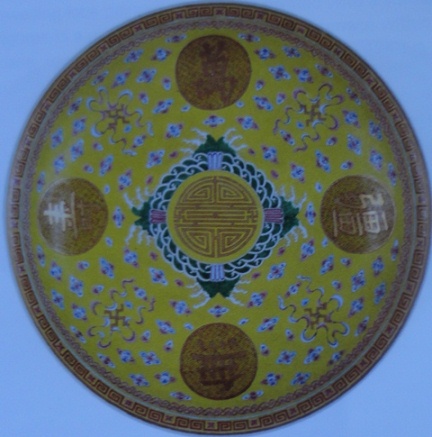
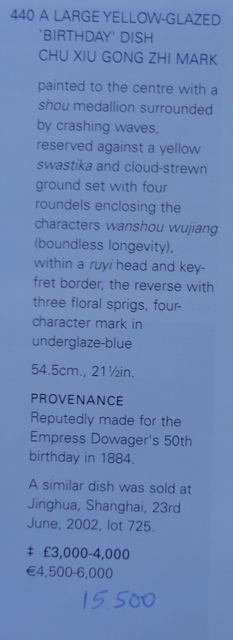
I (hopefully) have attached photos of a dish that I sold at Sothebys in London in 2006. There are numbers of chargers with this mark and similar or different designs I have seen.

I think you have more research to do to explain the recipients of these first quality pieces.

There are few pleasures like a friendly debate.
Please don't take it personally.
Regards
Tony


Subject:Re: Dayazhai and Chu Xiu Gong Zhi Ware
Posted By: JLim Fri, Jul 20, 2012


Dear Mr Allen

You mention the Art Gallery of NSW. I often go there to see the Chinese porcelain. Do you have any opinion on the authenticity of the Imperial pieces there generally?

I think I remember in one of your books you express doubt over the piece allegedly from Qianlong's time with one of his poems written on it.

Regards
JLim

Subject:Re: Dayazhai and Chu Xiu Gong Zhi Ware
Posted By: Linus Fri, Jul 20, 2012

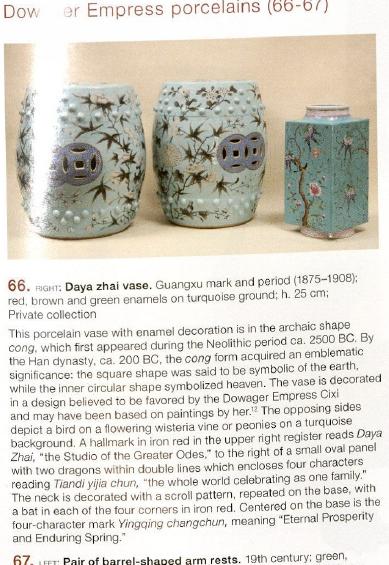
No worries Tony, I appreciate the open debate. To begin, my motive was not to rewrite history. After consulting several Western writers on the topic, such as Soame Jenyns and H.A. van Oort, I noticed a recurring unverified premise of Chu Xiu Gong and Dayazhai porcelain associated with Cixi. Worse, they sometimes confused reproductions with the real deal, like in the example of the Dayazhai bowl from the Sir David Percival Collection. Looking at the pic you successfully uploaded, I see the exact same problem I’m trying to solve with the provenance: “reputedly made for the Empress Dowager”. Reputedly is as good as believed and attributed to, but in no way definite and conclusive.

Ronald Longsdorf did an admirable job in sorting out the Dayazhai mess. He argued a plausible estimate and date to the Tongzhi era, which is both corroborated by Zhongguo tao ci quan ji. On that point, it’s inadequate to merely depend on Western literature without regard to Chinese research. Where else would one find original records on something made in China? Rather than delving further into available muddled information, it’s sensible to go directly to the source.

The 1983 catalog Imperial Porcelain of Late Qing from the Kwan Collection actually took a cautious view of the Dayazhai mark. That discussion did not pertain in the slightest to the lists cited in the “Palace Regulations”, but to the total lack of Dayazhai from the text. There was trouble locating exactly where the place Dayazhai was. Without clear proof, the book couldn’t rule out Dayzhai as a commercial kiln or shop fulfilling an imperial order, or being marketed to Europeans. Because the Dayazhai name was prevalent on Cixi’s court paintings as well, even I would not go that far in my speculation.

Kwan also noted the exceptional Dayazhai samples from the National Palace Museum, and very few pieces outside matched them. Just as I relied on examples from palace holdings as the standard, it’s obvious how rare the genuine works are through simple comparison. Instead of the misrepresented figure you quoted, the first quality Dayazhai and Chu Xiu Gong objects are extremely low in number as current research validated. Since the whole lot’s questionable, it’s a question of accounting for those authentic tidbits, nowhere near the quantities previously assumed.

In the end, Kwan acknowledged the need for further studies on the Dayazhai series. Fortunately, later publications by Longsdorf and Zhongguo tao ci quan ji help fill in the void. I feel it’s useful to always consider the most up-to-date knowledge on any matter. In fact, I’m not really deviating from modern understanding, just confirming its evolved explanation.

As stated in my initial message, my goal is focused on determining whether Cixi was the owner of some Dayazhai and Chu Xiu Gong items. Thanks for pointing out the contradictions. Responding to the issues has revealed the unlikelihood that Cixi was the true recipient.

Subject:Re: Dayazhai and Chu Xiu Gong Zhi Ware
Posted By: Linus Fri, Jul 20, 2012

Clarifying Kwan's quote of the sets enumerated for the Empress Dowager in the "Palace Regulations", the book does not state the yellow and various colored designs were specifically labeled Dayazhai or Chu Xiu Gong. On the contrary, it found the Dayazhai non-existent in the official source. For the sake and confines of this specific forum, it's not the venue to expand the debate into Wan Shou Wu Jian or other Tongzhi and Guangxu marked porcelain in relation to Cixi's usage.

Also noteworthy, the yellow-green-aubergine pattern as exemplified by the Chu Xiu Gong dish I selected for the posting was not mentioned in the "Palace Regulations". Based on its widespread popularity under successive Qing emperors, Kwan theorized such works did make its way to the imperial family. A fair scenario, but admittedly undocumented. Kwan doesn't explicitly cite Chu Xiu Gong in the "Palace Regulations" either, but repeated the specious refrain of commonly believed to belong to Cixi's residence. Recalling which colors governed which consort's dishware does not constitute an actual order for specific dishes. During the historical period I'm investigating, you recognized the imperial wives "seems unlikely to have achieved that quota, certainly in the Tongzhi (1861-1875) reign." The discrepancies don't provide a clear connection.

Luckily illustrated in Zhoungguo tao ci quan ji was one Chu Xiu Gong dish from the palace collection. Its serves a fitting model for analysis. Sure it's a reasonable safer bet to depend on things still from the source, rather than untraceable samples dispersed elsewhere. I feel Bill is quite right in suggesting the intensive task of comparing various pieces to decipher authenticity, which is apparently starting to be done now as opposed to recycling past conjecture and mistakes.

Funny the Dr. Veleanu quip, since I find myself playing the dour role of the prosecutors instead. In good spirit, where's the proof of this stuff? Current fact-checking not just by me is finally putting the Dayazhai and Chu Xiu Gong ware into honest light. Of course, the research goes on, and I eagerly await what's uncovered next.

Subject:Re: Dayazhai and Chu Xiu Gong Zhi Ware
Posted By: Anthony J Allen Fri, Jul 20, 2012

Hi Linus,
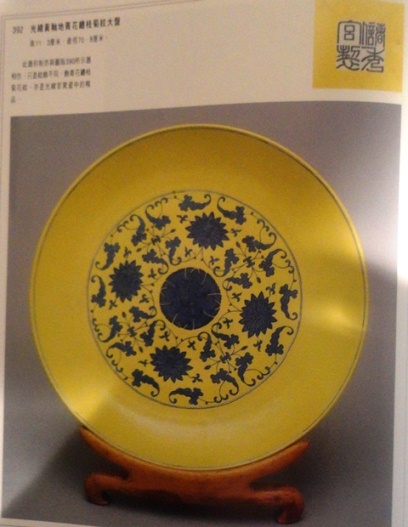
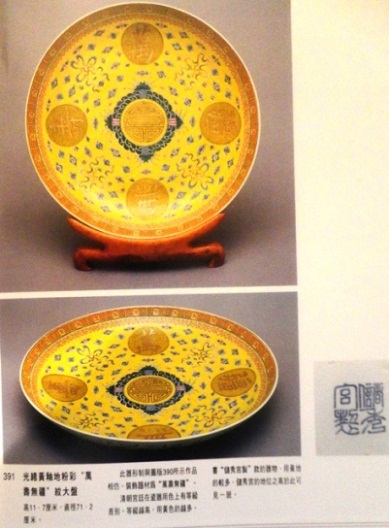
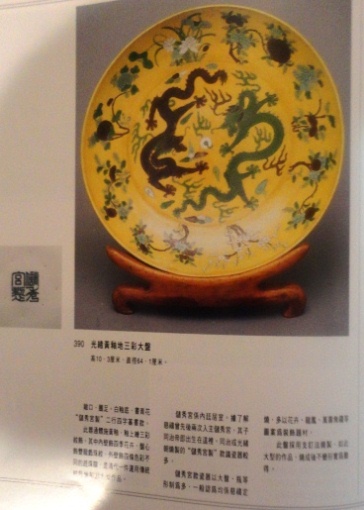
The following photos are from the Shanghai Antique and Curio Store publication, "An Appreciation of Qing Dynasty Porcelain".

I doubt the authors would agree with your conclusions.
Regards
Tony


Subject:Re: Dayazhai and Chu Xiu Gong Zhi Ware
Posted By: Linus Sat, Jul 21, 2012

Much obliged for the update Tony. Like the prior misquoted Kwan reference, "An Appreciation of Qing Dynasty Porcelain" actually lends credence to my side. You cite the publisher as the Shanghai Antique and Curio Store. Do we know the illustrated objects' provenance? Were they photographed from the palace's ceramic holdings or another collection? Dealers and collectors can freely highlight their lots as reputedly, allegedly, likely, etc. from the Forbidden City, but that's not necessarily in league with official court records.

Then let's turn to exactly what the authors are writing, since implying "doubt the authors would agree with me". Although the images were fuzzy and close-ups would be appreciated, it's fairly readable. The title and text concerns physical descriptions. Except for the Guangxu date, no further history is given. While the dragon plate page briefly refers to Chu Xiu Gong's location in the palace, no mention on who commissioned the dishware. Just as I already contend, no word on Cixi’s role. Leaving us without any assertions, the book can’t possibly be contradicted by anyone. Rhetorically speaking, I'd be glad if someone tried to fill in the blanks.

I should reiterate my thoughts to avoid further misunderstanding. First off, the reasoning I'm bringing forth is not solely my own. I'm indebted to sources such as Longsdorf, Zhoungguo tao ci quan ji, and the Palace Museum for their valuable explanations. After delving into the subject lately, I find the emerging rigorous studies offer better comprehensive understanding of Dayazhai and Chu Xiu Gong objects. I equally recognize the calls for better research by Kwan, unverified conclusions by outdated Western literature, and absence of information contained in "An Appreciation of Qing Dynasty Porcelain". Their flaws and omissions aid in discerning the true facts. So I'm not making conclusions without precedent or basis.

Returning to the real purpose of my thread, I'm seeking evidence Cixi personally used Dayazhai and Chu Xiu Gong ware. Specifically, the turquoise Dayazhai jar and Chu Xiu Gong yellow dish with green and aubergine dragons. My question does not relate to deciphering every variety created in the imperial kilns during that period. That's a topic suitable for elsewhere, which fellow enthusiasts are eagerly invited to debate. No matter the amount of purported pieces endlessly disputed here, it still doesn't prove anything once belonged in Cixi’s room.

In all this time, not a single historical document linking Cixi directly with a Dayazhai jar or Chu Xiu Gong dish has appeared. For now, the only correct judgment is to say not proven beyond doubt. Any developments are always welcomed, but please keep it focused on the particulars of this case.

By the way Tony, your efforts are commendable, and again, many thanks for the interesting conversation. I really wish a Qing edict exists clearly stating Cixi’s order of Dayazhai and Chu Xiu Gong porcelain. That would be a whole lot easier.

Subject:Re: Dayazhai and Chu Xiu Gong Zhi Ware
Posted By: Anthony J Allen Sun, Jul 22, 2012

Hi Linus,
It astounds me that you will accept only a Chinese court document as proof. What about Bushell's commentary at the time? And Hobson's book was published in 1915, only seven years after Cixi died. Ask yourself why they would both make up such a story.

As to the Shanghai Antique and Curio Store, I was told that during the cultural revolution (Mao years) the only legal place a Chinese resident could dispose of antiques was through one or other of the Government run antique stores. I asked where the pieces illustrated were kept, as they were evidently forbidden for sale, and my Chinese dealer friend told me he thought they were in the Shanghai Museum. Hearsay I know.

I have attached a photo of a Dayazhai lidded pot that Liu illustrates in the National Palace Museum Collection in Taipei.

Also another in Wang Qingzheng's A Dictionary of Chinese Ceramics. He is a professor and ceramics expert at the Ceramics Department of the Shanghai Museum.

These experts are not singing from your song book.


My apologies for the poor photos, taken in haste in the dark and cold of New Zealand's winter.

Regards
Tony


Subject:Re: Dayazhai and Chu Xiu Gong Zhi Ware
Posted By: Linus Mon, Jul 23, 2012

Glad to know it’s cold somewhere Tony, because it’s hot here in the States.

Sorry to inform you, but the examples you provided turns up my song instead. Think there’s continuing misunderstanding. Just to be absolutely clear thrice, I’m not debating the production of Dayazhai and Chu Xiu Gong. The question I’m raising is what, if any, ended up in Cixi’s personal use. Specifically, I wish to ascertain the provenance on that Dayazhai turquoise jar and yellow-green-aubergine Chu Xiu Gong.

Professor Wang’s cursory overview fails to detail much. And I long knew about the National Palace Museum’s box, along with other Dayazhai objects at its Beijing counterpart (please see pics below). There are even historical Dayazhai sketches by court artists I can gladly direct you to. The encyclopedia Zhongguo tao ci quan ji illustrate different colored Dayazhai dishware and flower pots from the palace’s collection. Similar to the Chu Xiu Gong dish in Zhongguo tao ci quan ji too, they offer a reliable standard for comparison. To repeat, my concern is not over the existence of Dayazhai or Chu Xiu Gong though, but to whom they belonged in real life. Hope you understand that significant distinction.

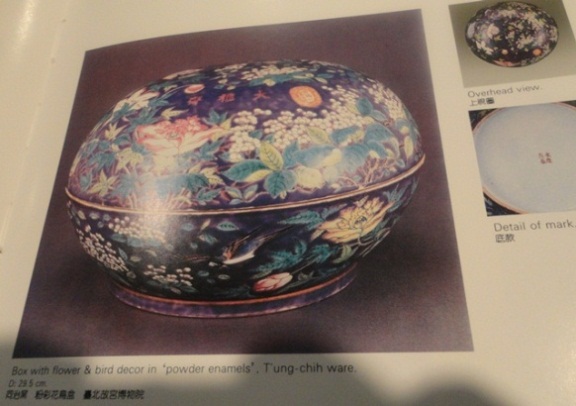
If you notice the date for the box in Taipei’s museum, it reads T’ung chih. That timeframe corroborates credible sources such as Longsdorff and Zhongguo tao ci quan ji. The latter traced the Dayazhai name to Yuangming Yuan, and noted the commissioned set was left unused due to the failed rebuilding. Longsdorff proposed a meager 2 of each kind possibly made it to Cixi. Since their dates line up, perhaps their assessments deserve a little merit. So if every Dayazhai item out there were produced in the imperial kiln, still doesn’t mean Cixi touched anything. The unlikelihood of a tangible link between Cixi and Dayazhai items stands confirmed yet again.

Think about this, how does one prove ownership? In the world over, a receipt plays quite an astonishing role. However, the search for a document turned futile as you indicated for good reason. Remember Kwan found the labels Dayazhai and Chu Xiu Gong absent from the “Palace Regulations”. Imagine recording the multitude of imperial accessories, then overlooking the Empress Dowager’s prized dishware like they never really mattered. Ironic it highlighted Dayazhai and Chu Xiu Gong’s irrelevant position.

Last correction, in no way did I insinuate Bushell fabricated his story about examining O’Conor’s Dayazhai bowls. If you read carefully, I said he made a presumption without clear evidence from behind the palace walls, especially in light of his stubborn mistaken appraisal. Similar to your hearsay story on the Shanghai Antique and Curio Store, Bushell’s commentary admitted, “She [Cixi] is said to have sent down some bowls and saucer dishes from the Chien-lung period from the palace at Peking as patterns to be copied at Ching-te-chen”. Placing faith in the word on the street, Bushell could be termed misinformed, but certainly not a liar by me.

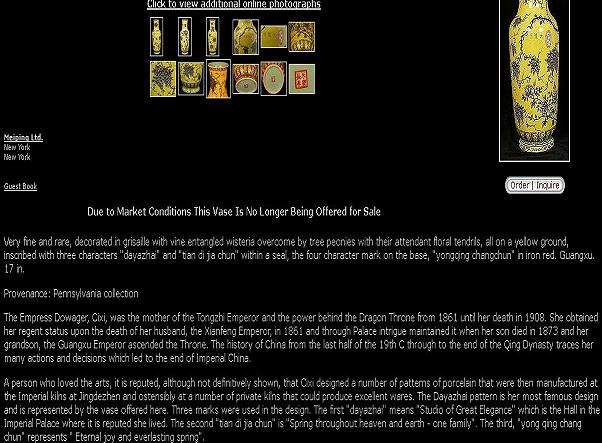
Should you think I’m the only person with a mindful approach to the Dayazhai issue, I leave you with a fellow art dealer’s assessment (screenshot below). Quoting their expert words, not mine, “it is reputed, although not definitively shown, that Cixi designed a number of patterns of porcelain that were then manufactured”.

Thanks for trying Tony, it’s been worthwhile believe me.


Subject:Re: Dayazhai and Chu Xiu Gong Zhi Ware
Posted By: Linus Mon, Jul 23, 2012

Another fact to consider whenever the presumption is made that Dayazhai was Cixi’s personal dinnerware without inside knowledge, as Bushell committed. Two witnesses at Cixi’s court, who were physically at the ruler’s side, wrote firsthand accounts of life in the palace. The American painter of Cixi’s portrait Katherine Carl recalled the set-up of Cixi’s dining table in the book With the Empress Dowager, “Her dishes were of yellow porcelain, with curiously chased silver covers of pyramidal shape and quaint design”. Lady-in-waiting Princess Derling’s memoir Two Years in the Forbidden City recounted mealtime, “It seems that it was a habit of Her Majesty to take her meals wherever she happened to be, so that there was no particular place that she used as dining room. I should also mention that these bowls were of Imperial yellow with silver covers. Some were ornamented with green dragons and some with the Chinese character Shou”. Both separate recollections match, with one noticing further details.

Besides corroborating the yellow and multicolored plates, bowls plus cups ordered for the Empress Dowager in the “Palace Regulations” cited by Kwan, we also learn what the colorful patterns were of. Green dragons and shou symbols are NOT featured on any of Dayazhai’s floral and animal designs. Discounting Dayazhai ware fired in vibrant turquoise and purple, the yellow samples invariably depicted flowers, birds and insects. As a result, Dayazhai objects were never observed as Cixi’s tableware. Of course, Bushell and others are free to guess at the sovereign’s silverware, but any fair court would weigh eyewitness testimonies over outside editorials.

Grateful for all your help Tony, because I’m finding greater clarity and comprehension of the Dayazhai and Chu Xiu Gong issue with the ideas you’re sharing.

Subject:Re: Dayazhai and Chu Xiu Gong Zhi Ware
Posted By: Linus Mon, Jul 30, 2012

Since the Art Gallery of New South Wales was previously mentioned as supposedly contrary evidence, I should correct that erroneous misrepresentation too. The institution’s online database lists a Dayazhai bowl (please click on link). Quoting the artifact’s notes, “Her taste in porcelain is reflected in the type often referred to as 'Empress Dowager' porcelain, said to have been made specially for her use during the reign of her nephew, the Guangxu emperor (1874-1908).” Again the curators selected the inconclusive term “said”, hardly any firm proof to draw upon.

As Kwan observed in Dayazhai items outside the palace collection, the NSW’s example also fails in comparison to the original design (please see attached image). Noting the visual difference immediately, it lacks the vibrant colors and details of a piece worthy of imperial status.

Adding to the Western literature cited here that turned out to be the ones inadequate, my doubts on Cixi’s personal use of Dayazhai porcelain are reconfirmed time after time.


URL Title :Link


Subject:Re: Dayazhai and Chu Xiu Gong Zhi Ware
Posted By: JLim Wed, Aug 01, 2012


With regard to the Dayazhai piece at the NSW Art Gallery, please note that the more vibrant turquoise background indicates a modern fake.

Subject:Re: Dayazhai and Chu Xiu Gong Zhi Ware
Posted By: Linus Thu, Aug 02, 2012

Hi JLim,

Thanks for the interesting perspective, but the official evidence doesn’t quite support the generalization of vibrant colors as fakes in the case of Dayazhai porcelain.

The previous attached pot was photographed at the Palace Museum in Beijing, which once was the exclusive home of Qing emperors and empresses. Being the source of all imperial ware, it’s difficult to imagine curators and experts there highlighting any fakes from the collection. The Forbidden City’s holdings are considered priceless in terms of historical and cultural achievement. Although the Chinese are credited with numerous inventions, time travel was beyond their abilities. Hard to envision a modern forgery making its way back to the original furnishings.

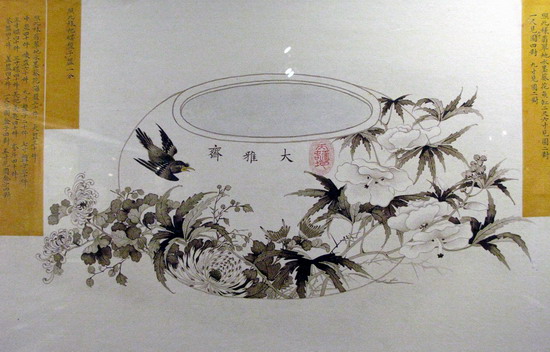
Fortunately, the court sketch for the design also remains at the Palace Museum (please see below pic). The richly drawn imagery match the pot exactly. Notice the lush shaded leaf variations, the distinct petals on the chrysanthemum, plus the robust bird flying straight ahead. The same fine details are repeated on another plate shown at the Palace Museum (please see below pic). Once again, the turquoise background stands out in vibrancy. In contrast, the NSW sample appears dull and sparse in both tone and scenery. Its rendered bird even looks crooked and sickly in comparison. Because the NSW piece does not remotely resemble the palace set, it was therefore not produced in accordance with commissioned blueprints. By who or when is anyone’s guess.


Subject:Re: Dayazhai and Chu Xiu Gong Zhi Ware
Posted By: Linus Sun, Jul 22, 2012

More irony ensues. Told to subscribe to a "wider audience", the additional works dubbed contrary have further confirmed doubts upon their correct reading. Kwan never found official quotes for Dayazhai or Chu Xiu Gong ceramics, and "An Appreciation of Qing Dynasty Porcelain" neglected to explain Cixi's involvement. If that's not enough historical inconsistencies, I learn of the infamous Bushell Bowl.

Pardon my prior typographical error in ruining Bushell's good name, but he's proven not infallible as well. As the notes from a recent academic seminar entitled “A Flash in the Pan or the Bushell Bowl Debate” recalled, in 1870, Dr. Bushell purchased a Western Zhou attributed bronze ritual vessel in Beijing. Despite serious questions raised by others, he adamantly defended its authenticity till his dying day, touting Chinese experts upheld his view. The Chinese knew all along it was a fake. In the 18th century, the scholar Feng Hao had deduced the object's fraudulence. Modern scientific testing concluded it was indeed not what Bushell vehemently claimed.

That failed comprehension was the legitimate concern I stated earlier when Bushell was first mentioned on this post. His book Chinese Art asserted Dayazhai "are interesting from the fact that they are part of a dinner service made specially at the imperial factory of 'Ching-te-cheng' for the empress dowager". However, he didn't supply any corroborating evidence. Kwan didn't find an imperial order for Dayazhai products in the original "Palace Regulations". Utilizing palace blueprints, the Chinese encyclopedia Zhongguo tao ci quan ji traced Dayazhai to the aborted reconstruction of Yuanming Yuan. With all the Dayazhai samples held at the Palace Museum, no official accounts reported Cixi's personal use of any of them, much less Chu Xiu Gong dishes. Yet Bushell remained content with his assumptions, perhaps like the ritual bronze.

Still no documentation uncovered on Cixi's alleged porcelain creations, especially one Dayazhai turquoise jar and one Chu Xiu Gong yellow-green-aubergine dish.


Subject:Re: Dayazhai and Chu Xiu Gong Zhi Ware
Posted By: Linus Fri, Jul 27, 2012

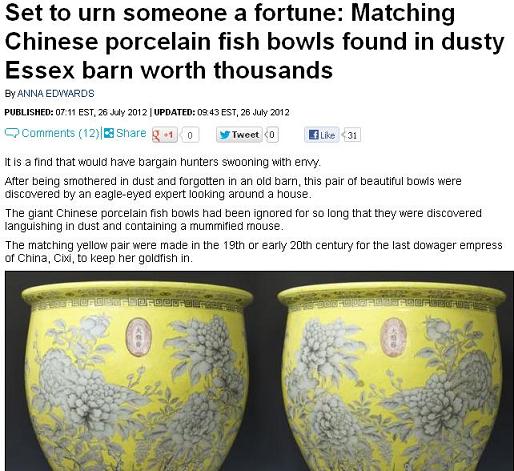
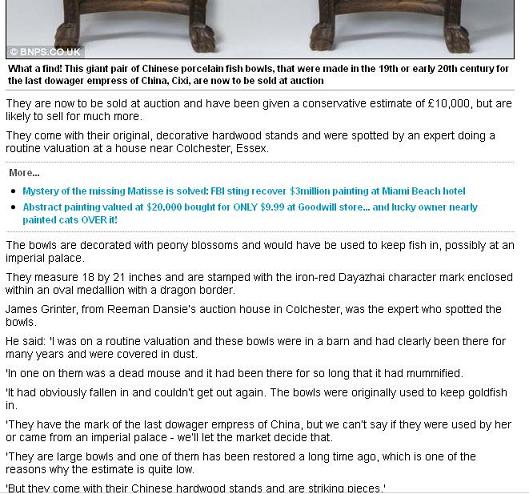
New update: a pair of large Dayazhai fish bowls were discovered forgotten in a British barn (please see link). In the interesting article, you can read an auction expert's quoted opinion, "They have the mark of the last dowager empress of China, but we can’t say if they were used by her or came from an imperial palace - we’ll let the market decide that".

Given current findings, it really doesn't seem like I'm the only one wary of making a direct connection between Dayazhai porcelain and Cixi. Doubts still linger out there.


URL Title :News Article


Subject:Re: Dayazhai and Chu Xiu Gong Zhi Ware
Posted By: Bill H Sat, Jul 28, 2012

Looks like the Olympics must have crowded that story off the Mail's front page.
Cheers,
Bill H.

Subject:Re: Dayazhai and Chu Xiu Gong Zhi Ware
Posted By: Linus Mon, Jul 30, 2012

Thanks for the update Bill. Looks like Olympic fever has gripped the nation.

Retrieving the article, I copied and pasted it as two consecutive pics instead. Enjoy the find.


Subject:Re: Dayazhai and Chu Xiu Gong Zhi Ware
Posted By: Michaela Thu, Aug 02, 2012

This is an interesting discussion. I have a book which I am very slowly having translated which MAY answer your questions (or it may not!).

The book is "Gugong Museum: GUANYANG YUCI: GUGONG BOWUYUAN CANG QINGDAI ZHI CI GUANYANG YU YUYAO CIQI. (Official Designs for Imperial Porcelains: Qing Dynasty Official Designs for the Manufacture of Porcelain and Imperial Ceramics in the Collection of the Gugong Museum). Beijing, 2007. 335 pp. Colour plates throughout. 31x23 cm. Boards.

A book on this subject has been much needed and awaited. It has long been known that the Zaobanchu (imperial workshops) in the Forbidden City made paintings with designs for ceramics for use by the Emperor; indeed some have been on recent exhibition in the Gugong Museum. These painted designs (which also bore details of size and shape of the proposed ceramic object) were sent to Jingdezhen and ceramics there manufactured from the designs. This work shows a large and fine varied array of these painted designs, together with the actual manufactured imperial ceramics for the Tongzhi and Guangxu Qing emperors. All the painted designs and ceramics are held in the collection of the Gugong Museum and many have never been published before, particularly the drawings. An excellent visual reference and research tool both into Qing imperial ceramics and the workings of the Zaobanchu. Illustrated throughout in colour, many of the ceramics being illustrated in multiple views to show to full effect their relation with the painted designs. Text in Chinese."

It shows so many of the Dayazhai porcelains in the Gugong (Imperial palace) Museum, and as noted above, the 'cartoons' used for their manufacture. There is plentiful discussion, in chinese, of all aspects - some of the inroductory chapters look at :
- Look at the Official Sample System in Ancient China from the Qing Dynasty Official Porcelain Sample in the National Palace Museum by Wang Guangyao
- Qing Dynasty Imperial Porcelain by Zhang Xiaorui
- Official Porcelain Samples Collection of the National Palace Museum by Li Weidong

Chu Xiu Gong wares are not discussed, but the Tihedian wares and the pieces for Tongzhi's wedding are. I just don't know as yet what they say!

Anyway, this is published by the holders of the largest collection of Dayazhai wares anywhere, the pictures are breathtaking and I am sure that the contents would go as far as possible in answering your questions.
Available from prominent Asian bookstores in UK and USA last time I looked.
Cheers, Michaela

Subject:Re: Dayazhai and Chu Xiu Gong Zhi Ware
Posted By: Linus Fri, Aug 03, 2012

Cheers indeed Michaele. I also recently found a copy of GUANYANG YUCI, which provides the most credible study in my opinion. Clearing up over a century's accumulation of confused and erroneous Western literature, it smartly relies on firsthand official records. Glad you think it's equally useful.

Upholding research that the Dayazhai series was originally intended for the unsuccessful Yuanmingyuan reconstruction during the Tongzhi era, the book adds it was later reissued in the second year of Emperor Guangxu's reign (1876). A total of 4,992 items, composed of variously decorated dinnerware and flower pots. If you read the illustrated sketches, the side notes actually list the number of bowls and jars for each drawn theme. Wonder how many remain accounted for in the Palace Museum now.

Looking at the examples from the Forbidden City, you also see the objects were stunningly rich in color and detail. As I previously demonstrated, visual comparisons can easily be made with the stuff outside. Hopefully, you'd agree that the NSW bowl fails in matching the genuine article. I have serious doubts regarding the initial jar on my post as well. When placed against the turquoise jar in GUANYANG YUCI, wouldn't you say there's a lesser quality feel, in addition to some discrepancies in composition.

While Dayazhai porcelain was connected to the imperial kilns, the question whether Cixi utilized all or part of the 4,992 pieces herself isn't specifically answered by the book. We should consider the historical circumstances then. Throughout the 1870s, Empress Dowager Cian remained co-regent with Cixi, so she did not single-handedly rule the day. Starting in the middle of that decade, Cixi was incapacitated by a life threatening illness for several years. The debilitating affliction would've occurred right alongside Dayazhai production. Since Cian shared the same fond memories of the lost Yuanmingyuan residence, perhaps she continued onward with the Dayazhai project. Moreover, the insider accounts by the previously cited Princess Derling and Katherine Carl never mentioned any Dayazhai designs on Cixi's dining table. Seems these ware were abandoned yet again, maybe not long after their second revival.

Subject:Re: Dayazhai and Chu Xiu Gong Zhi Ware
Posted By: Michaela Sat, Aug 04, 2012

Linus, trying to prove that something didn't happen by giving proof that there is no evidence will only mess with your mind! You are coming to this Dayazhai maze with a different and centred approach - you just can't make any definitive conclusuions about this, so it may be time to ask another question, one that you actually have some chance of answering - well that's what I was always told when I asked ridiculously convoluted questions about the universe, that nobody could hope to answer!!!

However, you have raised many interesting ideas. I personally love the idea that Cixi had a design 'hand' in the Dayazhai wares - it adds a romance that you will have trouble dispelling, and it is what interested me initially in these porcelains, others too I imagine.

But when you start asking questions about the timing of all these late Qing 'new' designs, the trouble starts across the board. For example, the yellow ground, 'Birthday pattern' as it is called - I have searched everywhere for a definitive statement of WHOSE birthday this was meant to commerorate - any ideas?

More thoughts - the Art Gallery of NSW Dayazhai style bowl - who ever said this was part of the Longsdorf 'real' Dayazhai pantheon - I always thought that the zhadou in the Art Gallery of Victoria were the ones mentioned by Longsdorf - I have never seen a decent picture of these but intend to organise a personal visit. And yet the example online in the Art Gallery of NSW shows no images of any marks, so it is hard to tell. However, J.H. Myrtle was a very astute collector of Late Qing and early C20th wares and he bequeathed much of it to the Gallery - I have been trying to get a complete inventory of his bequest because it is a very valuable resource.

I think you mentioned somewhere about the pristine nature of the examples in the Palace Museum as possible proof that they were never used by Cixi. But the actual examples in the GUANYANG YUCI on pp 157, 162, 164 show hairline cracks and significant wear to the enamels. In addition, if my memory serves me right, I always thought that the Dayazhai pieces were meant to DECORATE a new Hall (at whichever Palace), never to actually be used by Cixi. The emphasis was always on 'designed or overseen' by Cixi, for fitting out a new Hall (which nobody seemed to be able to locate!?!). Anyway, Cixi's visitors, including foreign delegations, artists in residence, like Katherine Carl, would then obviously not comment on them. Like you, I have read countless biographies, stories etc on Cixi - the information one wants is never forthcoming. One is only left with piecemeal and inadequate historical documents, and the examples themselves. For the Dayazhai Pantheon, these are my latest estimates:

1. Turquoise ground, overglaze famille rose pattern of roses and wisteria, with a Hwamie bird amongst the branches – SPRING – three pieces known in private collections, one in the Musee Guimet in Paris, two in the National Gallery of Victoria, Australia, one in the National Palace Museum, Taipei and at least seven in the Gugong Museum - 14 TOTAL

2. Yellow ground, with opaque white peonies in full flower and bud, and insects (moths) and leaves in grisaille – SPRING – three pieces known in museums/collections in the west plus at least six in the Gugong Museum - 9 TOTAL

3. White ground, natural lotus flower and leaves, with herons – SUMMER – three pieces known in the British Museum, at least six in the Gugong Museum - 9 TOTAL

4. Turquoise ground, with opaque white chrysanthemum and hibiscus flowers, leaves and foliage in grisaille, one flying blackish bird – AUTUMN – one example known in a private collection in the west, at least 8 pieces in the Gugong Museum - 9 TOTAL

5. Purple ground, with purple, pink and yellow poppies and buds and possibly peach flowers (or single multiflora tiny rose or even a single spiraea) and grey-green foliage in polychrome enamels, and a black & white bird in flight – WINTER - three pieces known in private collections, one piece in the National Palace Museum in Taipei and at least seven pieces in the Gugong Museum - 11 TOTAL

That's 52 verified pieces.........................
Best, Michaela

Subject:Re: Dayazhai and Chu Xiu Gong Zhi Ware
Posted By: Linus Mon, Aug 06, 2012

Many thanks for sharing Michaela. It's certainly a privilege and pleasure to always compare notes. Our combined efforts might shed new light on the Dayazhai mystery yet.

To begin, I should explain my pursuit is purely academic. Within any proper research, verifiable facts have to back up purported thesis. Historians are taught to rely on firsthand documents and evidence, not hearsay or unfounded claims. I realize my concern on whether Cixi personally used Dayazhai pieces is quite narrow, and the criteria I'm seeking is rather demanding. But a honest investigative approach doesn't mix in fanciful stories. For example, the words "Let them eat cake!" are popularly attributed to Marie Antoinette, but no records ever showed she uttered the phrase. Similarly, the allure of Cixi's "hand" in Dayazhai designs persist, but that doesn't make it reality either.

In fairness, I don't find this case unacceptable nor incomprehensibly convoluted for minds to think about. Sorry if anyone felt so. On the contrary, it's been most enlightening. You're absolutely right to contend there's no way to prove Cixi's direct involvement, therein lies the self-explanatory answer. Not sure how clearer and simpler that can be. As you well summed up, the evidence is inadequate and not forthcoming. With everything out there, no definitive link between Cixi and Dayazhai has been established. By stating the obvious outcome yourself, it doesn't appear exceedingly indecipherable or controversial.

Instead of feeling disheartened as you assumed, I'm actually delighted you recognize the serious difficulty in sorting out late Qing imperial provenance. Regardless of legitimate evidence, Cixi's name is frequently attached by repute to whatever. While legend and myth has a place in imagination, it doesn't matter in the real universe. Just as I delved into Dayazhai and Chu Xiu Gong, you're perfectly correct to wonder who was the recipient of "Wan Shou Wu Jian" dishware, without resorting to unsubstantiated tales.

Clarifying an issue raised, I never associated the NSW bowl with Longsdorf's writings or the zhadou pair at Melbourne's National Gallery. I had an entirely different purpose in mentioning NSW. An earlier poster cited the Art Gallery of New South Wales as proof of Cixi's connection to Dayazhai. However, the museum's own website noted its particular bowl was "said to have been made specially for her use during the reign of her nephew, the Guangxu emperor (1874-1908)". The experts' cautious assessment hardly sounds conclusive. Furthermore, I was comparing the NSW bowl's outside design to the official set in Guangyan Yuci. You can check for any seals in person, but the aesthetics already don't match.

Evaluation of Dayazhai's "pristine nature" in relation to Cixi's non-use is credited to Zhongguo tao ci quan ji, not my observation or judgement. The defects you saw in Guangyan Yuci could have come from overuse, by who then? Perhaps the prosaic reason would be damage in storage. For the most part, the samples appear to retain their fine colors and detail. Unlike another poster's worries, the lush design doesn't suggest a modern forgery, especially for an artifact from the Palace Museum.

Yes, the exact location of Dayazhai was once unknown, but Zhongguo tao ci and Guangyan Yuci tracked the location to Yuanming Yuan. The Dayazhai and Tiandi Yijia Chun buildings were originally alongside Cixi and Cian's living quarters. The reconstruction was ordered by Emperor Tongzhi for the two female regents, thus it was intended to DECORATE both Cixi and Cian's restored rooms. After the project was abandoned, the Dayazhai series was revived and presumably wound up in the Forbidden City. However, what made it to who is left unresolved. Confronted by Guangyan Yuci's other illustrations of Tongzhi and Guangxu era imperial porcelain, are we to believe Cixi was somehow responsible for everything fired in the imperial kiln.

Due to the wealth of genuine history available on Cixi, sad to hear you find it all unsatisfactory. With careful reading, one gets to go beyond the caricature to unmask the person inside. For instance, Princess Derling witnessed Cixi's everlasting devotion to her husband Emperor Xianfeng. That explains the significance of Dayzhai and Tiandi Yijia Chun, which Zhongguo tao ci and Guangyan Yuci have traced to the halls where Cixi lived during her marital years. You overlooked the importance of Derling and Carl's recount of Cixi's tableware too. Obviously they couldn't see Dayazhai ware in the uncompleted Yuanming Yuan, but here's the key - Dayazhai ware didn't appear at the Forbidden City and Summer Palace as well. Spending years within the enclosure, neither courtier noticed anything of the sort. That's not a puzzle or riddle to ponder, but sheer testimony.

Looking at your final numbers, I surmise you combined Longdorf's estimates with the examples featured in Guanyan Yuci. That's a good start, but I suspect there's much more since Guanyan Yuci accounted 4,992 items. While my focus is only on Cixi, you're welcome to determine the total amount of top quality Dayazhai worldwide. Going off topic with irrelevant or specious inquiries won't help my specific case.

Again, we end without proof beyond a doubt. It's been incredibly fascinating and worthwhile though.

Subject:Re: Dayazhai and Chu Xiu Gong Zhi Ware
Posted By: Michaela Tue, Aug 07, 2012

Thanks for the updated information!

Subject:Re: Dayazhai and Chu Xiu Gong Zhi Ware
Posted By: Linus Tue, Aug 07, 2012

For interested readers, an update on the precise location of Dayazhai's namesake Tian di yi jia chun. Attached a link to an academic article on the Lei family, who were the imperial Qing architects. Figure 2 depicts the proposed model for the Tian di yi jia chun hall "made by the Lei for the consideration of the Tongzhi Emperor and empresses Ci'an and Cixi when restoration work on the gardens was undertaken in the 1870s." As recent research indicated, the Dayazhai porcelain series originated during this rebuilding effort, which happens to be corroborated by official records rather than continuing guesswork. As I previously noted, it might be wise to examine the personalities and politics of the day to understand what was really going on in the palace.

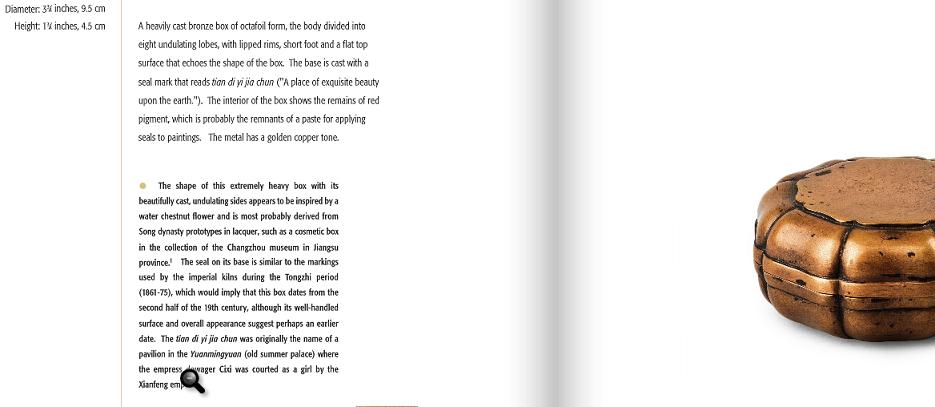
In addition, the seal Tian di yi jia chun appears beyond ceramics. I previously discussed paintings with Dayazhai and Tian di yi jia chun seals. It's well established such artworks were not necessarily painted by Cixi herself, but by her court artists instead. Now I find there's also a scholar's bronze seal paste box inscribed Tian di yi jia chun(please check image link). The description mentioned the name's usage by imperial kilns during the Tongzhi era, and as the historic pavilion in Yuanming Yuan where Cixi enjoyed Emperor Xianfeng's company. If Dayazhai and Tian di yi jia chun were truly the exclusive emblems of Cixi, does the box immediately count as Cixi's personal belongings too? The authors fail to state such a direct ownership by association, and isn't even afraid to "suggest perhaps an earlier date". So it wasn't always meant solely for Cixi's hands.


URL Title :Article


Subject:Re: Dayazhai and Chu Xiu Gong Zhi Ware
Posted By: Linus Thu, Aug 16, 2012

Neglecting original historical records, Bushell and Hobson’s conclusions on Dayazhai ware proved to be unfounded speculation rather than fact. Recent studies locate Dayazhai and Tian di yi jia chun as pavilions in the Yuanming Yuan, constituting both Cixi and Cian’s living quarters with the Emperor Xianfeng. In Bushell’s book Chinese Art, he erroneously stated, “Ta Ya Chai ‘Pavilion of Grand Culture’, the name of the new palaces of the Empress Dowager at Peking, in connection with her motto T’ien ti yi jia ch’un”. Hobson’s book Handbook of Marks on Pottery and Porcelain rehashed the same misinformation by ascribing the names Tian di yi jia chun as “Motto of the late Empress Dowager” and Dayazhai as “one of her palaces”. Not only did the Yuanming Yuan complex predate Cixi’s lifetime, but it was never reconstructed after the 1860 destruction. Thus it could never have been a new residence for Cixi again. As the bronze seal paste box previously showed too, Tian di yi jia chun wasn’t a term solely restricted for Cixi’s purpose, but actually referred to an existing place.

Meanwhile, in Pu Yi’s autobiography From Emperor to Citizen, the former Chinese ruler recalled, “All the crockery was imperial yellow porcelain with dragon designs and the words ‘Ten thousand long lives without limit’ painted on it”. Although Pu Yi was Cixi’s successor, it nevertheless reinforced Derling and Carl’s eyewitness impressions of a typical imperial table. Yellow and dragons dominated the dishware, rather than multi-colored creature designs symbolized in Dayazhai. Off topic but worth noting, the Wan Shou Wu Jian series doesn’t appear to belong exclusively to Cixi’s birthday as well, since Pu Yi’s court continued to use them without respect to any past individual or occasion.

Subject:Re: Dayazhai and Chu Xiu Gong Zhi Ware
Posted By: Linus Fri, Aug 17, 2012

Just read the Chinese article study entitled The Location and Function of ‘Daya Studio’, written by Palace Museum curator Zhou Suqin (available at link). Going through the archives instead of guesswork, he offers historical insight into Dayazhai and Tian di yi jia chun.

To briefly summarize, the name Dayazhai was created in the 5th year of Emperor Xianfeng's reign for two locations. An inscribed plaque adorned the Tian di yi jia chun complex in Yuanming Yuan, while its counterpart was displayed within the Forbidden City’s Hall of Mental Cultivation. Since both sites were occupied by Cixi while consort to Xianfeng, the signs denoted a mark of marital favor. The true author was the emperor, whose memory Cixi faithfully upheld through continued usage. Hence the real meaning of the namesakes, unrelated to symbolizing her personal grandeur or power.

Additionally, the author pinpointed the origins of Dayazhai ware. During the attempted reconstruction of Yuanming Yuan, the Emperor Tongzhi along with the Empress Dowagers Cixi and Cian personally inspected every detail of the building plans, including all the decorations. An order was given to the "九江关" official in the 3rd month of the 13th year of Emperor Tongzhi’s reign (1874) to supervise the firing of Dayazhai porcelain. Completed by the second year of the Emperor Guangxu's reign, the entire stock was then put aside in the imperial collection because the Yuanming Yuan project was already abandoned. Rather than declaring Cixi's ownership, Dayazhai items were actually manufactured under the wider court's auspices. Given the more collaborative approach, it can't merely be deemed as Cixi's pet project. It's imprecise to view her as the sole initiator.

Attributing the Dayazhai series automatically as Cixi's prerogative is therefore a flawed belief. There's no evidence she single-handedly devised Dayazhai pieces, nor got the chance to utilize any of it.

URL Title :Article


Subject:Re: Dayazhai and Chu Xiu Gong Zhi Ware
Posted By: Linus Sun, Aug 19, 2012

As my post winds down, I want to thank everyone who contributed to a stimulating and illuminating discussion. I’m very appreciative of the various points offered. Sifting through all the information, I hope readers gained better understanding as well.

Final thoughts – Lacking verifiable evidence, it remains unproven whether Cixi used Dayazhai ware herself. Historical facts seem to downplay such an idea. The names Dayazhai and Tian di yi jia chun evoked memories of a lost pavilion in the Yuanming Yuan palace, where Cixi lived as Emperor Xianfeng’s beloved consort. They were never intended as her personal mottos. Court records also show the rebuilding effort was undertaken by Emperor Tongzhi. Zhou Suqin’s article quoted the emperor’s pronouncement on the 18th day of the 9th month in the 12th year of Tongzhi (1873). It stated that upon attaining majority, the emperor felt gratitude to both empress dowagers [Cixi and Cian] for their prior services as regents, and desired to rebuild the Yuanming Yuan to its former glory for them out of respect. In addition, the sovereign requested personal donations from officials and princes to finance the project, thus fulfilling his filial obligation to the two empress dowagers. Commanding the plans and funds, Emperor Tongzhi clearly took the decisive role in reconstruction efforts.

Zhou noted the imperial edict in the 13th year of Tongzhi ordering an official to produce Dayazhai and Tian di yi jia chun inscribed porcelain. Already governing in his own right then, the emperor was solely responsible for issuing directives. It was improbable Cixi took unilateral decisions in the process. Even during court meetings with architects and designers, Cixi’s attendance was mentioned alongside Cian and Tongzhi. While Cixi could’ve been consulted on the details, Cian would’ve been too, and Tongzhi was the ultimate ruler. Talk over Yuanming Yuan’s revival finally ended with Emperor Tongzhi’s death in 1874. Neither Cixi nor Cian thought to commission further attempts. Doubtful Cixi truly expressed a forceful hand and say in Dayazhai’s creation, considering its dependence on the emperor's backing.

Since Yuanming Yuan’s Tian di yi jia chun failed to be rebuilt, numerous examples of Dayazhai ceramics wound up in the palace collection. Yet still nothing made their way into Cixi’s presence. Eyewitnesses such as Derling and Carl didn’t notice anything resembling Dayazhai designs on her table. Not surprising really, why should Cixi hang onto reminders of an unsuccessful venture sponsored by others, if she wasn’t particularly involved in the first place.

Discounting uncorroborated speculation, I tried to rely on firsthand accounts and documents to ascertain the true story of Dayazhai. As the more careful experts counseled before, the link between Dayazhai and Cixi is in no way definite and conclusive.

Unfortunately in this investigation, I didn’t find much original material on Chu Xiu Gong ware, leaving proof of their association with Cixi non-existent.

Subject:Re: Dayazhai and Chu Xiu Gong Zhi Ware
Posted By: Linus Mon, Aug 20, 2012

Excuse the addendum, but I had incorrectly edited a paragraph in my concluding thoughts.

Eyewitnesses such as Derling and Carl didn’t notice anything resembling Dayazhai designs on her table. What they did witness corresponded to other wares produced in the imperial kilns during that period, such as the characteristic shou patterns illustrated in the official guide Guangyan Yuci. Additionally, the last emperor’s recollection was filled with Wan Shou Wu Jian tableware. Upholding the traditional mealtime set-up of yellow dishware, the imperial household continued to pass over displaying the Dayazhai items stored in their holdings. Because Pu Yi’s succession followed Cixi’s death, previous porcelain likely remained in usage at the palace, especially given the dynasty’s immediate collapse. Long after the 1911 revolution, Pu Yi’s court clung to life in the Forbidden City until 1924. Be interesting if anyone contend they had the power to continue making Xuantong orders from the republican-era kilns. Due to the contemporary testimonials from the inside unlike Bushell, those additional series actually make much better candidates for the large inventory cited for the empress dowager in Kwan’s Palace Regulations, rather than unseen Dayazhai. Not surprising really, why should Cixi hang onto reminders of an unsuccessful venture sponsored by others, if she wasn’t particularly involved in the first place.

Subject:Re: Dayazhai and Chu Xiu Gong Zhi Ware
Posted By: Linus Wed, Aug 29, 2012

After a trip to the library, I obtained new information worth sharing.

The porcelain expert at the Palace Museum Geng Baochang discusses Dayazhai ware in his book Ming Qing ci qi jian ding. Notwithstanding reproductions, the bold series was linked to the court’s official kilns. However, there was no mention of Cixi’s involvement. Regarding Dayazhai’s floral patterns, Geng cited the influence of famous Qing artists Nantian [aka Yun Shouping] and Xugu instead. Supplementing the complicated politics and history behind Dayazhai’s production, Cixi doesn’t deserve credit for artistic originality either. The notion that Cixi alone conjured up Dayazhai items seems ever more far-fetched.

In the Shenyang Palace Museum’s catalog Shenyang gu gong bo wu yuan, the section “Fine Porcelain of Qing’s Official Kilns” included a yellow and aubergine dragon dish attributed to the Guangxu era. Looking at that particular example marked Chu Xiu Gong, it’s apparent how the samples shown earlier on this post fail in comparison. For example, the aubergine and green in the middle clouds differ in arrangement. The overall colors on the Shenyang piece appear uniform and crisp, rather than dull or blotchy. Not only do the dragons’ scales shine, but the flowers and leaves are finely detailed. Lastly, the standard dish’s diameter measures 71 cm as opposed to the smaller 47 cm. Given its impeccable provenance, at least there’s one reliable Chui Xiu Gong ware to count on. But yet again, the writers didn’t specifically identify Cixi as the inevitable owner.

Subject:Re: Dayazhai and Chu Xiu Gong Zhi Ware
Posted By: Linus Sat, Sep 01, 2012

I’m writing a follow-up review of the book GUANYANG YUCI. At times, the narrative becomes a political diatribe against a ruthless Cixi, draining China’s finances to pay for her extravagant luxuries. Yet the evidence offered doesn’t quite match the fiery rhetoric.

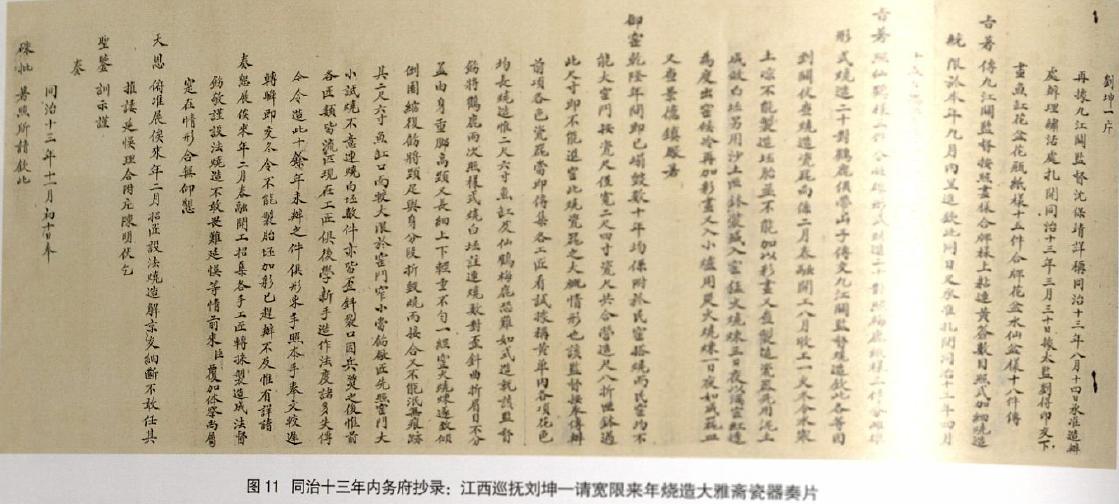
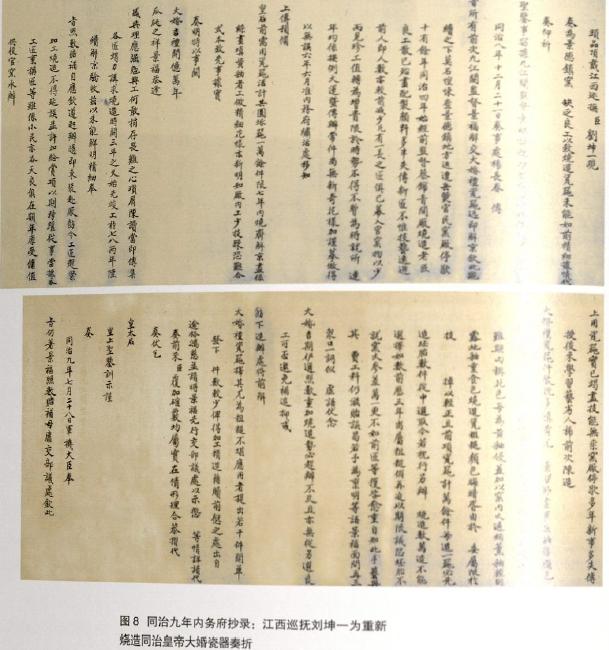
As Zhou Suqin’s article stated, the imperial order for Dayazhai items was made in the 13th year of Tongzhi by the emperor himself. GUANYANG YUCI includes a memorial from the official supervising Dayazhai production at the kilns (please see first pic). Dated the 13th year of Tongzhi, the document sought the throne’s approval regarding a delay. It omitted addressing the empress dowager however. GUANGYAN YUCI also included the same official’s memorial four years earlier during Emperor Tongzhi’s wedding (please see second pic). Besides directly beseeching the empress dowager, it noted the empress dowager’s request for a specific amount of wares.

Why the significant change in protocol? As mentioned before, Emperor Tongzhi attained majority by 1873, and Cixi and Cian had retired as regents then. Plans to rebuild Yuanming Yuan for both empress dowagers were in the hands of the new ruler, which was duly reflected in bureaucratic wording. Since Cixi’s authority, along with Cian’s, stopped being recognized within the power shift, government underlings keenly understood decisions on Dayazhai porcelain didn’t rest with the empress dowager anymore.

In addition, GUANYANG YUCI occasionally presents other researchers’ flawed conclusions. For example, it cites authors who argue Dayazhai sketches were drawn by the court painter Miao Jiahu with Cixi personally on hand. Firsthand reports already place Dayazhai’s firing during the Tongzhi era. Miao was not employed by Cixi until Emperor Guangxu’s reign, making any such connection a historical impossibility.


Subject:Re: Dayazhai and Chu Xiu Gong Zhi Ware
Posted By: Linus Thu, Sep 06, 2012

Found an intriguing exhibit from the Palace Museum in Beijing (please click on link), which highlighted actual examples of colored ceramics specified for imperial consorts. At the far left, one can see a yellow dish with aubergine and green dragons. Though simpler in design, and likely from a different period, its style nonetheless resembles the larger Chu Xiu Gong yellow plate with aubergine and green dragons in the Shenyang Palace Museum’s publication. Also on display was a white dish with red dragons, reminiscent of the white-red Chu Xiu Gong plate from the Nanjing Museum’s imperial collection that was featured in the book Zhonguo tao ci quan ji. These 2 particular samples are the only Chu Xiu Gong pieces I’m aware of with credible provenance from the imperial source.

The dragons of Chu Xiu Gong ware appear to follow palace precedents. Lacking originality, the official patterns dutifully reflected the tableware of the lowliest concubines titled Gui Ren and Chang Zai. Their observance of established forms seem to render them ill-suited for Cixi’s exalted position as empress dowager and regent though. If she truly commissioned porcelain for her own use, they should expectantly incorporate the proper symbols, rather than oddly demoted status.

URL Title :Link


Subject:Re: Dayazhai and Chu Xiu Gong Zhi Ware
Posted By: Linus Fri, Sep 07, 2012

Adding to the chorus of firsthand proof, rather than the uninformed kind, Lady Susan Townley recorded her mealtime invite to the palace in the memoir My Chinese Note Book. The foreign guest wrote, “Needless to say we did not eat much, although the Empress-Dowager who sat at our table was most anxious that we should do so, and herself set us an example by consuming several bowlsful of rice and milk, a great mark of favour, for she never sits at the same table as her court ladies and always eats in private. On this occasion she was served by kneeling attendants, and used imperial yellow china; our dishes were yellow with green and black dragons on them.” Yet again, another eyewitness noted the absence of Dayazhai ware in Cixi’s proximity.

After carefully vetting outside Western sources, plus examining original Chinese documentation, Cixi’s alleged singular creation and usage of Dayazhai remains uncorroborated. While Dayazhai samples were undoubtedly produced by the Qing court during Cixi’s lifetime, it’s quite a leap to then assume they were all due to Cixi herself, especially when the real evidence begs to differ.

Subject:Re: Dayazhai and Chu Xiu Gong Zhi Ware
Posted By: Linus Wed, Sep 26, 2012

Just read Volume 1 of Simon Kwan’s PhD Thesis “The Imperial Porcelain Wares of the Late Qing Dynasty”, whose subsequent work was discussed earlier on this post. While subscribing to the conventional thought on Cixi’s overreaching role, Kwan’s inclusion of court records unwittingly provide a differing account.

Pages 160-1 quoted an official report from the imperial kilns to Emperor Tongzhi. Written in the same year as the Dayazhai order featured in GUANYANG YUCI, the document reconfirmed the process followed for imperial commissions. It read:
“According to the superintendent of the Jiujiang Custom Office, Mr. Shen Baojing, instruction was given on the fourteenth day of the eight month in the thirteenth year of Tongzhi (1874) for the Department of Works to implement the design produced by the Textile Department on the thirtieth day of the third month of thirteenth year of Tongzhi (1874) based on the drawings given to them by the eunuch Mr. Liu Deyin. There are fifteen drawings of fish bowls and flower pots and eighteen drawings of flower pots and narcissus pots. Your Majesty ordered that the superintendent of Jiujiang should produce and fire these wares according the quantities indicated in the yellow notes. These are to be submitted to palace on the ninth month of this year. On the same day, instruction was also given to implement the design given by the head eunuch Mr. Meng Zhongji on the fifteenth day of the fourth month of the thirteenth year of Tongzhi (1874). These are three model of cranes and three paper drawings of deers. Your Majesty ordered that twenty pairs of male and female cranes are to be made according to the three models and twenty pairs of stags and deers according to the three paper drawings are to be reproduced and fired. All the cranes and deers should include a small hill beside them …
The superintendent of Jiujian was ordered to produce and fire them …”

As already established, the emperor had attained majority and ruling in his own right then. Again no word of deference or reference was made to the former regent Empress Dowager Cixi, nor Cian. Thus from the addressee, it’s clear to see who exactly was in command of porcelain production during the time of Dayazhai’s creation. In addition, the palace kept entire departments and functionaries responsible for porcelain designs. Given the technical bureaucracy in place, the romantic notion that Cixi sketched Dayazhai blueprints with her own hands seems to be pure fantasy as well. So while the emperor and his underlings’ roles have been verified, there’s still no direct evidence connecting Cixi.

Subject:Re: Dayazhai and Chu Xiu Gong Zhi Ware
Posted By: Linus Sat, Sep 29, 2012

Further eyewitness account from the American minister’s wife to the court of Cixi. On page 274 of Letters from China with particular reference to the Empress Dowager and the women of China, author Sarah Pike Conger recorded the personal mementos given by Cixi to foreign diplomatic ladies, “Her Majesty sends cakes and fruits of different kinds, in round, Imperial yellow boxes decorated with gold characters and Imperial dragons.” Instead of the purple and turquoise Dayazhai round boxes featured on this post, yellow combined with dragons and inscriptions remain Cixi’s preferred ware, whether bestowed on others or on her own table. No one had seen Dayazhai’s floral and creature in actual use.

Official palace statistics also downplay Cixi’s private stockpile. In the academic article A Brief Discussion of the Banquets of the Qing Court [available at link], the section Banquet Tableware Used at the Qing Court stated, “The Qing court paid handsomely for banquet tableware. For instance, in 1894 (Guangxu 20th year) alone, the court spent 13,856 liang of silver for 789 gold bowls, basins, silver pans, and jars; 30,000 liang of silver for 13,200 silver and pewter vessels, and another 20,376 liang of silver for 14,200 lacquer boxes made by the Suzhou Imperial Textile Office. In the same year, 29,170 porcelain items were made at the Imperial Porcelain in Jiangxi: size one deep bowls, size two deep bowls, large bowls, medium bowls, small huai-bowls, banquet bowls (yanwan), soup bowls, and rice bowls, together with basins, plates, and spoons of various sizes decorated with different glazes and patterns, including those suitable for birthday good wishes, such as ‘May you live ten thousand years without limits’ (wanshou wujiang)”.

Such vast quantities raise serious points. First, their creation was attributed to the “Qing court”, not solely Cixi’s doing. As Dayazhai's history turned out, there’s certainly more players and influences at work. The 1894 pieces undoubtedly went to more than one person. Remember Kwan’s quote of slightly over 1,000 ceramics allocated for the empress dowager, that’s but a tiny drop compared to the grand total for just one year. In other words, with everything fired in the imperial kilns, a fraction mathematically made it to the empress dowager herself. Low probability reinforces the unlikelihood that every Dayazhai or Chu Xiu Gong design automatically has Cixi’s name on it. Perhaps it explains the Chu Xiu Gong dish with lesser green and aubergine dragons fitting lower noblewomen, rather than meaning to serve Cixi.

According to the Palace Museum’s publication GUANYANG YUCI, the total order for Dayazhai stood at nearly 5,000, which easily surpass Kwan’s regulations. It's been suggested Kwan’s figure “is a huge quantity for one person, and probably explains why so many pieces survive in collection today.” Quite the contrary, the inventory by far exceeds any single individual's quota. Even with all the supplies generated at the imperial kilns, the question of who exactly used what still doesn’t instantly get answered, especially when lacking firsthand proof as in the case with Dayazhai and Chu Xiu Gong.


URL Title :Article


Subject:Re: Dayazhai and Chu Xiu Gong Zhi Ware
Posted By: Linus Wed, Oct 03, 2012

Besides the “tian di yi jia chun” mark on scholar bronzes as described in one of my previous replies, the third Dayazhai seal “yongqing changchun” also has uses beyond Cixi herself. There’s a Qing red vase with gold “double happiness” characters at the Östasiatiska Museet carrying the mark “Yongqing changchun” (please see link: http://collections.smvk.se/carlotta-om/web/object/104878).

Translating the Swedish research notes, it states the piece was probably made in 1889 by the Empress Dowager Cixi for her 60th birthday. Both the date and recipient don’t quite line up. Cixi’s 60th birthday was actually celebrated in 1894 during the first Sino-Japanese War. Predating Guangxu’s reign instead, the vase’s design matches the official wares specially created for Emperors Tongzhi’s imperial wedding (please see examples at: http://china.okcang.cn/a/20111201/4ed7526fd570b.shtml & http://china.okcang.cn/a/20111129/4ed48e4ea2cb3.shtml).

It makes better sense for the festive “double happiness” and red color to honor newlyweds, rather than Cixi’s longevity or power. Not only was the symbolism wrong, the Empress Dowager never remarried since becoming a widow in 1861. The auspicious term “yongqing changchun” was not an exclusive motto for any single person then. Dayazhai’s ceramic inscriptions don’t instantly show Cixi’s fingerprints.

Lastly, the Östasiatiska museet interestingly has a Dayazhai bowl (please see link: http://collections.smvk.se/carlotta-om/web/object/104839). The notes describe it as made for the Empress Dowager at the end of the 19th century. Fortunately, there’s plenty of updated original documentation to provide more accurate details. The aesthetic qualities are lacking a bit too, compared to the same yet finer samples from the Palace Museum’s collection already seen on this post above.

Subject:Re: Dayazhai and Chu Xiu Gong Zhi Ware
Posted By: Linus Fri, Oct 05, 2012

Just found a lacquer box bearing the inscription Chu Xiu Gong, which Christie's reckoned to be from the 18th century (please see link: http://www.christies.com/lotfinder/lot/a-cinnabar-and-black-lacquer-box-and-4980858-details.aspx?intobjectid=4980858). Like all the other seals associated with Dayazhai wares discussed before on this post, the Chu Xiu Gong mark does not appear as an exclusive stamp intended for Cixi alone either. The words had a history and usage long before she ever arrived on the scene.

Subject:Re: Dayazhai and Chu Xiu Gong Zhi Ware
Posted By: Linus Sat, Oct 06, 2012

Additionally, there's a jade ruyi carved with the Chu Xiu Gong mark (please see link: http://www.bonhams.com/auctions/19250/lot/6077/). No date or provenance was specified. Yet again, the open question doesn't uphold the premise that Chu Xiu Gong items were solely reserved for Cixi.

Important to remember that the theory of linking Chu Xiu Gong's name with Cixi always remained speculative. No official records have been uncovered involving a court order for Chu Xiu Gong ware, unlike Emperor Tongzhi's documented command for Dayazhai porcelain production.

Two samples of Chu Xiu Gong dishes exist in the former palace collection, but it's statistically improbable every piece made in the official kilns found its way directly into Cixi's hands. While Dayazhai's creation depended on influences and people other than Cixi, Chu Xiu Gong's origin is left unproven.

Subject:Re: Dayazhai and Chu Xiu Gong Zhi Ware
Posted By: Linus Thu, Oct 11, 2012

Revealing better understanding of the political situation during the time of Dayazhai production, I found a pertinent historical account on page 87 of Stephen Haw’s book Beijing: A Concise History. It stated, “The Emperor took up the idea of restoration of the Yuan Ming Yuan”. However, the project’s exorbitant budget faced strong opposition from high officials including Prince Gong. As the emperor’s uncle, he was once the Prince Regent along with regents Cixi and Cian. With rebuilding halted, “The Emperor blamed his uncle for thwarting his plans”, and consequently demoted Prince Gong. However, “Protests flooded in from other princes and ministers and even the two Dowager Empresses added their voices to the criticism. After only one day, the Emperor had to restore the Prince to all his former posts and ranks.”

Based on the unfolding of events, Cixi clearly dispelled the autocratic myth. Given Dayazhai’s association with Yuanmingyuan’s reconstruction, Emperor Tongzhi was the prime instigator for the whole effort. When subordinates succeeded in derailing "his plans", Cixi actually sided with the critics, thereby counteracting the emperor’s wishes for her benefit. She chose to support abandoning the work rather than cling onto any gains for herself. While Yuanmingyuan's proposed models and porcelain might've delighted Cixi, she realized their creation rested entirely in the hands of others. Failing to either initiate or dominate on her own, Cixi demonstrated a lack of total control over the emperor and officials. That more accurate viewpoint is corroborated by her absence in the original court records regarding Dayazhai ceramics, which were directed solely to Emperor Tongzhi instead.

Subject:Re: Dayazhai and Chu Xiu Gong Zhi Ware
Posted By: Bill H Fri, Oct 12, 2012

I believe I saw a passage either in Liu Liang-yu's 'Survey of Qing Official and popular Wares' or one of his catalogs to the effect that the Tongzhi emperor had planned to dedicate the Yuanmingyuan reconstruction all or in part to his mother, the Empress Dowager, but had given up the plan after seeing how much it would cost.

Liu states in the Qing 'Survey' that the Guangxu-period porcelain made on the occasion of Cixi's birthdays and bearing the marks 'Dayazhai', 'Tiandi Yijia Chun', 'Chang chun tong qing' and 'Yong Qing Chang Chun' "...must be regarded as official ware and should never be confused with ordinary 'official old ware' with its various studio marks."

Best regards,

Bill H.

Subject:Re: Dayazhai and Chu Xiu Gong Zhi Ware
Posted By: Linus Sat, Oct 13, 2012

Great to hear from you again Bill, and thanks for the tip on Liu's book. Based on all the evidence outlined on this post, it does corroborate the view that Yuanmingyuan's reconstruction was proposed by Emperor Tongzhi to honor his mother the Empress Dowager. But it's important to note government records then recognized two official Empress Dowagers. Cixi and Cian had acted together as ruling matriarchs on behalf of the young sovereign. The rebuilding was not meant to benefit one lady over another. Furthermore, the emperor proved to be the only figure pushing the plans with the court. Both Cixi or Cian supported the critics in the end. Thus the imperial order for Dayazhai ware originated in the emperor's policy, rather than allegedly as a personal dictate from an omnipotent Cixi.

In addition, the historical document in GUANYANG YUCI showed Dayazhai production was carried out under the direction of Emperor Tongzhi. Without his support, the entire Yuanmingyuan project collapsed. When batches of Dayazhai porcelain were finally completed in the first years of the succeeding Emperor Guangxu, they were left unseen by eyewitnesses inside the palace. Given its initial failure, the Dayazhai series understandably wouldn't appear to be resurrected for Cixi's birthday or subsequent auspicious state occasions. Certainly GUANYANG YUCI and sources dated Dayazhai in the archives to the Tongzhi era. Since "official ware" made in the imperial kilns weren't necessarily reserved for the rulers though, it might explain the numerous Dayazhai renditions floating around immediately afterward.

Glad Liu realized the studio marks possess a lineage predating Cixi's lifetime. Bushell, Hobson and some highlight Cixi's proprietary ownership of the Dayazhai seals, believing they were strictly her exclusive domain. However, like the politics over Yuamingyuan's reconstruction, the facts tend to be more revealing and nuanced. As in the case with Chu Xiu Gong's mark too, it's brash to automatically ascribe such items to Cixi herself. Attentive minds are more careful in their declarations, as seen by the examples of Longsdorf, Kwan, NSW's website, plus experts quoted in the Daily Mail and elsewhere.

Subject:Re: Dayazhai and Chu Xiu Gong Zhi Ware
Posted By: Linus Sat, Oct 20, 2012

A noteworthy press release from Christie's 2008 sale "Dowager Empress Cixi: Elegance of the Late Qing" [please see full Chinese version at link]. While Dayazhai ware was included in the auction, it was given proper historical context:
這些大雅齋瓷器是同治皇帝在1864 年為整修圓明園而定製的。但由於後來資金匱乏,這些瓷器被送往故宮保存。
The Dayazhai series was ordered by Emperor Tongzhi in 1864 for the rebuilding of Yuamingyuan. After lack of funding halted the project, finished porcelain pieces were stored in the palace's holdings.

There appears to be a typo with the date, since the Yuanmingyuan restoration occurred in 1874. However, the facts remain accurate, being confirmed by academic research. Dayazhai was not Cixi's personal invention, but came about from Tongzhi's doing. Without the emperor's patronage, completed Dayazhai items were put idly away, rather than serving further purpose at court.

Speculation of a direct and exclusive connection to Cixi remains just that. Scanned an image of the Dayazhai pot featured in the National University of Singapore's publication "Lee Kong Chian Art Museum: Collection of Chinese Ceramics, Bronze, Archaic Jade, Paintings & Calligraphy". Quoting "reputedly made for Empress Dowager Cixi" is neither conclusive nor precise, like NSW's use of the word "said". With all the firsthand accounts and records available, the real story is better fully explained.


URL Title :Press Release


Subject:Re: Dayazhai and Chu Xiu Gong Zhi Ware
Posted By: Linus Sun, Oct 21, 2012

Delving deeper into the historical records, it's understandable why Dayazhai ware fell into instant oblivion. Emperor Tongzhi commissioned Dayazhai products from the imperial kilns in 1874, and over the next few years, completed pieces ended up in the palace's storehouse. Even supposing the whole lot was still intended for Empress Dowager Cixi, she did not possess the physical ability to enjoy it.

According to page 107 of James Fowler's academic thesis "Treating the Emperors in the Qing Palace: The tension between the Manchu rulers' public power and private frailty" [full text available at link], "Cixi became particularly ill in 1875 during the succession crisis involving her son. She remained virtually incapacitated for several years, and was never the same again." Then on page 108, "In 1880, Cixi was particularly ill, causing her to be bedridden." Owing to Cixi's grave medical situation then, it's hard to imagine intricate porcelain arrangements really taking up her debilitated focus. With her health plus life in mortal agony, some bowls, pots, dishes, etc. from a failed predecessor were bound to be overlooked and forgotten.

URL Title :Thesis


Subject:Re: Dayazhai and Chu Xiu Gong Zhi Ware
Posted By: Linus Wed, Oct 31, 2012

After reading Gunhild Avitable's catalog Vom Schatz der Drachen: chinesisches Porzellan des 19. und 20., I'm certainly not the only person to question Cixi's alleged control of the imperial kilns during the established time frame of Dayazhai creation.

On page 160 the author declared, "During the period of the Tongzhi emperor, Cixi did not enjoy such a position of power as she later acquired. Thus I do not share Kwan's view ... that vases with this mark were produced during this earlier period on the instructions of Cixi." Tongzhi's contentious dictates for Yuamingyuan's rebuilding clearly demonstrated Cixi's insignificant power, as did the presence of co-empress dowager Cian at court then.

Based on archival records, political circumstances and medical diagnoses, the notion that Cixi single-handedly commanded the empire's porcelain production seems quite implausible.

Subject:Re: Dayazhai and Chu Xiu Gong Zhi Ware
Posted By: Linus Thu, Nov 01, 2012

Found a Dayazhai vase featured in the Joslyn Art Museum's exhibition catalog Elegance of the Qing Court: Reflections of a Dynasty Through Its Art (please see first pic). Yet again, Dayazhai's origins were inconclusively termed "believed to be favored by the Dowager Empress Cixi and may have been based on paintings by her." Compared to the Dayazhai samples from the Palace Museum, this particular example also fails to measure up aesthetically. Note the misaligned characters plus crude bird and floral representations (please see second close-up).

Trying to link Dayazhai's designs as Cixi's personal artwork is fraught with historical inconsistencies. According to the article “In Her Majesty’s Service: Women Painters in China at the Court of the Empress Dowager Cixi”, curator Ka Bo Tsang wrote, "Whether the Empress Dowager Cixi had tried her hand at painting prior to appointing women painters is uncertain. If she had no practical experiences before these painters were brought into her service in 1888, then she would already have been about fifty-four years old when she took up the brush seriously." Thus Cixi's artistic talents did not really flourish until over a decade after the 1874 edict for Dayazhai production. Furthermore, the timeline accurately matches the political situation. Only with Emperor Tongzhi's death in 1875 and Empress Dowager Cian's passing in 1881, Cixi was able to assert herself more. But by then, the completed order of Dayazhai ware was already collecting dust in the imperial storerooms.


Subject:Re: Dayazhai and Chu Xiu Gong Zhi Ware
Posted By: Linus Sat, Nov 03, 2012

Further evidence contradicts the idea that Dayazhai and Chu Xiu Gong ware served “a huge quantity for one person, and probably explains why so many pieces survive in collections today.” In the official Catalogue of the Collection of Chinese Exhibits at the Louisiana Purchase Exposition St. Louis 1904 [full book available at link], pages 155-6 explained the contemporary workings of the imperial kilns. Some key points in the write-up:

- "The only fine porcelain now made is 'tribute porcelain' of which a large supply is sent annually to Peking for the use of the Emperor." Once more, porcelain production remained the traditional purview of the emperor for his court, not as an exclusive factory for the empress dowager's whims. There's no remarks about Cixi's special orders or singular influence.

- "Only quite perfect pieces are sent to the court; hence many pieces baked for Imperial use, but in favor of supposed superior pieces, or for some flaw or imperfection, find their way into the local market. These are the best modern pieces open to purchase by the general public." Instead of an entire supply destined for the imperial table, a significant portion was deemed inferior, and disposed to the masses. That's understandably why the examples at the Joslyn Art Museum, Lee Kong Chian Art Museum, NSW, Östasiatiska Museet, and the two items I initially posted fail to match high quality counterparts from the Shenyang, Beijing and Taipei's palace collections. Notwithstanding outright forgeries, the stuff floating around the art market historically constituted rejects unworthy of imperial ownership.

The American ambassador's wife Sarah Conger recorded on page 331 of her memoirs Letters from China, "The Imperial porcelain is all made in the interior some distance from Kiukiang. I wished to purchase some, as it is not to be found in Peking, but the pieces in the shops here are rejected ones,- those having slight blemishes." Wouldn't be surprised if the Dayazhai bowls observed by Bushell were acquired by the diplomat O'Conor in the same common manner, rather than actually coming from within the palace walls.

URL Title :Catalogue


Subject:Re: Dayazhai and Chu Xiu Gong Zhi Ware
Posted By: Linus Thu, Nov 08, 2012

Uncovered a curious theory explaining the basis for Chu Xiu Gong ware. A Chu Xiu Gong plate sold by Sotheby’s (please check link:
http://www.christies.com/lotfinder/LotDetailsPrintable.aspx?intObjectID=5380652) resembles a plate attributed to Cixi in a Dutch museum’s collection (please check link: http://www.aziatischekeramiek.nl/items/view/12002/items?search=keizerin&x=0&y=0). Translating the write-up, it suggests the imperial kilns had examples of 18th century Qianlong porcelain for Cixi to copy.

However, such a boring artistic approach doesn’t quite fit Cixi’s style. Scholars point to her trend setting ways. In John Vollmer’s article “Power in the Inner Court of the Qing Dynasty: The Emperor’s Clothes” (full text available at link: http://www.dmns.org/media/376852/pseries3-15red2.pdf), the second to last paragraph stated, “clothes from the private court of Cixi, the last dowager empress (1835-1908), reveal a personal taste”. When it came to Cixi’s own dress, “Some of her formal garments demonstrate the adaptation of imperial imagery to reflect her role as regent. Her jifu and gunfu often included the full set of the twelve symbols of imperial authority in violation of protocol.” Eschewing rigid conformity in favor of bold individualism, it seems out of character for Cixi to rely on old used designs.

Onto another issue, the Dayazhai ware that ended up outside China generally appears to be subpar (please see example at link: https://www.rijksmuseum.nl/nl/collectie/AK-MAK-598-B). Compared to examples from the Palace Museums, the colors and shapes are just off. Instead of erroneously blaming the empress’s insatiable demands, the proliferation of Dayazhai dishes affirm the imperial kilns’ practice of selling inferior official products on the open market. That might’ve caused the widespread presence of Chu Xiu Gong plates as well, especially given their uninspiring and repetitive patterns.

Subject:Re: Dayazhai and Chu Xiu Gong Zhi Ware
Posted By: Linus Thu, Nov 08, 2012

Official photographs and portraits visually reveal the type of porcelains surrounding Cixi in her daily life, showing nothing reminiscent of Dayazhai and Chu Xiu Gong wares. The two paintings were made by Western artists whom the empress sat for in the palace (please refer to attached images), while the photo set was taken by a native courtier (please click attached link).

The painted pots to her sides display imperial yellow, accented by medallion scenes plus often referenced "shou" characters. In the throne photos, monochrome pots stood on the left and right. Dayazhai's multicolored creature and flowery pot designs appear quite different in form.

The composition of Chu Xiu Gong dishes (such as at link: http://202.76.19.54/template?series=191&article=11771&sale_info=11046) were uncharacteristically frillier and flatter than similar large fruit plates in the photos and painting. Aside from a subdued monochrome underside, the inside was created deeper for actual usage.

Once more, real evidence fail to document Chu Xiu Gong and Dayazhai ceramics within Cixi's physical proximity.


URL Title :Gallery


Subject:Re: Dayazhai and Chu Xiu Gong Zhi Ware
Posted By: Linus Wed, Nov 14, 2012

Referring back to the publication GUANYANG YUCI, page 51 in the section on Tongzhi's wedding porcelain contains a revealing snippet (please see scanned image below). The second line translates as official Qing ceramics followed the ruler's tastes, which were drawn out by court artists, then forwarded from the Imperial Household Department to the Jingdezhen kilns.

The process described aptly reconfirms the history behind Dayazhai's production. With both Cixi and Cian stepping down as regents, Emperor Tongzhi ruled in his own name, thereby was left in sole command of state resources. Also given the technical bureaucracy in place, the idea Cixi personally had an artistic hand in the details seems ever more far-fetched. Furthermore, the same practice conceivably applied to Chu Xiu Gong ware too. Rather than recycling worn and old patterns, Cixi would've executed her prerogative. Yet the lesser colors and compositions found on Chu Xiu Gong pieces fail to adequately match Cixi's grand status.


Subject:Re: Dayazhai and Chu Xiu Gong Zhi Ware
Posted By: Linus Mon, Nov 26, 2012

Read another curious theory behind Chu Xiu Gong ware [please click on link for online article]. While reporting on an exhibited large dish “stamped ‘made for the Chuxiu Palace’ (the residence of the Dowager Empress)”, it explained “Such large dishes were only made in the Longquan kiln, which dates from the Yuan dynasty, and were very rare in the Qing Dynasty”.

Unaware of this particular ceramic group, I looked into the history of Longquan production in China. Apparently “rare” better described the type’s downfall in the Qing period, rather than treasured status like its Jingdezehen counterpart. Citing page 203 of Suzanne Valenstein’s A Handbook of Chinese Ceramics, “The quality of Longquan wares began to deteriorate markedly … During the Qing dynasty, those kilns that had not completely shut down were reduced to producing routine, everyday pottery for local consumption.” Page 47 of Lili Fang’s book Chinese Ceramics concurs, “By the mid-Qing Dynasty however, the Longquan kilns were in decline and soon ceased production.” Given Cixi’s exalted status, would she really order disappearing tacky goods for her palatial surroundings? Similar to assuming Cixi’s tolerance of rehashed and demoted symbolism, this newfound premise doesn’t sound convincing either.


URL Title :Article


Subject:Re: Dayazhai and Chu Xiu Gong Zhi Ware
Posted By: Linus Mon, Dec 03, 2012

One more eyewitness account of the palace dishware used during Cixi's lifetime. Page 138 of Lanxin Xiang's history book The Origins of the Boxer War: A Multinational Study quotes Baroness Maude von Ketteler's record of her audience with the Empress Dowager in 1900. "All of the delicacies of a high Chinese feast were to be had, bird's nest, soup of sharks'-fins, eggs quite black with age, and served in lovely white jade cups on gold trays".

Jade materials certainly fail to match Dayazhai's porcelain designs. Not surprising when considering Dayazhai pieces never made an actual appearance on Cixi's or her guests' tables. The thoroughly widening ceramic, photographic, biographical, political, medical, and mathematical analyses from various sources continue to devalue Cixi's alleged role in creating the Dayazhai series.

Subject:Re: Dayazhai and Chu Xiu Gong Zhi Ware
Posted By: Linus Fri, Dec 07, 2012

While it's arguable the Dayazhai designs were uniquely devised by Emperor Tongzhi's court artists, Chu Xiu Gong ware was created as older official patterns. Even by 1912, the Illustrated Catalogue of the Noteworthy Collection of Herbert G. Squiers concluded likewise [please refer to online text at link].

Featuring a dragon plate stamped "Chu Hsiu Kung Chih, meaning 'Made for the principal palace of the Empress Dowager'", it was nevertheless "ascribable to the period of Chia-ch'ing (1796-1820)". Long predating Cixi's birth in 1835 and accession to the regency in 1861, this particular mark couldn't have been manufactured according to her specifications. That also logically explains the mismatched symbolism on Chu Xiu Gong dishes against the empress dowager's loftier stature and taste.

As Kwan noted in his study of Qing porcelain, imagery found on Chu Xiu Gong appeared to be popular under successive emperors. Though reproduced by the imperial kilns in the Guangxu era, Chu Xiu Gong markings were never exclusively created and connected to the Empress Dowager Cixi, given their prior antecedents and usage.

URL Title :Book


Subject:Re: Dayazhai and Chu Xiu Gong Zhi Ware
Posted By: Linus Fri, Dec 07, 2012

In the 1977 Sotheby Parke Bernet publication Fine Chinese Ceramics, a listed Chu Xiu Gong dish was attributed to the “early 19th century” (please see scanned text below). Again, that timeline placed its creation well before Cixi’s regency from the mid-19th century onward. Combined with the absence of court documentation, there’s no apparent consensus and proof for accepting the notion that Chu Xiu Gong ware was exclusively manufactured for Cixi herself.


Subject:Re: Dayazhai and Chu Xiu Gong Zhi Ware
Posted By: Linus Sat, Dec 08, 2012

Returning to the specious belief that any Dayazhai item was produced by the court, the sheer variety of designs actually contravenes official blueprints for the ware. Instead of citing examples in collections worldwide as evidence, it’s important to compare them to samples within the Palace Museums. Almost in every instance, as Kwan and Longsdorf noted too, the items abroad fail to match the originals in appearance and form.

Besides the inferior renditions outlined previously on this post, here are three others featured on the Chazen Art Museum’s online database:
http://embarkkiosk.chazen.wisc.edu/Obj14246?sid=4421&x=1212562
http://embarkkiosk.chazen.wisc.edu/Obj13937?sid=4421&x=1211263
http://embarkkiosk.chazen.wisc.edu/Obj13938?sid=4421&x=1211265
Shapes, colors, patterns and markings all deviate visually.

Likely outright forgeries or rejects sold by the imperial kilns, their very existence doesn’t add to the serious research of deciphering Dayazhai’s true origins, especially “to explain the recipients of these first quality pieces.” Difficult to believe such shoddy works were really manufactured according to Emperor Tongzhi’s imperial order.

Subject:Re: Dayazhai and Chu Xiu Gong Zhi Ware
Posted By: Linus Sat, Dec 22, 2012

Watching the Summer Palace documentary produced by Chinese television, it’s clear the jars and dishes recorded in the paintings and photos of Cixi still exist today (Translated video available at link, fast forward to time 21:00). In front of the Hall of Joyful Longevity, yellow flower pots with blue and red “shou” characters have the same appearance as those in the empress’s official portrait. Beyond hearsay, there’s no such physical evidence connecting any Dayazhai items to Cixi’s presence.

Inside the hall, deep blue plates with floral designs once served as fruit trays, just as the snapshots of Cixi showed. Their monumental sizes overshadow typical Chu Xiu Gong ware, plus the flowery artistry doesn’t adhere to used blue-and-white or dragon patterns. With simple visual detective work, Cixi’s personal porcelain collection can be easily discerned.


URL Title :Video


Subject:Re: Dayazhai and Chu Xiu Gong Zhi Ware
Posted By: Jessie Sun, Dec 23, 2012

Thank you for posting the Video link for the China Palace. Wonderful!

Subject:Re: Dayazhai and Chu Xiu Gong Zhi Ware
Posted By: Linus Mon, Dec 24, 2012

You’re most welcome Jessie, glad you enjoyed the informative documentaries. Another series from China entitled History of Chinese Porcelain actually touches upon Dayazhai ware (video at link, fast forward to 19:00). Classified as mixed glaze, the “softened look” was quite popular among ladies of the past, including Cixi. Joining the widespread acclaim, she did not possess any original claim over the style.

Furthermore, the Dayazhai series was “custom-tailored for the dowager’s living quarters”. While it can be said they were intended for Cixi’s domicile, the full facts on what happened need to be remembered. The marks refer to long established halls in the Yuanmingyuan Palace, which the Emperor Tongzhi sought to rebuild for the empress dowagers Cixi and Cian upon his full assumption of power. As court documents showed, the emperor alone ordered the production of Dayazhai ceramics in anticipation of the restored complex. And yet the empress dowagers sided with ministerial opposition in dooming Tongzhi’s pet project. Despite Dayazhai’s planned creation, Cixi neither clung to its ownership nor fruition according to all the historical evidence.


URL Title :Video


Asianart.com | Associations | Articles | Exhibitions | Galleries |