
|
2. NAWAB KHALIL KHAN India (Mughal) 1680-1690 Height: 20.3 cm Width: 13 cm |
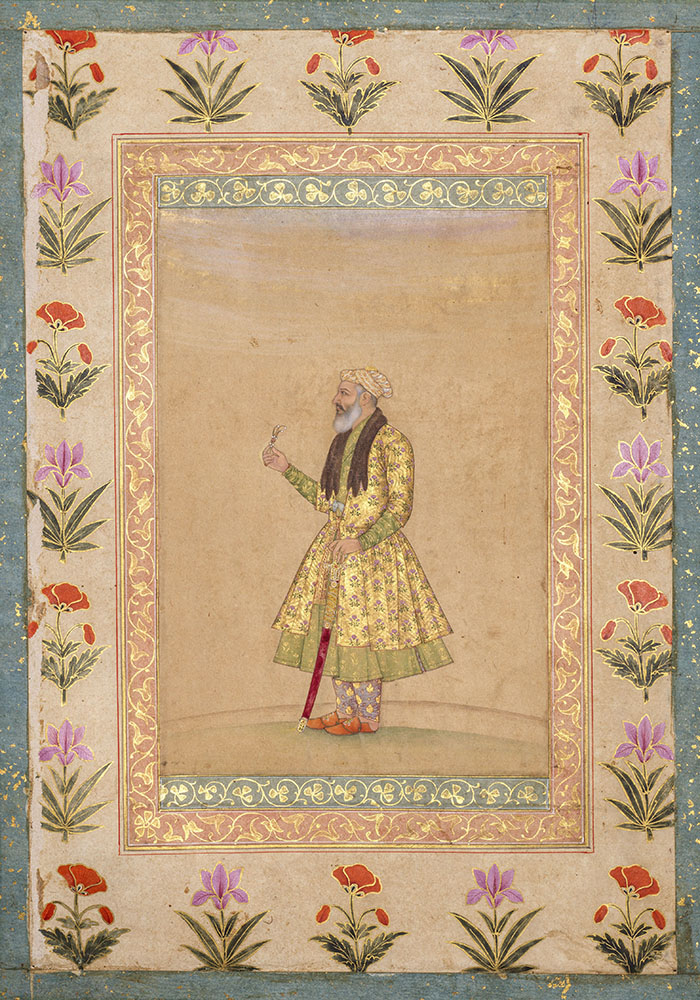
Opaque watercolour heightened with gold on paper. The subject is identified by a devanagari inscription on the reverse. Also on the back are Persian notations and a partially trimmed inscription in Deccani Hindi that contains a (purchase?) date of V.S. 1792/1735 AD. An elegantly dressed nobleman stands facing left against a plain background. Of special interest is the horse-headed jade dagger handle (khanjar) that protrudes from his gold brocade coat. The hilt of the khanjar is carved from light grey jade with grooves for the hand on the grip. He holds a gold, ruby and pearl turban ornament (sarpech) in his right hand. His left hand rests on the gold and enamelled talwar hilt of his sword, the long blade of which is sheathed in red velvet wrapped with gold brocade to the upper half, the chape resting on the ground next to his leather sandals. His left hand is painted with exquisite detail and elegant poise: a square jewelled ring on his third finger, an oval inscription ring on his little finger, and veins showing through the skin on the back of his hand. Completing his ensemble is a fur scarf around his neck that together with his warm layers of clothing suggest that this portrait was painted in the winter time. The landscape is lightly tinted with green in the gently rising ground on which he stands with wispy clouds in the sky above. The portrait is mounted on an album page with a floral border trimmed at the outer edges and surrounded with green and gold borders. Provenance: Spink and Son, London Published and Exhibited: Spink and Son Ltd., Indian Miniature Painting, Wednesday 25th November to Friday 18th December 1987, cat. no. 10. |