asianart.com | articles
Articles by Dr. Pratapaditya Pal
Download the PDF version of this article
and Some Remarks on the Famous “Ford Tārā”
© Pratapaditya Pal
September 02, 2025
It gives all of us at asianart.com great pleasure to present this article by Dr. Pal just days before his approaching 90th birthday.
(click on the small image for full screen image with captions.)
Part I
In Memoriam
However, there indeed was, a Ford in my future—not from the factory in Dearborn, MI, but from Baltimore, Maryland, in the form of a handsome and elegantly-attired gentleman, who was also a keen collector of art from India and the Himalayan countries of Nepal and Tibet. According to John, we met in 1967 in Boston when I joined the city’s Museum of Fine Arts, which at that time was considered to have the most distinguished collection of art from most major nations and cultures of Asia.

Fig. A: The Ford house Chinese room At our very first meeting, John invited me to visit the family home to see their collections. For a lonely bachelor from a large family, this was like manna from heaven. At the time, the Ford casa on Greenway in Baltimore was a multistoried Federal-style mansion furnished with Chinese furniture and Chinoiserie and cabinets filled with what seemed to me the largest assemblage of snuff bottles, formed mostly by his godfather Edward O’Dell (1901-1982) (Fig. A). Also, there was a more numerically modest collection of John’s objects from South Asia and the Himalayas, consisting of both sculptures and portable paintings. With the warm hospitality of the family, especially John’s mother—whom I always called “Mrs. Ford” and who was a virtuoso cook with a Southern flair—it did not take long for a lonesome Indian dove to enjoy the spicier gumbo rather than Boston beans.
Cuisine was also a principal reason for me to urge my family in Calcutta to find me a bride. Soon, they did, and by April of the following year, I flew home to return with my life’s partner: Chitralekha (aka Chitra). Both of us then continued to visit the Fords of Baltimore for home comforts. Late in 1969, I moved to sunny and balmy Los Angeles to take up a new position; two harsh Boston winters I thought were enough.
In the meantime, John, a patron of Baltimore’s prestigious Walters Art Museum (then known as The Walters Art Gallery), had arranged for an exhibition of his collection, scheduled for 1971. I was invited to curate it, which I gladly accepted.
The opening of the exhibition was a big event in both our lives, but, in retrospect, for John, it proved to be a life-changer. Like my own mother in India, John’s mother was concerned about John’s continued bachelorhood. After all, she herself was aging, and John was already in the fourth decade of his life.
As we stood together near the entrance of that exhibition at the Walters, greeting the guests, we simultaneously said, “Wow,” as a beautiful vision entered through the doors. Elegantly attired and exotically bejeweled, she was escorted by a man known to John. As she approached us, she stretched out her delicate hand and introduced herself. “I am Berthe,” with a strong French accent. I instantly realized that John was smitten and the rest is history, too long to narrate here.
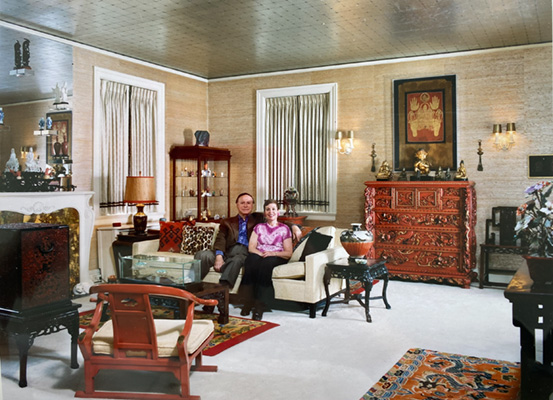 Fig. B: John and Berthe Ford in the second floor living room |
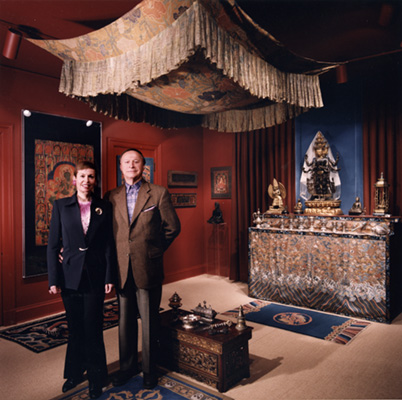 Fig. C: John and Berthe Ford in the Tibetan shrine room |
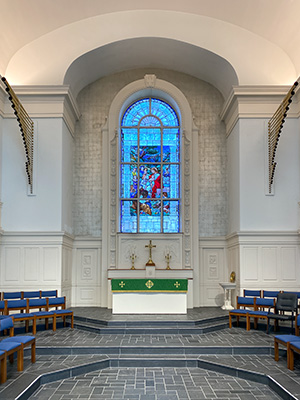 Fig. D: The Altar area of John's church |
In summation, John Ford was a versatile man: a bon vivant, a graduate of Johns Hopkins University and Maryland College of Art with a Bachelor of Fine Arts degree, a choir singer at his local church, a lifelong lover of classical music—both vocal and instrumental—a sensitive interior designer by profession (fig. D), a connoisseur of Asian art in general, an unstinting supporter of the Walters Art Museum, a founder of the International Snuff Bottle Society (which Berthe now chairs with equal passion and expertise), a generous donor, etc., etc., etc. (to be delivered with a slight southern drawl like the inimitable Rex Harrison in the film My Fair Lady, and not in my Indo-Anglo accent).
Om Shanti (Peace), Om Shanti, Om Shanti.[1]
Revisiting the Ford Tārā
(1)
This statement was made by John Ford to Valerie Doran in 1998, recorded in a long article titled “Recent Developments in the Tibetan Art Field” in the journal Orientations published from Hong Kong. [3] Later in another long article in 2001 in the same journal, Doran further contributed a second article in the form of an interview with both the Fords which is one of the most candid that I have read in the fields of Himalayan and Indian art.[4] In fact, already in the early 1950s when I was finishing high school in Darjeeling, we were encountering Tibetan refugees peddling both painted and metal artifacts from their homeland. A couple of years later at college in India’s capital New Delhi, we daily continued to see more Tibetan refugees selling their precious art objects on the pavements in posh localities to eke out a living.“I graduated college in 1960 and decided that I wanted to collect in my own areas and not compete with my parents. When I went to India I saw numerous Tibetan bronzes and paintings in New Delhi and Bombay … I had a quasi-religious feeling for the devotional aspect of the works – and also the idea that divinities could have sex intrigued me. I had previously been confronted with Buddhism in its most austere manifestation, and now in these passionate works there was the merging of the primary and the metaphysical.”[2]
It should also be recalled that after World War II, East Asia was a troubled zone, with the communist takeover in China, Japan’s preoccupation with recovering, the Korean war, etc. In fact, if I remember correctly, there was an embargo in force in the United States on imports of Chinese goods including art. As a result, the void was filled by the arts of South and Southeast Asia. So it was a propitious time for Americans to visit the newly emerging nations of Asia; particularly, South and Southeast Asia.
One of the first eminent Americans to realize the relevance of Asia after World War II was not a politician but John D. Rockefeller, 3rd (1908-1978), himself a major collector of Asian art, who after a journey across the continent in the 1950s at the behest of the American government, returned to found the Asia Society in New York City. Simultaneously he also established the JDR 3rd fund to support the cultural activities of the Society as well as the exchange of cultural and scholarly exchanges between Asians and Americans. One of the major purposes of the Asia Society was to organize and support exhibitions and to make Americans more familiar with both visual and performing arts of Asia.
It was because of these two Rockefeller organizations that I was able to make my own first trip to the USA in the summer of 1964 from Cambridge University to see the first “Art of Nepal” exhibition selected by the well-known Stella Kramrisch (1886-1993). I may well have briefly met on that visit both John Ford, as well as another budding collector of Himalayan art and our mutual friend Jack Zimmerman: both subsequently became two of the major American collectors of Himalayan material in the USA in the second half of the 20th century.[5]
More vivid is my memory of meeting the collectors/dealers Alice and Nasli Heeramaneck and of several visits to their townhome at 23, 83rd Street in Manhattan, a veritable mecca for Indian and Himalayan art. I also met Gordon Washburn (1904-1983), the first director of the Asia Society, who surprised me by inviting me to do the first Tibetan Art exhibition at the society’s galleries.[6] The other noteworthy person I met on that occasion was Eleanor Olson, curator of the Oriental Collections since 1938 at the Newark Museum which was already known for its extensive collection of art of the Himalayan cultures. Years later in the 1980s, both Alice and Eleanor would play important roles in the acquisition of perhaps the greatest Himalayan treasure now in the Ford collection, the early Tibetan painting of the Buddhist goddess Tārā which is not only of exceptional importance for the history of Tibetan painting, but also that of the early paintings of the Pāla period of Indian history (8th-12th c.).
Apart from the two catalogues of the Ford collection, mentioned in the eulogy in Part I, an essay by Eva Ray appeared in the 1986 Marg publication American Collectors of Asian Art. When she wrote that article, Eva Ray was associated with Bryn Mawr college but unfortunately since then I have lost contact with her. Her article provides substantial information regarding the early development the Ford Collection. Regarding his first show in 1971, she wrote:
The Walters was also significant for Mr. Ford in a very personal way. He met his future wife Berthe at the opening. She too was interested in Tibetan thangkas and had a collection of her own. Her interest in paintings has influenced and shaped the expansion of the Ford Collection in this area.[7]It is clear that their mutual interest in Tibetan and Indian paintings was yet another reason why John and Berthe bonded. By the time I was asked to organize the 2001 exhibition, it became clear how strongly Berthe had contributed to the expansion of the collection, not only of Tibetan paintings, but also from Nepal and the Indian subcontinent. It was indeed due to her encouragement and zeal, as we will see below, that the Tibetan masterpiece known as the “Ford Tārā” entered the collection.
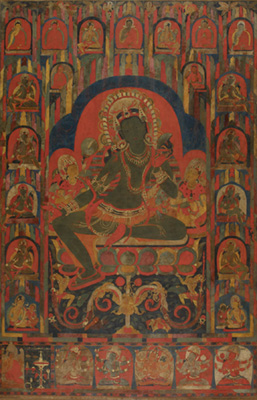
Fig. 1 This singular thangka was brought to my attention both by Alice Heeramaneck and the Fords almost simultaneously sometime in the 1980s. [Fig. 1] By the time I wrote the second catalogue of the Ford exhibition in 2001, it had become the most published object in their entire collection as the bibliographical references in that catalogue demonstrates. To my knowledge, the well-known Tibetan art historian Jane Casey alone has published it at least half a dozen times between 1994 and the present (see bibliography).
A Tibetan inscription on the lining of the brocade border at the back of the thangka provides us with a great deal of information which attests that it was rendered at the famous Reting monastery founded in 1057 by the master Dromtön (1004-63).[8] Dromtön was a principal disciple of the Indian monk-teacher Atiśa Dipańkara (982-1054), who left the subcontinent for Tibet at an advanced age and expired there. Apart from the fact that Atiśa was the key figure in the resurgence of Buddhism in Tibet, his personal patron deity was the goddess Tārā in the form known as “the one who delivers her devotees from the eight great fears of life” (asṭamahābhaya). Before her, Avalokiteśvara was the deliverer from such perils as we will see later in the article.
Only recently I learnt the full story from Berthe about how the Fords acquired the Tārā painting. Briefly, it first belonged to an art-dealer-cum-guru known popularly as “Rudi” who had a gallery in downtown Manhattan.[9] He sold the work to Eleanor Olson personally rather than to the Newark Museum.[10] Eleanor in turn sold it to Alice Heermaneck who offered it to the Fords. They, of course, did not know its past history at the time beyond Rudi, but, despite its poor condition, recognized it as an early Tibetan work. Its history and importance became clear when, after restoration, it was studied and published by the Tibetan art-historian Jane Casey in 1998. (Casey 1998). Most recently she has published it again in a collection of short articles, in the Rubin Museum’s Himalayan Art in 108 Objects. (Casey 2023)
Undoubtedly the most prominent decorative feature of the painting is the liberal use of the stylized rock formations which surrounds the shrine giving the impression of an enormous grotto. Although there are innumerable textual forms of Tārā included in the early c. 12th century compilation known as Sādhanamāla (Garland of Meditations), none mentions a mountainscape or cave as her habitat.
It is well known to students of Buddhist iconography that Tārā is a female version of the prominent male bodhisatva Avalokiteśvara and even regarded as his consort. However, noteworthy is that while icons of Avalokiteśvara generally carry the image of his parental Buddha Amitābha in his headdress, this Tārā has all five of them in the uppermost row, with Amoghasiddhi in the center, flanked by two bodhisatvas. One would think that like Avalokiteśvara, Tārā would have Buddha Amitābha, but her exceptionalism is indicated by her association with all five Buddhas.
Whether seated or standing, the hand attributes are usually similar for both deities: the right usually displays the gesture of charity or boon (varada) and the left holds a lotus flower. As will be discussed below, the gesture of the right hand of Tārā is different in this instance. Equally familiar is the fact that Lokeśvara is said to reside on the mythical Mountain Potaiaka. However, I am yet to locate a single literary description about Tārā’s habitat being a mountain or a cave among the scores that are compiled in the Sādhanamāla.
Rarely, however, is Avalokiteśvara in India—or for that matter the Himalayan countries and Southeast Asia—depicted in art in a rocky landscape, but he is seated on a rock representing a hill in East Asian art. Nevertheless, there is a glowing description of the abode of the bodhisatva in the eulogy of a text devoted to Tārā in the well-known litany of the goddess known as “The Eulogy of the 108 Names of the Noble and Regal Tārā.” [Āryatārābhāṭṭārīkā-nāmāshtottaraśatakastotra ] I quote the relevant verses translated into English by the renowned Buddhist scholar Edward Conze.[11] The translation by Conze is included in his edited book titled Buddhist Texts through the Ages. Conze does not identify the author but this beautiful litany is almost certainly that by the 7th century master Chandragomin:
The translation begins as follows:
Om. Homage to the Holy Tārā!
(1) The beautiful and delightful Potalaka is resplendent with various animals covered with manifold trees and creepers, resounding with the sound of many birds.
(2) And with murmur of waterfalls, thronged with wild beasts of many kinds, Many species of flowers everywhere,
…
(6) There the wonderful lord Avalokita, who labours for the weal of all beings,
(7) Dwelt, seated on the lotus seat
A great ascetic, full of friendliness and compassion,
(8) He taught Dharma at the great assembly of deities … [12]
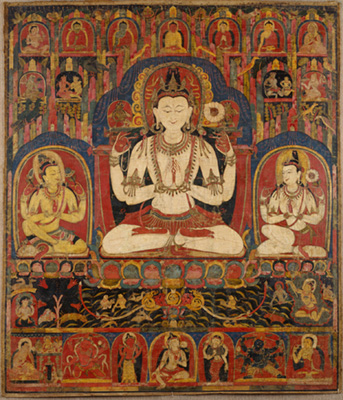
Fig. 2 After reading this flowery and poetic composition, I examined again another early thangka in the Ford collection depicting the Avalokiteśvara of the six syllables (Ṣhaḍakṣarī), in this case clearly shown in a rocky landscape [Fig. 2]. It too may well have been based on the eulogy under discussion in the context of the Tārā. In neither case is the name of the artist known, but he may well have been a disciple of the Indian master artist described as Āchārya Manu.[13] Incidentally, note that in this painting the goddess who sits on the left of Ṣhaḍakṣarī Lokeśvara is four-armed, of white complexion and called ‘Ṣhaḍakṣarī Mahāvidyā’ which means the “great knowledge of the six syllables,” which, of course, is the famous Oṃ Maṇi Padme Hūṃ, the most favorite chant of the Buddhist Tibetans.[14]
To return to the text, Avalokita then engages in a dialogue with the bodhisattva Vajrapani, and in response to Vajrapani's questioning whereby beings "can be freed from birth-and-death", Avalokita answers that this can be done by the intercession of
(13) "the mothers of the world, born of the power of my vow and understanding,"...
(14) "Like the risen sun to behold, shining like the full moon,
The Taras illuminate the trees with their Gods, Asuras and men,
(15) They shake the triple world, and terrify the Yakshas and Rakhshasas.
The Goddess who holds the blue lotus in her hands, says:
'Have no fear, have no fear'"[15]
Avalokita then continues with a long eulogy which not only includes the 108 names of Tara but describes further her forms as well as her qualities that could well have been used by the artist to render the Ford masterpiece.
She is called “joy of starlight, full of pity for all beings,” which of course is Lokeśvara’s own principal quality; she is the “daughter of the Sugatas,” [16] “heart of friendliness,” “endlessly immaculate,” “green in appearance.” She is said to labor for the weal of all beings and also, savior, and victor in battle (as Durgā is of the Hindus), also Māyā (the name of the Gautama Buddha’s mother, Kāli (also a Hindu goddess), Brahmāṇī, mother of the Vedas, etc. That she is called Kāli or the Black One is not surprising for it is generally known that she, the female form of Kāla (Time) and also the Black One, is common to both Buddhists and Hindus. Both Tārā and Kāli are also addressed as Shyāmā, the green one: green and black are interchangeable. However, to address her as “Brahmāṇī and the Mother of the Vedas” is most strange for an anti-Vedic system of faith.
Fig. 3 Even with a minimum knowledge of Hinduism, one will note that Tārā’s names and epithets are similar to those of the great Hindu goddess Durgā. It is also amazing that in tantric Hindusim almost all the major deities of both gender have similar litanies of 108 names.[17] Tārā is further called Girijā, daughter of the mountain, as is Durgā. In fact, Himalaya (the mountain range north of the subcontinent) is her father which is why she is also named Pārvatī (the mountain’s daughter). As we see in a much later painting from Indian Kangra in the Ford collection, a beautiful and familiar composition of the Hindu Holy family of Shiva and Girijā/Pārvatī seated below the more realistically snowcapped Mt. Kailash. (Fig. 3) (Pal, 2002, plate 48, p 115).
Curiously, the last name of Tārā in the litany of Chandragomin quoted above is described in the following distych:
(43) “Fearless, a Gautami, the worldly daughter of the holy Lokesvara.Gautamī is the feminine of the male Gautama, the given name of the historical Buddha, and yet she is also the daughter of Lokeśvara rather than a consort. Although, at one level, both the Buddhist and the Hindu theologists and polemicists were at loggerheads, throwing invectives at each other’s doctrinal differences, at the iconographic and ritualistic level of worship, there was considerable mutual borrowings and adaptations among the followers of the two faiths as is observable in Nepal even today.
Tara, infinite by the virtues of her names, she fufills all hopes.”
Chandragomin’s lyrical litany of the 108 names of Tārā is an example of a type of text common both in Hindu and Buddhist literature. One of the earliest Hindu texts of this type is the Devīmāhātmya, which likely was composed in the Gupta Age (C. 300-600) and incorporated in the Mārkaṇḍeya Purāṇa. Another popular text devoted to the great Hindu Goddess is simply called the Devīpurāṇa, popular in Eastern India and later than the Devīmāhātmya. All these are of course compilations and cannot be given a precise date or assigned to a particular author. However, we are better informed with both Buddhists and Jains where more texts can be associated with particular authors and dates. The most active period for the Buddhists seems to have been from the 7th century, with both Chandragomin and Sarahapāda, until the 12th century as discussed by the late Benoytosh Bhattacharya in the Sādhanamāla (Garland of Invocations) first published almost a century ago.[18]
The beautiful litany in praise of the 108 names of Tārā by the 7th century master Chandragom was translated into Tibetan by Atiśa himself. Around the same time, two other great authors and devotees of Tārā, according to the Tibetan sources, were of Indian origin. They were Kashmiri Sarvajñamitra and Śāśvatavajra, both of whom flourished before CE 1100.[19] At least two of the former’s eulogy of Tārā have survived, while ten of the latter. One of these refers to a form of Tārā called Mahācīna Tārā or The Tārā of Great China. This also reflects the belief among the Hindus that a form of Tārā was brought to India from Bhoṭadeśa, the land of Bhoṭas, or Tibet, while Mahācīna referred to China.[20]

Fig. 4
What is curious is that in about half a century almost since the appearance of the Ford Tārā in New York, no earlier thangka with landscape elements has been discovered. However, we know of one other work, a Kesi silk tapestry now preserved in the Hermitage Museum in St. Petersburg (Russia) that shows a familiarity with the Ford Tārā (Fig. 4). It is a much simpler work compositionally with fewer figures. Tārā is the same in the two works: her right hand displays the abhaya gesture and above her are all five seated Buddhas, two attendant deities depicted below the goddess are fierce and stand like guardians while a pair of serpent headed males support the stem of the lotus flower below her. However, the characteristic decorative motif consisting of the stave-like crystalline and stylized rock motif with some vegetation is also included but in a more muted manner. No doubt, the Tangut tapestry has been much simplified in this instance for technical reasons. However, there is no doubt that the influence must have come from the Reting monastery in some unknown way. Originating in Eastern India, the distinctive landscape elements obviously spread to both Tibet and Nepal (thanks to Acharya Manu?) during Atiśa’s visit and spread as far as Khara Koto, where the kesi was excavated.

Fig. 5
There were three known regions of India where stylized rock motifs are encountered in sculptures rather than paintings: the mountainous region of Kashmir and Swat Valley as early as the 7th century, Nepal Valley by the Lichchavi period (400-900) on stone sculptures and Eastern India by the time Atiśa went to Tibet to revivify the faith there. While the Kashmiri formula remained restricted to the Western Tibetan region, the East Indian form was familiar in the Kathmandu Valley and also in in Central Tibet, especially in paintings.
By 1500, however, both in Nepal and Tibet the artists were showing their own inventiveness as is seen in a unique thangka of about c. 1500 portraying the singing saint Milarepa (1040-1152) consisting of both the older multi-hued stave-like forms against snowy mountain ranges, no doubt representing Mount Kailash, the playground of Milarepa. (Fig. 5) The unknown artist of this beautifully composed and brilliantly colored thangka was obviously acquainted with the formulaic tradition of the age of Atiśa and Milarepa, but was also an innovative master, likely familiar with the Chinese tradition.
Thus, while the rocky landscape is appropriate for a painting of the Ford Tārā, what is curious is that I know of no other Tārā representation where the stave-like crystalline motif is given such prominence either in Tibet or Nepal. In the later spectacular Tārā, now at the Cleveland Museum (Fig. 6), she is seated in a grove of richly variegated and multihued trees arranged like a gigantic bouquet. The tree is called khadira in the text and catechu in English. Its only use in India that I know is that its bark is made into a paste, like that of sandalwood. While the latter is used only externally for its fragrance, the catechu paste is edible and is applied to counteract the otherwise burning sensation of the lime paste added of the paan or betel leaf, commonly chewed in South Asia with areca nut and other aromatics and, also, tobacco.[21]
 Fig. 6 |
 Fig. 7 |
While the depiction of Tārā in a “rocky” landscape is not common, it is certainly not inappropriate, as discussed above. However, no other painted version of the theme has come to light yet, either in Tibet or Nepal. What is even more curious is that the stave-like motif became an obsessive feature of Taklung lineage thangkas of high ranking lamas for which no iconographic reason is obvious. Here I illustrate just one example, that of the second abbot Kuyalwa and his lineage in the Ford collection as well. (Fig. 7) With their distinctive shapes and diverse coloring the motif does provide a nice decorative frame but with no apparent symbolic significance, as in the Ford Tārā.[22]
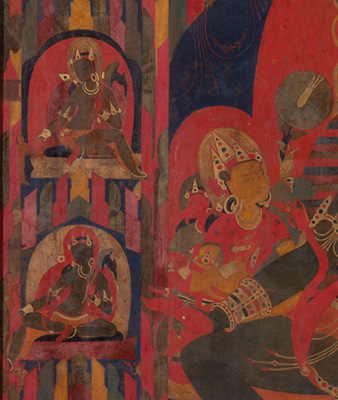
Fig. 8: Green Tārā
detail, right hand in abhaya mudra A final note must be provided for an error in early discussions of this outstanding and unique example of Tibetan painting. All the scholars who described this painting previously - myself included - accepted that the Sadhanamala description of the goddess as “displaying varada mudra with her right hand” accurately described the gesture in this painting. While in my earlier writings on the painting I didn't refer to the gestures of the goddess, I did not point out that clearly the right hand is not in varada mudra. In her 1998 Orientations article and her latest article, Jane Casey - who no doubt noticed the earlier error in other studies - suggested that “her right hand offers a gracious gesture of renunciation (shramana mudra)”. This “shramana mudra” can be found in several relatively modern lists of mudras, but it does not seem to appear in classical compilations. [23].
A more likely interpretation is that the gesture of Tārā's right hand is a version of the gesture known generally as abhaya hasta, denoting “have no fear”. What else could be more appropriate for the goddess who is addressed as “one who saves her devotees from the eight great perils,” following her creator Lokeśvara, who removes all our obstacles in our earthly existence, both on land and water? We see the same gesture in the two other Taras we have illustrated here, the Kesi silk tapestry now preserved in the Hermitage Museum in St. Petersburg (Russia) Fig 4, and the marvelous "Cleveland Tara" (Fig. 6), and we can add another, the exquisite sculpture of Tara previously in the Henss collection (Fig. 8 detail) [24]
We may recall the experience of the Chinese pilgrim Faxian’s (early 4th century) return journey home by ship from India when a severe storm overtook them and all his manuscripts and images were lost to the sea, despite his appeal to the bodhisatva Avalokiteśvara. Before Tārā, he was the deity of deliverance from the great fears of mundane lives.[25]
As a matter of fact, it is common for Hindus as well, certainly among Bengali-speakers, to utter the name “Tārā” before a journey of any kind. The Sanskrit word tārā or tārakā is used commonly to denote a star, and who does not know how important was the discovery of the “Northern Star” for safe navigation in the high seas as well as on land journeys?[26]
Ever since my childhood, I have always heard the elders mutter as a mantra as they go out the front door of the house, the Bengali expression: Jai Tārā Mā (“Victory to the mother Tārā”).
In conclusion, the Reting/Ford Tārā, which came to the west due to the tragic circumstances of the Chinese invasion and annexation of Tibet in 1949-50, still remains the earliest and clearest example of the interaction of Pala period Buddhist painting in eastern India and the subsequent efflorescence of Buddhist painting in Central Tibet due to the arrival of Atiśa, the great Indian monk of the Vikramaśilā monastery. It is not surprising that since then other early paintings in the same style have also emerged, among others contemporary portraits of Tibetan hierarchs including an impressive portrait of the great teacher himself (Fig. 9).[27] Of course, we do also have a smaller portrait of Atiśa above the head of Tārā on the right side of her head while on the other side is that of his chief Tibetan disciple Dromtön. While these are much too small, they remain among the earliest known depictions of the master and his disciple and close friend. It is curious how radically different a typical representation is in later Tibetan art (Fig. 10). It would be interesting for a scholar to explore the reason where and when this alternate image was invented. If the early Kadampa thanka in the Metropolitan Museum is painted from life when he was an octogenarian, for the Reting monastery, it was still idealized. But then why was this abandoned and replaced by what is clearly another imaginary and symbolical image?
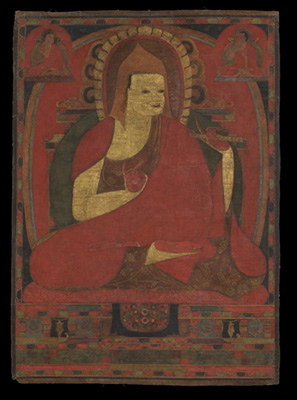 Fig. 9 |
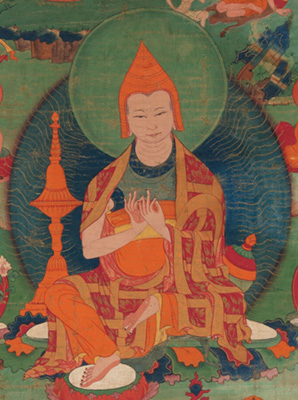 Fig. 10: 18th c Portrait of the Indian Monk Atisha (detail) |
As Chattopadhayaya writes, referring to the voyage to Tibet and the meeting of Dromton and Atiśa “It was miraculously predicted even before Atiśa left India, and it was engineered by the divine grace of Tārādevī.” [29] On Tara's instructions, Atiśa went to a small Buddhist temple in a designated place, and offered some cowrie shells on a maṇḍala before the image of Tārā. Suddenly “a yogini with locks flowing to her feet” appeared and Atiśa asked her if he should go to Tibet, and she told him to go and that he would meet and “be of great service” to Dromtön there, “and through him, to the whole country” .
In another source mentioned in an appendix of the book, we are told that when Atiśa was born in Vikrampur near the capital Dhaka of present-day Bangladesh to a royal family in 982 C.E., his parents heard music outside the palace and his mother “saw that something resembling a freshly bloomed lotus was falling in front of the baby and the baby’s face looked like that of Tārādevī.”[30]
As mentioned above, the meeting between Atiśa and Dromtön and their close relationship in Tibet was also predicted by Tārādevī. It is not surprising, therefore, that the two monks looking down at the goddess in the Ford Tārā should be Atiśa and Dromtön. While this is probably the earliest depiction of the two historical figures in Central Tibetan painting, they are too small to recognize their individual features. However, fortunately the early portrait now in the Kossak collection at the Metropolitan Museum of Art, N.Y. (fig. 9), presents us with a more accurate portrait of the Indian master.
A Postscript for Tārā article
Imagine my surprise when I came across a text called Tārābodhaya Utpātakathā, (no. 93, pp. 151-53) which literally means the stories about the troubles or impediments or dangers relieved by Tārā. The manuscript is written on traditional Nepali paper and was copied in the Newar era 819 corresponding to the year 1699 C.E., according to the brief colophon without the name of the composer of the text or that of the writer or copyist.
As is the case with the ca. 7th century text of Chandragomin of the 108 names of Tārā, the remover of the eight great fears, discussed in the article above, this text too begins not by invoking Tārā but Lokeśvara and his residence Potalaka. I quote below the beginning verse as read by Shastri:
Om namo Lokeśvarāya / śrīmat potalake ramye lokanāthaṁ prapṛicchati / mānavānāṁ hitārthāya tārādevī mahākripā //
This passage clearly states that for the good of mankind, Lokanātha who lives in Potalaka created the goddess Tārā out of his great compassion. This leaves us in no doubt that Tārā is the creation of Lokeśvara or Avalokiteśvara and the text Tārābodhaya Utpātakathā was a popular version of the more famous ancient text created in antiquity.
Interestingly, the earlier expression aṣtamahābhaya or “the eight great fears” is replaced here by the word utpāta, which, according to Monier Williams (p. 180) occurs as early as the Atharvaveda and means “a sudden event, an unexpected appearance; an unusual and startling event boding calamity, etc.” Incidentally, it is also a common expression in Bengali, and I often heard it uttered by our mother whenever we made a nuisance of ourselves in our childhood. In short, it is a colloquial term for an unexpected event such as an earthquake, flood, etc. The opening verses clearly state, following the earlier text, that Tārā was created by Avalokiteśvara, also known as Lokeśvara or Lokanātha, in his Potalaka paradise because of his unlimited compassion for the good of mankind.
According to Shastri, the colophon is īti srītābodhāye utpāta kathā samāpta // sambat 819. The slight error in the spelling of the name Tārā is clearly due to a misprint. Unfortunately, the colophon does not provide us with the name of the Nepali author of the new text. It would be interesting for a future scholar to read and translate the entire text.
Notes
[1] The above was written in a rush soon after John’s departure and for publication in the International Chinese Snuff Bottle Society’s journal, a copy of which I sent to Ian Alsop. He then expressed his desire to publish it in AsianArt.com for wider circulation for those interested in Asian art history for whom the second part below is added. It should be stressed at the beginning that I was never an advisor to John or Berthe after their marriage in the formation of their collection. As an old friend, they would on occasions consult me before buying an object or I may have, at times, brought one to their attention; largely, they formed their extensive and varied collection of art from the Indian subcontinent, Nepal and Tibet on their own. The memorial comments above have been illustrated with photographs provided kindly by Berthe Ford.
[2] Quoted from Doran 1998, p. 107. It should be noted as well that an early influence on John, apart from Edward O’Dell, was his close friend Cecil B. Rush of Baltimore who was keenly interested in Tibet and its culture.
[3]
Doran, Valerie 1998 : 99-107.
[4] See Doran, Valerie C. 2001. “The Evolution of Seeking: A Conversation with John and Berthe Ford.” Orientations 32, 7, pp. 81-88.
[5] While Jack Zimmerman and his wife Muriel also simultaneously began collecting the arts of both Nepal and Tibet, the Fords were broader in their taste in assembling the arts from the Indian subcontinent as well: not only religious arts of all periods, but both Mughal and Rajput painting. Ultimately, the Fords donated their collection to the Walters Art Museum to which John was devoted from his salad days. They also sold and donated a substantial group of objects to the Virginia Museum of Fine Arts in Richmond, VA. See Rice and Durham 2019 for a selection of the objects.
[6] While I had consciously selected the architecture of Nepal for my doctorate thesis at Calcutta university, my interest in Tibet and its culture had developed while at high school in Darjeeling when I had a large number of Tibetan friends and had a great Tibetan language teacher in Lobsang Lhalungpa who later wrote a great biography of the Tibetan saint Milarepa.
[7] Ray, Eva. 1986. “John Gilmore Ford (1934-)” in Pal 1986.
[8] The images of the two historical inscriptions on on the lining of the brocade border at the back of the thangka can be found in Jane Casey, “Tara Who Protects from the Eight Great Fears: On the Origins and History of an Early Tibetan Masterwork,” Project Himalayan Art, Rubin Museum of Art, 2023, http://rubinmuseum.org/projecthimalayanart/essays/tara-who-protects-from-the-eight-great-fears, Fig. 6 and 7.
The illustrations are
https://rubinmuseum.org/projecthimalayanart/wp-content/uploads/sites/2/essays/27/Object-027_Fig-6.jpg
And
https://rubinmuseum.org/projecthimalayanart/wp-content/uploads/sites/2/essays/27/Object-027_Fig-7.jpg
[9] Rudi’s full name was Albert Rudolph (1928-1973), but he was also known as Swami Rudrananda. A colorful personality, he was both an art dealer and a spiritual man with a devoted following. I did not know him personally and visited his gallery in downtown Manhattan. I am grateful to both my friends Arnold Lieberman and Ian Alsop for information regarding Rudi. See also, https://en.wikipedia.org/wiki/Rudi_(spiritual_teacher)
[10] Very likely the museum did not have the funds, or, by then, Olson had retired.
[11] Conze et al. 1964, pp. 196-202. Eva Allinger was the first scholar to correctly identify that the Ford Tārā’s iconography was based on Chandragomin’s text, but she did not refer to Conze’s translation of 1964 or discuss the topography of her habitat in the thangka. See Allinger 1995.
[12] Conze et al. 1964, p 196.
[13] Pal 2001, p. 228 for a discussion about this Indian master artist about whom nothing else is known. It is interesting that he was simply named Manu but characterized as a superior (ācārya) artist and may have been in Atiśa’s reference. It appears that nothing else has come to light about him since the last time of writing in 2001.
[14] See Pal 2001, p. 228-229 for a beautifully rendered thangka of the subject likely from the same atelier as the Tārā.
[15] Conze et al. 1964, p 197.
[16] The word sugata is of course a synonym of the Buddha and in this instance probably means the Buddhas of the Mahayana/Vajrayana pantheons. As a matter of fact, in Pala sculptures and in Tibetan painting, the five are often seen seated below the five Buddhas as is the case with the Ford Tārā under discussion.
[17] 108 is a highly significant and composite number as it has multiple divisions such as 1, 2, 3, 4, 6, 9, 12, 18, 27, 36, 54, and 108. This makes it useful in rituals, timekeeping, and cycles in both Hinduism and Buddhism. For instance, 108 prayer beads can be evenly split into smaller groups (like 12 sets of 9 or 9 sets of 12), for structured meditation.
I am indebted to Dr. Reeti Shimkhada for providing me with the explanation on the internet. Apparently the source is S.S. Gupta (2025—see bibliography and https://doi.org/10.1007/978-981-97-2465-9_10, personal communication 03/27/2025).
The similarity between Tārā and Durgā was first pointed out by D.C. Bhattacharya (1974), p. 45, n. 26.
[18] B. Bhattacharya 1968 (1923) Introduction for scores of descriptions of the goddess Tārā in different form.
[19] Sarvajñamitra, according to the Tanjur, was from Kashmir and composed the famous eulogy of Tārā called Sragdharāstotra and was active around 1050.
[20] This tradition may well have been a mythologization of the discovery of the magnetic needle of the compass and the directional importance for navigation by the Chinese at around this time, according to Joseph Needham (Sanskrit tārā) and the fact that the compass or magnetic needle was known in China by the 11th century CE. See Winchester 2008, p. 269 for a list of Chinese mechanical inventions through history.
[21] Betel leaf and areca nut chewing may well have been practiced earlier in Southeast Asia from where it was introduced to the Indian subcontinent. According to Homer-Williams 1979, p. 336, Khadira is Acacia Catechu (having a hard wood, the resin of which is use in medicine called catechu, Khayar, Terra Japonica) and occurs as early as the Rigveda and Atharvaveda. See also p. 443 the discussion of the Prākrit word tāmbula for the concoction or pān culture.
[22] Admittedly I have not seen the two volumes of Jane Casey’s recently published book on the Taklung thangkas mostly of lineages in case she has found a justification.
[23] Casey 1998, p 65, and 2023, pp. 132-35. While writing this article recently I sent an email to her asking for a Sanskrit or Tibetan source for the gesture called śramana, and she agreed that there was none known to date.
[24] The Henss collection Tara was sold in 2022 in Bonhams New York. In the catalogue essay, the mudra was described as “While most representations of the goddess depict her right hand in either the symbolic gesture (mudra) of reassurance (abhaya) or generosity (varada), here she gently extends a downward facing palm in a gesture of blessing and providing sanctuary. This special iconography is reserved for depictions of a central shrine image of Tara Who Protects from the Eight Fears (Ashtamahabhaya Tara).” see https://www.bonhams.com/auction/27510/lot/305/a-gilt-copper-alloy-figure-of-green-tara-nepal-early-malla-period-13th-century/
[25] By the 11th century likely Tārā served the same purpose as is clear from the text of the Tārā litany discussed above.
[26] See Winchester 2008, 269, compass, magnetic needle, A.D. 1088.
[27] See Steven Kossak, Two Kadampa Portraits in the Metropolitan Museum of Art: a re-valuation (forthcoming). Fortunately, Kossak had sent me his manuscript recently and so this references in advance.
[28] Chattopadhyay (1967, reprint 1981).
[29] Chattopadhyay (1981): p. 357.
[30] Chattopadhyay (1981): 405.
Bibliography
Allinger, Eva. 1995. “The Green Tārā in the Ford Collection: Some Iconographical Remarks.” in South Asian Archaeology 1995. Proceedings of the 13th Conference of the European Association of South Asian Archaeologists. Vol. 2. Eds. R. Allchin and B. Allchin. 665-71. Science Publishers, Inc. and New Delhi and Calcutta: Oxford and IBH Publishing Co.
__________. 1998. “The Green Tārā in the Ford Collection: Some Stylistic Remarks.” In The Inner Asian International Style 12th-14th Centuries. Proceedings of the 7th Seminar of the International Association for Tibetan Studies, 1995. Vol. 7. Ed. D.E Klimburg-Salter and E. Allinger, 107-19. Vienna: Verlag der Österreichischen Akademic der Wissenschaften.
Banerjea, J.N. 1956 (2nd Ed.). The Development of Hindu Iconography. Calcutta, University of Calcutta.
Behrendt, Kurt. 2024. Mandalas: Mapping the Buddhist Arts of Tibet. New York: Metropolitan Museum of Art
Bhattacharyya, Benoytosh. 1958 (2nd Ed.). The Indian Buddhist Iconography. Calcutta: K.L. Mukhopadhyay.
__________. 1968. Sādhanamālā, 2 vols. Baroda: Oriental Institute.
Bhattacharyya, Dipak Chandra. 1974. Tantric Buddhist Iconographic Sources. New Delhi: Munshiram Manoharlal Publishers Pvt. Ltd.
Bhattacharyya, Dipak Chandra. 1978. Studies in Buddhist Iconography. New Delhi: Manohar Book Service.
Casey, Jane. (Singer, Jane Casey.) 1988. “An Early Tibetan Painting Revisited: The Ashtamahābhaya Tārā in the Ford Collection.” Orientations 29, 9: 65-73.
__________. (Singer, Jane Casey.) 1994. “Painting in Central Tibet ca. 950-1400.” Artibus Asiae 54, 1/2:87-136.
Casey, Jane. 2023. “On the Origins and History of an Early Tibetan Masterwork” in Debreczeny and Pakhoutova, 2023, 132-135.
Chattopadhyay, Alaka. 1981 (reprint). Atiśa and Tibet. Delhi: Motilal Banarsidass.
Conze, Edward (ed.). 1964. Buddhist Texts Through the Ages. New York, Harper and Row.
Debreczeny, Karl and Elena Pakhoutova (eds.). 2023. Himalayan Art in 108 Objects. Rubin Museum of Art in association with Scala Arts Publishers, Inc.
Doran, Valerie C. 1998 October. “Recent Developments in the Tibetan Art Field.” Orientations 29, 9: 99-107.
Doran, Valerie C. 2001. “The Evolution of Seeking: A Conversation with John and Berthe Ford.” Orientations 32, 7: 81-89.
Kossak, S.M. and J.C. Singer. 1998. Sacred Visions. New York: The Metropolitan Museum of Art.
Monier-Williams, Monier. 1979 [1899], A Sanskrit-English Dictionary. Oxford: at the Clarendon Press (Oxford University Press).
Pal, Pratapaditya (ed.). 1986. American Collectors of Asian Art. Bombay (now Mumbai): Marg Publications.
__________. 2001. Desire and Devotion: Art from India, Nepal & Tibet in the John and Berthe Ford Collection. Baltimore and London: The Walters Art Museum and Phillip Wilson Publishers, Ltd.
__________. 2003. Himalayas: An Aesthetic Adventure. Chicago: The Art Institute of Chicago in association with the University of California Press.
Ray, Eva. 1986. “John Gilmore Ford (1934-)” in Pal 1986.
Rice, John Henry and Jeffrey S. Durham. 2019. Awaken: A Tibetan Buddhist Journey Toward Enlightenment. Richmond, VA: Virginia Museum of Arts.
Articles by Dr. Pratapaditya Pal
asianart.com | articles