asianart.com | articles | Chinese version of this article
Articles by Amy Heller
Download the PDF version of this article
© Amy Heller
December 06, 2025
This article was written in 2022 for a bilingual catalogue of seven exceptional works of art that had been loaned by the Zhiguan Museum in Beijing to the Rubin Museum in New York. This catalogue was published in October 2023 as a magnificently produced volume in a very small edition: 妙相梵宗 / Sculptures from the Sacred Land, Edited by Luo Wenhua and Li Hongwei 罗文华, 李宏伟. As this volume is quite difficult to find or obtain, we are publishing the article here on asianart.com as well.
(click on the small image for full screen image with captions.)
I. The physical appearance and historical context of the Vajrasattva sculpture.
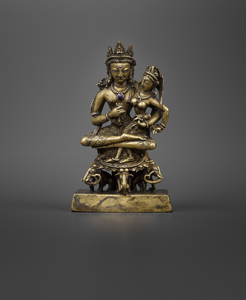
Fig. 1A This exceptional sculpture of the Buddha Vajrasattva and Vajrasatvamika [1], his female counterpart, represents the enlightened couple in the body of enjoyment, the Sambhogakaya, where they are crowned and adorned with jewellery and regal apparel as befitting the Adi-Buddha, the absolute supreme Buddha, a transcendent glorified Buddha. Here Vajrasattva and Vajrasatvamika are the epitome of the Kashmiri aesthetic of ca. 1000 AD: we may observe the precision and technical mastery of casting for the smooth modelling of their bodies with perfect proportions, the elegant position of the legs of Vajrasattva enclosing the legs of the goddess, the emphasis on inlay of silver (for their large almond-shape eyes and circular urna) and copper (for their bow-shaped mouth and their prominent nipples), the beaded jewellery and garments of Kashmiri royalty and aristocrats showing delicate attention to detail of the fabric patterns.
In the Vajrayana school of Buddhism, in the category of texts called the Yoga tantra, there is a schematic organization in relation to Five Buddha families, where the Buddha Vairocana (the Resplendent one) is central surrounded by a Buddha in each of the cardinal directions: Amitabha at west, Akshobhya at east, Ratnasambhava at south and Amoghasiddhi at north. In the Supreme Yoga tantra, a higher category of texts reserved for the more spiritually accomplished, rather than Vairocana, the Buddha Akshobhya (the Imperturbable one) is positioned at center. His support is the elephant. The presence of the three docile elephants (with silver inlay for their eyes) which uphold the lotus pedestal on which Vajrasattva is seated as he carries Vajrasatvamika, this is a reminder of Vajrasattva's spiritual relation with Akshobhya, whose small seated figure is represented in the central panel of Vajrasattva's crown. The other four triangular panels also have small representations of the other four Buddha of the Five Families. Vajrasatvamika's crown has only three triangular panels, each with three small vertically aligned jewels. Her head is also adorned by the distinctive veil worn at the back of the head by noble Kashmiri ladies and goddesses, the tips of the veil touch her shoulders. [2] The crowns of both Vajrasattva and Vajrasatvamika have beads of pearls surrounding each panel, and the hairlines of both figures show small curls with a middle part at center of forehead; these as well as the long veil of Vajrasatvamika and the geometric patterns of the fabric of the dhoti are all distinctive Kashmiri esthetic features which are characteristic of the Bodhisattva and offering goddesses of the stupa made in 1025 AD at the Tholing monastery, the royal monastery of the Guge Kingdom in honor of the memory of Yeshe Od, the sovereign of the Guge kingdom who was responsible for the revival of Buddhism ca. 1000 AD. (Figure 1, Figure 2, Figure 3). As they had evolved by the late 10th to 11th century, the Kashmiri images, both sculpted or painted, have slender yet robust and vigorous youthful bodies, with accentuated pectoral and abdominal muscles. The muscles of the long legs are unflexed with spherical kneecaps; the faces are rounded with almond-shaped eyes open to reveal the pupil (silver inlay set in tar to form a pupil in sculpture). The forehead usually has a broad hairline, often with a central parting and the hair is then coiled in a high chignon with locks cascading to the shoulders. Costumes alternate between simple monastic robes or more ornate, the dhotis patterned in minute geometric or floral motif fabrics, often in stripes (in copper or silver inlay in sculpture). The goddesses (and female donors) often wear a short sleeve, high-waisted blouse sensuously open to reveal their narrow waist and navel. The silhouette of a veil is often indicated behind their crowns formed of three isoceles triangles surrounded by a beading of gold or pearls or alternatively with three crescents, each encircling floral or geometric jewels.
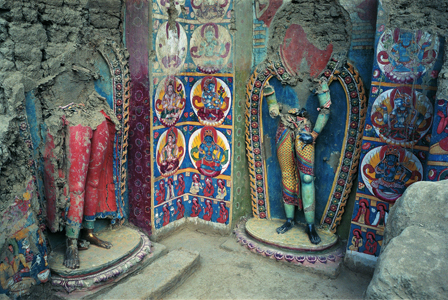 Fig. 1 |
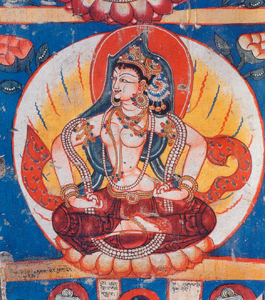 Fig. 2 |
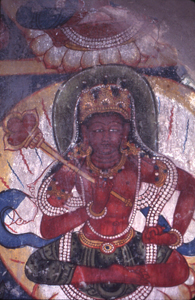 Fig. 3 |
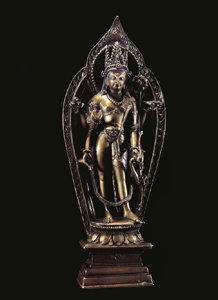 Fig. 4 |
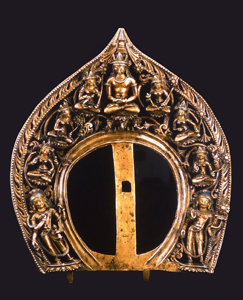 Fig. 5 |
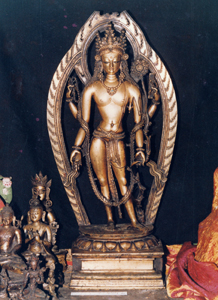
Fig. 6 Before continuing the discussion of this series of sculptures with three elephants as vahana, it is pertinent to return briefly to the standing sculpture of the four-arm Avalokiteshvara and its historical attribution by inscription to the context of Tholing in the eleventh century (Figure 6). This magnificent sculpture of Avalokiteśvara is now in Kamru monastery, Kinnaur, India, but local tradition says it originally came there from the Tholing monastery (Singh 1994:106-110). The image wears a highly ornate beaded crown of triangular isoceles panels replete with a seated Amitābha, as well as earrings, bracelets, necklace and double – strand, beaded belt. This sculpture bears a dedication inscription which explains its consecration by Viryabhadra, one of the Kashmiri pa ṇḍ itas who collaborated on translations with Rinchen Zangpo at Tholing (Heller 2008: 110). Texts bearing their joint signature are included in the Tibetan Buddhist canon. By virtue of their life-span, this sculpture too would have been produced in Tholing approximately between 1025-1050/60. This sculpture was dedicated to honor the memory of Smer lon Sherab gyal tshan (Smer blon shes rab rgyal mtshan) by his wife and children, as one of three sculptures of the "Three Great Protectors", the Three Great Bodhisattva, Rigs sum gonpo (Rigs gsum mgon po), viz. Avalokiteśvara, Mañjuśrī and Vajrapāṇi (Heller 2008: 107-116). There are numerous stones inscribed with names of the Smer family, including - several individuals and three ministers at the Alchi bridge, indicative that they were influential there (Takeuchi 2012, plates 11, 12, p. 54)i. Although their precise role as officials at Alchi and as ministers or emissaries serving the Guge kingdom remains to be determined, the Smer clan was sufficiently important to commission such a remarkable sculpture at Tholing and have the rituals performed by the illustrious paṇḍita Viryabhadra in mid-11th century.
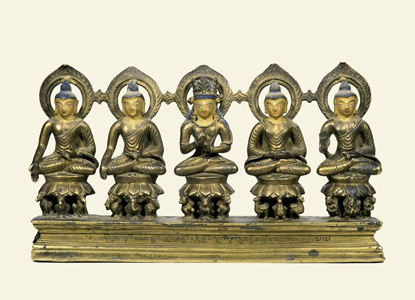
Fig. 7 In the context of the the sculptures of Vajrasattva and Vajrasatvamika and the Buddha of the aureole which both have their lotus pedestal resting on the three elephants as vahana, it is very important to discuss a sculpture now in the collection of the Potala Palace which exhibits this special vahana and has an important royal dedication inscription of the 11th century (Figure 7). As described by Ulrich von Schroeder, this rare icon is cast in the late Kashmiri style.[11] Here the Buddha of the Five Families are each represented on a simple lotus, seated in anthropomorphic aspect supported by the group of three characteristic animal vahana. The second from the left is the Buddha Akshobhya, identified by the group of elephants below and his characteristic gesture with his right hand forming the mudra of bhumisparsha, "touching the earth". The Potala sculpture represents Vairocana as the central Buddha with the regal garments, crown and jewelry of the Sambhogakaya "body of enjoyment, similar to the present sculpture of Vajrasattva. The four other Buddha have no crowns; instead each has the high spherical usnisha. All four wear monastic robes. The faces of the Five Buddha are painted with cold gold and pigments. The base of the scullpture has an inscription in Tibetan language which has been studied and translated by David P. Jackson, as follows:
"On the front of the pedestal is a dedicatory Tibetan inscription of two lines in dBu can script:
//rigs lnga'i sangs rgyas / rnal 'byor dge slong lha'i byang chub kyi mchod gnas//.
The Buddha of five lineages, the object of worship of the meditation monk Lha'i Byang chub". [12]
Von Schroeder's analysis is cogent and important, thus we paraphrase in full. According to the Tibetan inscription, this image was revered by Lha'i Byang chub (his name literally means "the perfect purified one"). The honorary title Lha may indicate that he was a member of the royal family. The expression "lha btsun" (royal monk) occurs as a prefix to the names of several rules of the Guge kingdom. The king Khor re became a monk and thereafter was known as Lha bla ma Yeshe Od or also as Bla ma Lha btsun Byang chub sems dpa Yeshe Od. [13] Yeshe Od's two sons Nagaraja and Devaraja also became monks. It is also possible that the inscription refers to a grand-nephew of Yeshe Od named btsun pa Byang chub Od, who was responsible for the renovation of the Tabo Assembly hall of Tabo monastery in 1041-1042.
Due to these criteria, a clear chronological context of the early eleventh century and royal commission may be undoubtedly established for the sculpture of the Buddha of the Five families, with the very distinctive three elephants beneath the lotus pedestal as is also found in the present sculpture of Vajrasattva and Vajrasatvamika (Figure 1-2).
II. Iconography and Ritual
In terms of the iconography, as Adi-Buddha, Vajrasattva presides over the five Buddha families, which explains why each of the five triangular leaves of his crown has a small seated Buddha within the panel of the crown. The faces of Vajrasattva and Vajrasatvamika are calm and serene, and a note of joy is perceived due to their gentle smiles. Vajrasattva holds the vajra scepter in his right hand positioned over his heart, while Vajrasatvamika holds the vajra in her right hand positioned on Vajrasattva's shoulder. The vajra is a symbol of the indestructible nature of Buddhist teachings, it thus conveys a sense of powerful strength and brilliance, like a diamond scepter. It is understood to represent the masculine principle (Robert Beer 2003:87). The vajra is complemented by the bell, which represents the feminine principle of the 'Perfection of Wisdom'; together the vajra and bell symbolize the indivisible perfect union of wisdom and the skilful means of generosity coupled with compassion to reach the state of the Enlightened mind. Vajrasattva holds the bell with the long fingers of his left hand at Vajrasatvamika's hip, while she holds her bell beside Vajrasattva's left wrist. Despite the difference in scale as she is smaller, their depictions and positions are so complimentary that their chests barely touch, with the lapis lazuli still present in Vajrasattva's necklace while Vajrasatvamika's precious stone has been lost over time.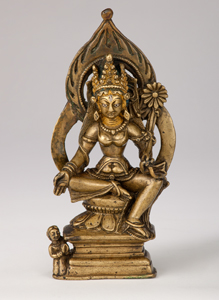
Fig. 8 A fragment of a nimbus remains at the level of Vajrasattva's shoulders, the upper portion has broken . At the level of the lotus pedestal, the feet of Vajrasatvamika are almost touching a double beaded strand with large oval medallion at the center of the pedestal above the head of the central elephant. At the back of the lotus pedestal, this double strand of beads is not continued, instead there is a rectangular plinth which is lacking all decoration. Below this plinth, one may observe two broad petals which have an overlay of two smaller scale copper petals. This distinctive broad lotus petal with two smaller petals as an upper tier has been attributed by Pratapaditya Pal to tenth century Kashmir sculptures such as Ushnishavijijaya, Doris Wiener Gallery, no. 70 in Bronzes of Kashmir, Guhya- Manjuvajra, Pan-Asian Collection, no 57, Pal, 1975. The plain vertical section of the base and the horizontal plinth are characteristics observed in sculptures attributed to either Kashmir or Western Tibet, ca. 1000 AD (Figure 8). This fine sculpture of Tara has a distinctive iconography, where the asana is the vamardhaparyanka, with the left leg pendant, precisely the opposite of later Tibetan representation of Green Tara who is seated in the lalitasana (right leg pendant). The sculpture was initially attributed to the Kashmiri artists active in Western Tibet by von Schroeder in 2010 and Béguin in 2013, and it is now attributed to Kashmir by the Alain Bordier Foundation. [14] The Aureole with Buddhist Deities (Fig. 5) indeed confirms the presence of Green Tara in Kashmiri sculpture in different iconographic representations than later found in Tibet. Moreover, also the garments and flat hat of the male donor at her feet correspond closely to the donor at the feet of Avalokiteshvara with six arms, attributed by Pratapaditya Pal to Kashmir, in the period before the Queen Didda inscribed Avalokitshvara. [15] The very tall triangular panels of the crown, the very smooth modelling of the body and lotus pedestal on rectangular plinth also recall the scupture of Trailokavijaya attributed by Pal to 10th century Kashmir. [16] Thus the present attribution of this Tara sculpture to Kashmir may be understood in context.
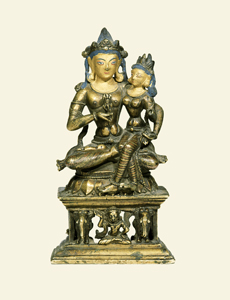
Fig. 9 In the knowledge of the present writer, the iconography of the present sculpture of Vajrasattva and Vajrasatvamika is unique. Only one similar sculpture of Vajrasattva with consort has been identified by Ulrich von Schroeder, in the collection of the Potala Palace in Lhasa (see figure 9). However, there are several distinctions between the Vajrasattva of the Zhiguan Museum and the Vajrasattva of the Potala collection. The present Vajrasattva is seated in the sattvaparyanka asana of royal ease, while the Potala statue is in full vajraparyanka, so called "lotus" position. In the Potala sculpture collection, the panels of the crown are damaged and only one fragmentary Buddha remains on the central panel. Due to his mudra of dhyana, meditation gesture, it is probable that the Buddha of the crown was Vairocana in his aspect "Abhisambodhi", ie. perfect enlightenment where he makes the gesture of meditation, dhyana mudra. Also, the faces of the male and female of the Potala sculpture are lacking the urna. The differences in the asana and the lack of urna may possibly indicate that the Potala sculpture represents Vajrasattva as the head of the 16 Bodhisattvas, while the present sculpture of Zhiguan museum clearly represents Vajrasattva as the Adi-Buddha with Vajrasatvamika as his consort. The rectangular base of the Potala sculpture has two elephants, which of course recall Akshobhya, who is represented at the back of the head of the Potala sculpture of Vajrasattva, but the front of the crown only has 3 panels. The casting and modeling are far less sophisticated, particularly the awkward arm positions. Von Schroeder has attributed the Potala sculpture to Kashmiri schools in western Tibet, 10th/11th century. In terms of refinement of technical mastery and clear iconographic context, the Potala sculpture is a different level of esthetics and commission than the present Vajrasattva and Vajrasatvamika of the Zhiguan Museum.
In terms of ritual, the present small sculpture of Vajrasattva and Vajrasatvamika seated together on their lotus above the base with 3 elephants, rather than a multiple casting on a rectangular platform such as the Buddhas of the Five Families, is understood to indicate a sculpture which was used within a ritual of a mandala. While the exact construction of the mandala remains to be determined, the different sectors of the mandala - the Buddha, the Bodhisattva , the goddesses, the protective deities - have all been identified whether in sculpture or in painted panels. [17] The iconography has parallels with contemporary monuments of western Tibet of the late 10th to 11th century.
For the Vajrasattva and Vajrasatvamika, the metallurgical analysis of leaded brass of the present sculpture confirms Kashmiri provenance rather than western Himalayas, whether cast in Guge by Kashmiri artists or cast in Kashmir, according to Chandra Reedy, Himalayan Bronzes, "The technical study clearly upholds Kashmir as the most probable region of origin". [18]
III. Conclusion
Since the studies of Giuseppe Tucci, in this vast territory, under the impetus of the royal lineage governing the kingdoms of Western Tibet and the Western Himalayas, it is clearly established that Buddhist paṇḍitas of several nationalities and several schools of Buddhism were invited to clarify and translate the Buddhist teachings into Tibetan (see Tucci 1988 [1932]: 37–49); Kashmiri artists were invited to Tholing as were also some artists from Nepal (Vitali 1996: 263), even artists from Magadha (Vitali 1996.: 313) to produce sculptures and mural paintings to honor the newly established Buddhist sanctuaries and monasteries. The great esteem by the royal lineage for the Kashmiri esthetic and their repeated commissions to Kashmiri artists leave no doubt. The present sculpture of Vajrasattva and Vajrasatvamika help us to contexutalize the commissions of royal sculptures in Tholing, capital and principal monastery of the Kingdom of Guge, during the period from ca. 1000 AD to 1050. Due to the dedication inscriptions, we thus come one step further in the confirmation of the presence of Kashmiri artists in Tholing and understanding the royal commissions they received during this period.To conclude, the esthetic and technical analysis of this sculpture indicate Kashmiri provenance in the late 10th to early 11th century during the period of the revival of Buddhism in the Guge kingdom at the behest of the sovereign Yeshe Od and his family. This remarkable sculpture of the Adi-Buddha Vajrasattva and his consort has been examined in context with the sculpture of royal commissions as identified by dedication inscription such as the Buddha of the Five Families, and the analogous Aureole with Buddhist deities. Vajrasattva and Vajrasatvamika exude such esthetic perfection and casting prowess that this sculpture too may well understood as a royal commission of the Guge kingdom.
Footnotes:
1. Vajrasattva as original spelling should be Vajrasatva, and the goddess is named Varjasatvamika, according to G. Bhattacarya cited by Pratapaditya Pal, 2016. Here for convenience to the general reader, the form Vajrasattva is maintained. Von Schroeder (2001: 154) has postulated the name of the goddess as Vajradhatvishvari, however this name is given when Vajrasattva has three faces and six hands according to the Nispannayogavali text 2, cited by M.-T. de Mallmann, 1986: 420.
2. See Pratapaditya Pal, Bronzes of Kashmir, 1975, plates 51 a,b Sugatisamdharshana Lokeshvara's two female companions wear the veil, as well as pl. 67 Prajnaparamita, pl. 68 Dhanada Tara ( both goddess and donor wear veil), pl. 69 Dhanada Tara.
3. According to the biography of Rin chen zang po, Yeshe O's royal chapelain, 32 Kashmiri artists came to Tholing to honour the request of Yeshe O. See David Snellgrove’s translation of the biography of Rin chen zang po in The Cultural Heritage of Ladakh, vol. 2, Warminster, Aris and Philips Ltd, 1980: 92.
4. Roberto Vitali, The Kingdoms of Guge-Pu.hrang, 1996: 111.
5. Pratapaditya Pal, Himalayas an Aesthetic Adventure, 2003: 128. "79 Aureole with Buddhist Deities", Western Himalayas or Western Tibet, 10th century. Bronze with silver and pigment, h. 29 cm, Private Collection Switzerland.
6. See Amy Heller, Preliminary remarks on the donor inscriptions and iconography of an 11th-century mchod rten at Tholing 2010: 58-61 discussion of different aspects of Vairocana during 8th -11th century.
7. Notably at Tabo Assembly Hall in the sculptural mandala dated 1041-1042.
8. This gesture is identified as per the discussion of Pratapaditya Pal, op. cit. 2003:128.
9. Pratapaditya Pal, op.cit. 2003: 128 and Pratapaditya Pal, op.cit. 1975: 146, 51 a, b, Sugatisamdharshana Lokeshvara, Kashmir, A.D. 980-1003, Sri Pratap Singh Museum, Srinagar.
10. Pratapaditya Pal, op.cit. 2003: 128.
11. Ulrich von Schroeder, Buddhist Sculpture in Tibet, 2001: 138, Plate 33.
12. D.P. Jackson, in Ulrich von Schroeder, ibid, 2001: p. 138.
13. Cristina Scherrer-Schaub, "Was Byang chub sems dpa' a Posthumous Title of King Ye shes 'od? The Evidence of a Tabo Colophon". 1999: 207-225.
14. Personal communication: 29 November 2021.
15. Pratapaditya Pal , op.cit. 1975: 144. No. 50 Sugatisamdharshana Lokeshvara Kashmir, 10th century. h. 14.1 cm, Pan-Asian Collection.
16. Pratapaditya Pal, op.cit. 2003: 126, 78 God Trailokavijaya.
17. Pratapaditya Pal 2003: 132, 83 "Buddha Amoghasiddhi" and 84 "Goddess" and 2003:144, 93 "Gods of the Chakrasamvara Mandala" and 94 "Gods of the Chakrasamvara Mandala."
18. Chandra Reedy 1987: 172.
Previously published:
1. Pratapaditya Pal, 1978. The Sensuous Immortals, p. 56, no. 29, Vajrasattva and consort, Kashmir, 11th century (Pan -Asian collection).
2. Ulrich von Schroeder, 1981. Indo-Tibetan Bronzes, p. 126, Fig. 20 C Kashmir or Spiti, 11th century. (Pan-Asian collection).
3. Deborah Klimburg-Salter, 1982. The Silk Route and the Diamond Path, p. 107, plate 38, Kashmir, 11th century (Robert H. Ellsworth, Ltd).
4. Michel Postel, Armand Neven, Kirti Mankodi, 1985. Antiquities of Himachal, p. 82, Akshobhya-Vajrasattva and Mamaki, Gilgit or Lahul, late 9th-early 10th century.
5. Chandra Reedy, 1997. Himalayan Bronzes, p. 172 item: Kashmir 92
(Robert H. Ellsworth, Ltd).
6. Christie's Auction 9390 Indian and Southeast Asian Art. 22 March 2000.
Lot 14. "An Important Bronze Figure of Vajrasattva and Consort", Kashmir,
11th century.
7. Pratapaditya Pal, 2016. Revisiting a Kashmiri-Style Buddhist Image of
Vajrasatva with Consort, Kashmir, ca. 1000 A.D. asianart.com September
19, 2016. https://www.asianart.com/articles/vajrasatva/index.html
Additional Bibliography:
2. Gilles Béguin, 2013. Art Sacré du Tibet, Collection Alain Bordier. Paris: Findakly.
3. Marie-Therèse de Mallmann, 1986, Introduction à l'Iconographie du bouddhisme tantrique, Paris: Adrien Maisonneuve.
4. Amy Heller, 1999. Tibetan Art, Milano: Jaca Book, Wappinger Falls (UK) Antique Collectors Club.
5. Amy Heller 2008. “Observations on an 11th century Tibetan Inscription on a Statue of Avalokite vara,” Revue des Etudes Tibétaines 14 (2008): 107-14. (reprint in 2009, Tibetan Studies in Honor of Samten Karmay, ed. Françoise Pommaret and Jean-Luc Achard (Dharamshala: Amnye Machen Institute, 2009), 107-14).
6. Amy Heller, 2010. "Preliminary Remarks on the Donor Inscriptions and Iconography of an 11th-century Mchod rten at Tholing" in E. Lo Bue and C. Luczanits, eds. Tibetan Art and Architecture in Context, Proceedings of the 11th Seminar of the International Association for Tibetan Studies, Andiast: International Institute for Tibetan and Buddhist Studies GmbH. 2010: 43-74.
7. David Paul Jackson, "Translation and reading of the inscription" in Ulrich von Schroeder, Buddhist Sculptures in Tibet, vol. I. 2001, p. 138.
8. Pratapaditya Pal, 2003, Himalayas an Aesthetic Adventure, Art Institute of Chicago.
9. Pratapaditya Pal, 1978. The Sensuous Immortals, Cambridge: The MIT Press.
10. Pratapaditya Pal, 1975. Bonzes of Kashmir, Graz: Akademische Verlag.
11. Chandra Reedy, 1997. Himalayan Bronzes Technology, Style and Choices. Newark: University of Delaware Press. London: Associated University Press.
12. Cristina Scherrer-Schaub, 1999. "Was Byang chub sems dpa' a Posthumous Title of King Ye shes 'od ? The Evidence of a Tabo Colophon" in C. Scherrer-Schaub and E.Steinkellner (eds). Tabo studies II : manuscripts, texts, inscriptions, and the arts. Roma: Istituto italiano per l'Africa e l'Oriente 1999: 207-225.
13. Ulrich von Schroeder, 1981. Indo-Tibetan Bronzes. Hong Kong: Visual Dharma Publications Ltd.
14. Ulrich von Schroeder, 2001. Buddhist sculptures in Tibet, Hong Kong: Visual Dharma publications.
15. Roberto Vitali, 1996. The Kingdoms of Gu-ge Pu.hrang According to Mnga'.ris rgyal.rabs by Gu.ge Mkhan.chen Ngag.dbang Grags.pa. Dharamsala: Tho.ling. gtsug.lag,khang lo.gcig.stong 'khor.ba'i rjes dran mdzad sgo'i go.sgrig tshogs.chung.
About the author:
Dr. Amy Heller is affiliated with the Institute for Science of Religion, University of Bern, and the Centre for Research on the Civilisations of East Asia, Paris. She has spent years in research and extensive travels in Tibet, the Himalayas and the Silk Road, and she has collaborated on exhibitions and catalogues for the Ashmolean Museum, the Metropolitan Museum of Art, Art Institute of Chicago, Musée Guimet, Abegg Foundation, Rietberg Museum, and Newark Museum. She has been a visiting professor at University of Roma La Sapienza, Centre for Tibetan Studies Sichuan University, and most recently taught at University of Bern.
Articles by Amy Heller
asianart.com | articles | Chinese version of this article