
|
1. JADE GEM-SET HORSE HEAD DAGGER India (Mughal) Late 17th century Length of dagger: 44.8 cm Length of hilt: 13.1 cm Width of hilt: 9.7 cm Depth of hilt: 2.4 cm |
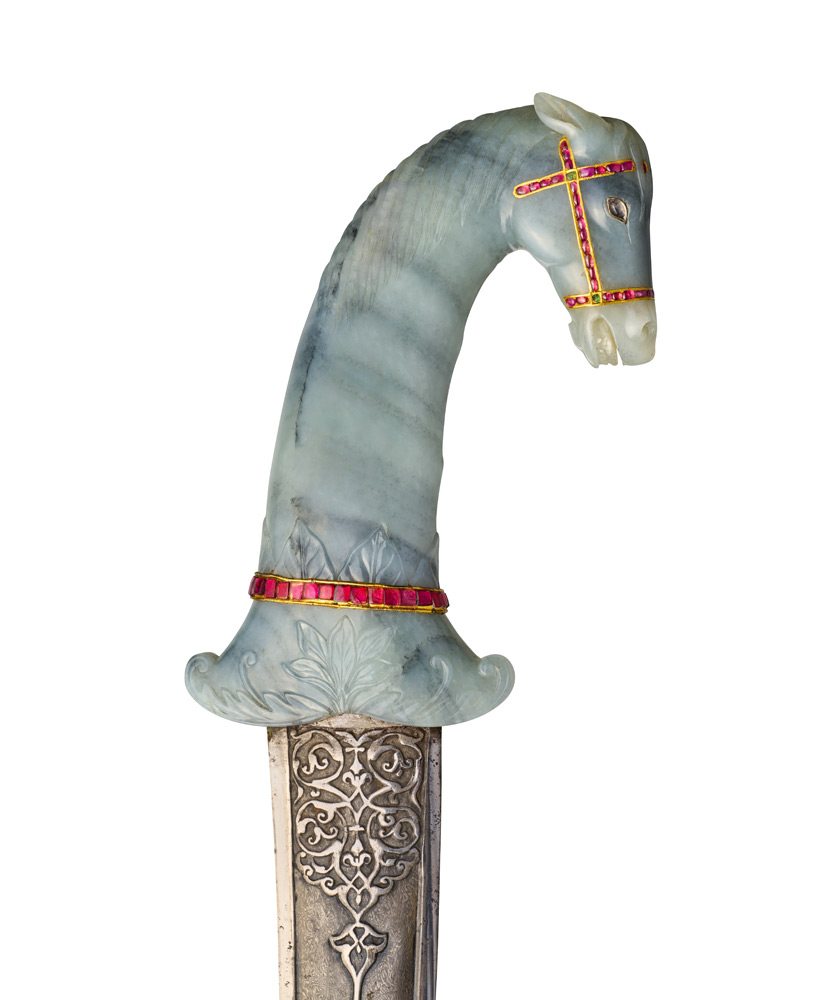
A magnificent gem-set jade dagger (khanjar) with a curved steel double-edged blade and a horse head hilt finely carved in polished greyish jade and decorated with jewels to the pommel and quillons. The blade has a fine watered steel design depicting a central ridge and reinforced tip, the forte of the blade carved with rumi arabesque patterns above a trefoil cartouche. The jade hilt is superbly carved from delicately mottled and streaked light grey jade in the form of a horse’s head, with flaring nostrils, pointed ears pressed slightly back on the head, rounded cheeks, open mouth revealing teeth and tongue and the mane swept as if by the wind to the horse’s right. The bridle is formed of gold and inlaid in the kundan technique with rubies and emeralds. The teardrop shaped eyes are set with rock crystals in silver sockets below carved brows. The jade hilt likely consists of two parts with the connection between guard and grip covered by a gold band set with rubies. A finely carved pattern of stylised acanthus leaves frames the band above and the scrolling quillons below. The grip has been subtly carved to the inner side with just perceptible indentations and ridges that provide a comfortable hold. The careful modelling of the face reveals the underlying structure of bone and muscle beneath the skin, bringing the horse vividly to life before our very eyes. The sprung tension to the mouth is outlined by the taut skin on either side, while the strength of the jaw and the muscles are brilliantly conveyed. The expressive features and fine carving, together with the weight and proportions of the dagger, admirably convey the power and vitality of the aristocratic animal. The velvet-covered wooden scabbard is decorated with steel mounts overlaid with gold in the koftgari technique to the chape and locket, depicting medallions of animals within geometric and floral patterns. At the Mughal court, naturalism in the lapidary arts reached its peak during the seventeenth century. Although jade dagger hilts were carved into a variety of animal forms, horses, as the principal animal of warfare, were a particular favourite. According to Stuart Cary Welch, the grooves on the grip indicate a date in the second half of the seventeenth century, as grooves are rarely found in the horse head khanjars of the Shah Jahan period. Welch’s close study of the many figures in the Padshahnama also reveals that the small number of daggers with animal hilts were reserved for the use of princes such as Dara Shikoh and Shah Shuja.(1) While the number of daggers with animal hilts increased during the late seventeenth and early eighteenth centuries, these continued to function as indicators of the highest rank and position at court.(2) Provenance: Philippe Missillier Collection no. 45C In the world of Islamic arms and armour, Missillier was synonymous with refined taste and learning and was very much the scholar-collector. Over a period of fifty years, he set out to master his subject; visiting museums, attending auctions, acquiring every catalogue and reference work, and immersing himself so totally in the field that he came to embody his subject, greatly contributing to the scholarship of the field. Published: Spink and Son, London, Islamic Art from India, Thursday, 24th April – 10th May 1980, p. 17, cat. no. 20. Howard Ricketts and Phillipe Missillier, 1988, Splendeur des Armes Orientales, 1988, pp. 96 & 97, cat. no. 154. References: 1. Stuart Cary Welch, India: Art and Culture 1300-1900, 1986, pp. 257-258. 2. Other horse head daggers from the Mughal period are illustrated in Howard Ricketts and Philippe Missillier, Splendeur des Armes Orientales, 1988, pp. 95-101 and Manuel Keene, Treasury of the World: Jewelled Arts of India in the Age of the Mughals, 2001, pp. 100-102. Detail: full view |