asianart.com | articles
TIBET – Monasteries Open Their Treasure Rooms –
the exhibition and its book
: A Review

by Michael Henss

Museum Villa Hügel, Essen, Germany, August 18 – November 26, 2006;
Museum for East Asian Art, Berlin, February 21 - May 28, 2007

Catalogue publication (German edition under the same title),
edited by Jeong-hee Lee-Kalisch,
664 p., 438 colour and 17 b/w-illustrations, München 2006 (Hirmer Publishing House)


As the title of this exceptional presentation of Tibetan art announces, monasteries and other institutions like the Potala and the Norbulingka palaces in Lhasa have opened their doors – in many cases for the first time – and sent their treasures abroad, together with cultural relics now preserved in the Tibet Museum at Lhasa, which was established as the first museum in Tibet (Tibetan Autonomous Region, TAR) only six years ago. [1]

Organised by the “Kulturstiftung Ruhr” (Cultural Foundation of Ruhr District) in the city of Essen, a leading privately sponsored cultural institution in Germany for over 40 years known for major exhibitions of Western and non-European art, in cooperation with the Administrative Bureau of Cultural Relics of the TAR in Lhasa, this pioneering enterprise has turned out to be a milestone in presenting Tibetan art on a high level, comparable in quantity and quality with other exhibition landmarks such as “Wisdom and Compassion” in San Francisco, New York, London, Bonn, Barcelona, Japan, and Taipei (1991-1998), and the “Himalayas – An Aesthetic Adventure” in Chicago and Washington (2003). [2]

The scholarly and administrative organisation of the German exhibition, including all negotations with the Tibetan and Chinese authorities in Lhasa and Beijing, was in the hands of a team led by Professor Jeong-hee Lee-Kalisch, chair of the Institute for East-Asian Art History at Berlin University (FU), which curated exhibitions on Chinese art (under the leadership of Prof. Roger Goepper) and on Korean art in 1995 and 1999.


Fig. 1
 

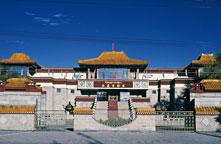
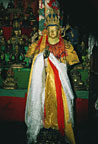
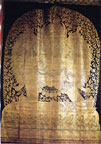
The exhibition under review had an American forerunner quite recently: “Tibet - Treasures from the Roof of the World”, which was organised by the Bowers Museum of Cultural Art in California in 2003 and successively shown by the Houston Museum of Natural Science, the Rubin Museum of Art in New York, and by the Asian Art Museum in San Francisco. Tibetan art treasures from the TAR had been presented for the first time in Europe in two small exhibitions organised by the Musée National d’Histoire Naturelle in Paris in 1987 and by the Rinascente department store in Milano in 1994, where four and eight objects respectively of the current German exhibition were shown. [3] While the Bowers exhibition was exclusively based on loans from public institutions in Lhasa like the Tibet Museum (fig.1) and the Potala and Norbulingka Palaces, Essen’s Villa Hügel Museum had the privilege of presenting for the first time some 25 religious works of art (11 catalogue entries) from five monasteries in Tibet, where they are still on display and ritually used. Great masterpieces, 14 important cultural relics, came only from two of these five monasteries, Mindröl Ling and Shalu. If one follows the comments of the German organisers the monastic institutions of Mindröl Ling, Gyantse, Shalu, Tashi Lhünpo and Sakya were very cooperative and even proud to have some of their treasures shown in the far West. However one cannot overlook some discrepancy between the proud title of the exhibition (“Monasteries Open Their Treasure Rooms”) and the fact that most of the objects are owned by museums (Tibet Museum, Potala Palace, Norbulingka Palace, Yarlung Museum) rather than monasteries. Seven monastic institutions did not open their doors to give loans abroad (Jokhang, Sera, Drepung, Nyethang, Yumbu Lakhar, Gongkar Chöde, Samye). Three very important cultural relics never seen before by foreigners came on loan from the Yarlung Museum at Tsethang, which has not been open to visitors during the last years. Not less than 45 paintings, statues, and ritual instruments are shown from the Potala Palace collection, another 18 objects are from the Norbulingka property; while 51 items were given by the Tibet Museum. As claimed in the catalogue the organisers did, however, “with respect to the believers”, not request works of art which are closely associated with the daily ritual praxis: A statement made maybe for reasons of prestige to which one may add that those items, even if requested, would not have been given on loan anyway. Regrettably all circa 60 objects from the Tibet Museum and from the Norbulingka Palace were given abroad without details about the former provenance, which at least in most cases is certainly known to the cultural relics authorities in Lhasa. And one also wonders where the magnificent brocade banner with the Yongle reign mark (no. 53 in the catalogue), one of the highlights in the exhibition, had been preserved previously.

Of the total of 138 objects, 33 were never seen before except by a few local experts, either in the original object or via publication. About 42 items, which is nearly one third of the whole exhibition, where never published before, and a total of 112 exhibits are shown for the first time outside China. Most of the loans, 85 pieces, cannot even be seen at their proper place in Tibet! These are impressive figures, and the inclusion of these rare and inaccessible objects is a credit to the considerate and successful selection policy of the Germans. The presence of these rare objects provide a contrast with the Bowers Museum exhibition, where the selection was apparently more determined by what had been offered by the Lhasa authorities.

The Essen exhibition, which was seen by 196,000 visitors before it moved to Berlin, has been clearly defined as an art exhibition with focus on aesthetic quality and art historical importance. The works of art were not just presented as an assembly of isolated aesthetic highlights; instead they were quite logically arranged within their historical and iconographical context.

The objects in the exhibition cover fifteen centuries, from a Chinese gilt bronze Shakyamuni statuette dated to 473 and brought at an unknown period to the Potala Palace to the Medicine thangka copies of the 1920s now kept in the Lhasa Museum. Thus this art historical survey of Tibet ends sometime before 1950 and does not include the period and person of the 14th Dalai Lama. This has been criticized by many visitors to the exhibition, whose idea and image of Tibet are essentially determined by this foremost and highly appreciated Tibetan representative of our days. For obvious reasons the devastations of countless historical relics during the so-called “Cultural Revolution” in the whole of China and Tibet between 1966 and 1976 were not documented in Essen and Berlin, but are still very tragically in mind, not only in the West. And those eminent losses cannot be covered by all the exhibited treasures, which fortunately have survived, for the religious benefit, daily use, study, and aesthetic pleasure of Tibetans in Tibet, in the diaspora, and abroad. That an exhibition of Tibetan cultural relics from present-day China shown in the West will focus on "Buddhist Art and Religion" alone is self-explaining. And self-restriction in this sense has been practised in Essen and in Lhasa, even at the Villa Hügel vernissage, when in an informal and discrete ambience no official speeches and statements were given and the officials from Lhasa and Beijing were hardly seen. When this exhibition, which has been under the patronage of the Chinese Prime Minister Hu Jintao and of the German Federal President Horst Köhler, was opened in its second venue on February 20, 2007, in the Museum for Asian Art at Berlin (director Prof. Willibald Veit and Dr. Herbert Butz for the East Asian department) in a more official way, welcome addresses were given by the President of the German House of Parliament, Norbert Lammert, by China’s ambassor Ma Canrong, and by Nyima Tsering, director of the Administrative Bureau of Cultural Relics of the TAR in Lhasa.

The homemade German texts in the show and in the catalogue-handbook get along without any overall guidelines except those of academic relevance and correctness toward the individual object and its cultural context. Such insight and discipline are not self-evident here and there and may give rise to criticism on both sides. The German organisers, one may argue, had no other choice in order to get this exhibition done. Yet they were intelligent enough to pay proper respect to the needs and feasibilities of the generous lenders and to get a maximum back. According to his own words the director of the Villa Hügel Cultural Foundation, Prof. Paul Vogt, was also well aware of the eventual political aspects and related discussions in this regard. But he noted: “Nevertheless Tibetans in exile supported actively the planning and preparations of this exhibition. Other came to pay their respect to these ritual images and were pleased to see such significant visual manifestations of their faith, which have been sent from Tibetan monasteries or institutions, and not from museums in the West. I am convinced that the public presentation of these religious objects and the scientific study and publication of Tibet’s cultural heritage will contribute to their preservation and safeguarding”. And the German Federal President justified his patronage with similar arguments: "This exhibition does not claim to present the history of Tibet until our days, however it shows religious works of art – often still in active ritual use – owned by public institutions and by monasteries. Thus they are part of a living culture and of the identity of the Tibetan people. The exhibition gives a chance for a cultural and spiritual mission. We believe that the presentation of Tibet’s cultural relics is also a contribution to emphasize and to support the autonomy of Tibet”.

In view of the different thematic categories the selection is well balanced between images and non-figural items, with 59 statues from miniature to life-size, 25 thangka paintings and six fabric images (kesi, silk embroidery), some 54 ritual objects, four sacred books, and twelve historical and other secular objects.

It was not the intention of this exhibition to illustrate and document the cultural history of Tibet or to give a visual introduction to the “Land of Snows”. Yet many chapters of Tibet’s religious and cultural history are covered by the five sections of the exhibition plan anyway.

The visitor – and the reader of the heavy (over 4 kg!) catalogue handbook – begins his kora ("bsko ra"; ritual circumambulation) in front of the early Indian and Tibetan Lamdre (lam ‘bras) lineage masters of the Sakyapa tradition, an at least most impressive “path and result” and no doubt a brilliant mental and highly eyecatching introduction into the visual dharma of Tibet. The second part, like all the other sections decorated in a colour scheme featuring one of the symbolic colours of the Five Buddha Families or of the five elements, is dedicated to the three-fold world of the dharma – body, speech, and mind: to the principal deities and teachers, the sacred scriptures, and to the stupa, the aniconic symbol of the Awakened One. The third part follows at the center of the exhibition: the mandalas, meditational emblems of microcosm and macrocosm, and then the fourth, a large section comprising a rather broad and not always convincing entity of “Rulers and Monasteries” with images of religious (and secular) sovereigns and their emblemata, various ritual implements and altar furnishings, which one would have prefered to see, however, in a more condensed and systematic context of a “temple iconology”. The last section of the exhibition - dedicated to Tibetan medicine - appears more like a rather arbitrary appendix (of an en-vogue subject) rather than an essential chapter of the fivefold path to enlightenment on the exhibition's ambitious path of circumambulation.

The aesthetic presentation in the huge, over a hundred years old building, once the residence of the famous Krupp family, a leading industrial “institution” in 20th century Germany, was very impressive. The spacious halls were skilfully transformed into several compartments with the objects shown in a decent setting of tranquilizing colours and concentrated light. In reasonable balance with the overall design additional texts provide sufficient information for the exhibits, much to the benefit of the visitor, who in other cases like the current exhibition on “The Dalai Lamas” in Zürich (Ethnographic Museum) and Rotterdam (World Museum) is solely and “compulsorily” guided around by audiophones. The high standard of the selection could not be realised in every field, presumably due to restrictions of the lenders of this exhibition. This is specifically evident for the painted Mandalas, which are represented only on a low quality level (nos. 68,72,73,78), although two exceptional 15th century Kalacakra Mandalas are kept in the Potala Palace and in the Lhasa Museum. Only a few other items might be considered dispensable, such as the paintings nos. 43, 46 and 58, or the statues nos. 30,51,52 and 66 along with some ritual objects such as nos. 90,91,93 and 101 did not match the excellent overall quality level of this exhibition.

In the following annotations I will mainly focus on those works of art, which by their outstanding artistic quality, their specific iconographic interest, or by characteristics inviting scholarly dispute may deserve some special attention.


Fig. 2a

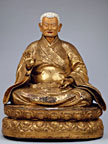
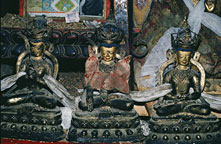
The ten life-size Lamdre masters in gilt copper repoussé technique from Mindröl Ling (sMin grol gling) monastery are no doubt among the most fascinating statues to exist in present-day Tibet (fig.2a,b). Though closely connected with the Sakya tradition the complete set of 21 images, from Buddha Vajradhara to the Shalu lotsawa Chökyong Sangpo (Chos skyong bZang po, 1441-1528), was moved from the deserted Drathang (Gra thang) monastery shortly before my first visit there in 1992 to the Nyingma seat at Mindröl Ling, where they are now installed in the heart of the dukhang. In style and technique these unique monumental yogins and teachers indicate a Newari atelier, which is confirmed by a Nagari inscription on one of the exposed images. It is believed that they were commissioned by Chökyong Sangpo, who came from Shalu to central Tibet in 1483 to become later on abbot of Drathang, where he introduced the Lamdre teachings of the Sakya tradition. At Gong dkar Chos sde he may have been in contact with the genius artist mKhyen brtse or with his atelier, whose unorthodox modern painting style and some related nearly lifesize and very realistic statues of Lamdre masters (as they are mentioned for an unidentifiable site in 1919) [4], were probably not without influence on the Nepalese artists.We are informed by the texts (Zhva lu gdan rabs) that Chökyong Sangpo’s disciple Ön Lodrö Pekar (‘On bLo gros Pad dkar) commissioned a precious image of his master after the death of the latter, which might be identical with the last one of the 21 statues at Mindröl Ling. Whether all other repoussé figures of this cycle were still made during the lifetime of Chökyong Sangpo remains purely speculative. [5] It is, however, more likely that the complete set was produced after the Shalu Lotsawa had died in 1528. Thus a date to the second quarter of the 16th century does not only correspond better to the general characteristics of a 16th century style like it is illustrated for example by the magnificent Siddha murals at Yamdrog Talung (Ya ‘brog sTag lung) monastery, but would be also in accordance with the dating of the exhibition catalogue (“first half of 16th century”), whose 33(!) pages on this subject present an extremely detailed documentation on the Sakya school in Tibet and its essential Lamdre tradition, as well as on the various iconographic, stylistic, art historical, and technical aspects of the Mindröl Ling statues (p.119-151). [6] In his precise and substantial commentaries, Andreas Kretschmar clearly identified the Mindröl Ling group clearly with the oral Vajra verses tradition of the Lamdre system from the early beginnings until Zhang ston Chos ‘bar (1053-1135, no.7 of the exhibition), which were written down for the first time by the third Sakya throne-holder Sa chen Kun dga’ sNying po (1092-1158, no.8).


Fig. 2b
 

By reviewing the sculptural highlights of the exhibition via some kind of chronological order, I do not follow here the “iconological” system of the overall presentation, which, displaying the objects within the specific context of function and meaning, is generally the best way to introduce a foreign culture of complex and difficult symbolism to a greater public. Among the early metal sculptures shown in the exhibition, two male figures of unknown iconography from the Potala Palace are labelled as “Zhang zhung Kingdom of Western Tibet, 8th century” (no.40), an attribution which is solely based on von Schroeder’s problematic “identification” of some twelve predominantly Buddhist (!) statuettes discovered by him in the Potala Palace and at a few other sites in Tibet in the 1990s. [7] In her text to this entry Marit Kretschmar (MK) refers mainly – and correctly – to the early “Central Asian” costumes of these images, a general feature however of early Tibetan figures without any priority for western Tibet (where in the pre-11th century period the “Kashmirian mode” had been the only stylistic convention anyway). This may just confirm the early date of these enigmatic statues, which hardly can be understood as “donors” (von Schroeder).

Until recently no cultural or artistic profile could be established for a western Tibetan Zhang zhung kingdom, of which no reliable archaeological data and clues do exist. Neither during the Tucci expeditions in the 1930s or the Chinese excavations at Tsaparang and Tholing in the 1980s and 1990s, nor in the course of the extensive field surveys in the western Changthang plains by John V.Bellezza and from the first archaeological investigations at Khyung lung dNgul mkhar by Professor Li Yongxian in 2004 have any similar artefacts come to light, which would support the hypothesis of a specific group of “Zhang zhung art”. And how much sense does it make to find Buddhist art production in a Bon-dominated kingdom, which by mere chronology did not exist anymore at the time when these images – on stylistic grounds – must have been manufactured? I also have doubts whether the twelve “Zhang zhung images” (as suggested by von Schroeder), partly cast in copper and partly in brass, make a homogenous “oeuvre”. Some of them belong to the style of Greater Kashmir, while others are more related to an early Newar-Central Tibetan style of the sPu rgyal dynasty period. [8] One may argue that Buddhism had found its way to the eastern borderlands of Greater Kashmir, which is indeed well-documented by several early rock-carved images in Ladakh, Zanskar, Baltistan and Gilgit, and assume, as von Schroeder does, that the “origins” for these statues might be sought for in “the Tibetan dominions in the western parts of Central Asia”. Yet the “origins” only? Or as another construct would make us believe: could these images have been “commissioned” by the Zhang zhung rulers from those “western” areas? Wouldn’t it be less speculative to associate them with the Tibetan borderlands in the West around the 8th century, with “Bolorian Tibet” or with “Little Bolor” (Tib. Bru zha), which was conquered by the Tibetans in 735?


Fig. 3

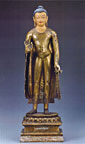
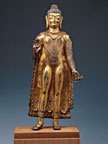
At least four of the six exhibited Kashmir style metal images are of exceptional quality and art historical importance. An additional advantage of the thoughtful selection is their wide chronological range over a period of circa 600 years, a rare chance to study the earliest and the latest Kashmir styles from about 600 to 1200 at the same time. The most impressive Kashmiri “guest” from the Potala Palace and one of only two existing early Kashmiri statues of this size and quality is a 94 cm tall standing Shakyamuni inscribed at the base in Sanskrit as having been donated by the monk Priyaruci and King Durlabha (-vardhana, r.circa 625-637), which allows a dating of the statue to circa 620-630 (no.13; fig.3). Almost 400 years later, sometime between 998 and 1016, when it had apparently been brought from Kashmir to western Tibet, a Tibetan inscription was added describing this Buddha as the personal meditational image of the royal prince Nagaraja (988-1026), son of the lama-king Ye shes ‘Od of Gu ge, who was constructing at that time the great “mandala temple” at Tholing. With the exception of the much later standing Buddha in the Cleveland Museum of Art (datable to circa 1000) and a similar statue in the Lindenmuseum Stuttgart, Germany, no monumental Kashmir style image of this importance has been shown in the West before.


Fig. 4a
 

Another significant 63 cm high gilt copper statue of a standing Shakyamuni from the Lhasa Museum (fig.4a) can be regarded in my opinion as a later, circa 11th century “Gu ge interpretation” by a Tibetan artist of the classical earlier Kashmir Buddha type (no.14: “Kashmir, 7th/8th century”). While the attribution of Kashmir style images from the 10th through the 12th centuries either to a Kashmiri or to a Tibetan artist is in many cases difficult or even impossible, the Lhasa Buddha indicates in comparison with nos.11 and 13 as well as with other “genuine” early Kashmir statuary a distinctive local “Gu ge design”: the more schematic “linear” garment style (“Faltenstil”) of the robe as well as the proportions of the head and its facial features seem to be general characteristics of Western Himalayan figural art between Gu ge and sPi ti during the 11th and 12th century, compared with nos.11 and 13 or other early statues of “genuine” Kashmiri provenance. [9]


Fig. 4b

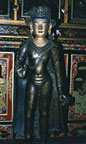
Coming back to the original Kashmir style images of the 7th and 8th centuries, the seated Buddha in dharmacakra-mudra no.11 is another exhibition highlight from Greater Kashmir, whose artistic production had an essential influence on Tibetan art during the formative phase between circa 1000 and 1200, primarily and rather exclusively in the western regions. From here these images may have been brought at that time and in later periods (probably a few during the Tibetan military campaigns in the 7th or 8th century) to central Tibet, where however their distinctive style did not have a substantial impact on statuary and painting, which increasingly came under the influence of the great Pala-Indian and Nepalese traditions. The Lhasa museum image no.11 is one of the finest seated Buddhas of an “antique” Gandharan-Swat Valley style lineage, with silver and copper inlays of Central Asian textile patterns. Similar sculptures are preserved in Western public and private collections and in the Yonghegong temple at Beijing [10], and in remote places in western Tibet, where even “unknown” masterpieces of an early Kashmir style have survived like at Gu ru rGyam cave sanctuary in ancient Khyung lung valley, to be properly rediscovered and hopefully published in the near future. Even at much more prominent places like the Ramoche in Lhasa, exceptional Kashmirian statues are preserved such as an (unpublished) 87 cm tall crowned Buddha of the circa 11th century, a period when probably most of the Kashmir style images were brought to central Tibet (fig.4b).

A very interesting six-armed Avalokiteshvara from the Potala Palace represents the late Kashmir style of around 1200 (no.35). However, I cannot agree with the catalogue text, according to which this image would not be “a Kashmiri work in the real sense”, yet with “influences from other regions”. From which regions? Was there ever any distinctive influence from the neighbouring regions on the art of Kashmir except of the Indian Gupta and the Gandharan-Swat mainstream? Has ever a Kashmiri statue been associated with the highly refined late Kashmir style of the Alchi murals, where similar floral ornaments and flamed patterns like on the throne and nimbus of the Potala statue do occur? [11] And can late or latest elements of an over five hundred years old artistic tradition (which is subject to change!) be interpreted as a foreign vocabulary?


Fig. 5

Fig. 6

Fig. 7

Fig. 8

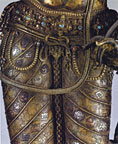
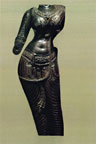
The Pala-Indian predecessors of Tibetan art are represented by one of the most beautiful and important masterpieces of the entire exhibition: the life-size standing Bodhisattva Maitreya from the Li ma lha khang in the Potala Palace collection (no.32; height: 154cm; figs.5,6,7). Before 1994, the year when these chapels were opened to the public for the first time, this exceptional 12th century brass statue virtually did not exist for pious pilgrims and experienced experts. Since then this most beautiful monumental Indian sculpture in Tibet has been largely covered by silk brocades. Thus the real grandeur of this Pala style statue with all the ornamental silver and copper inlays on the dhoti and the turquoise and other precious stones indicating a manufacture for a Tibetan patron was only revealed in the exhibition. The image was either produced in eastern India (as it is known for example for a painted scroll commissioned by Atisha) or, probably more likely, in Tibet by an Indian artist. At least two more monumental statues of the 11th and 12th centuries in a private property and at sNye thang monastery [12] document clearly the presence, and as I believe, the production of large Indian metal statues in Tibet. And one wonders about the strict objections of some Tibetologists against a probable Indian authorship of a few early thangkas found in Tibet. [13] Just three examples of comparable Indian stone and metal sculpture may prove what has not been seen in the catalogue text: a superb 11th century stone torso of a female figure in the Delhi National Museum (fig.8), a Tara stele in the Indian Museum at Calcutta dated to 1074, and a Kurkihar Avalokiteshvara in the Patna Museum of the late 11th or early 12th century. [14] – One cannot help but regret when looking at this Sambhogakaya-Maitreya, that he does not reveal his “true” unpainted face, now after over 800 years, though more for the pleasure of the art lover than for the benefit of unknown hierarchs and countless pilgrims on their path from the formal beauty of the phenomena to the formless truth of the dharma.

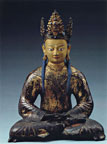
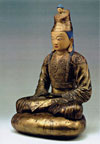
While other Nepalese sculpture is represented only by a small but beautiful 14th century gilt copper statuette of a thousand-armed Avalokiteshvara (no.33), the significant image of the seated bodhisattva (Amoghasiddhi?) no.20 should be rather attributed to a Newari atelier of the 11th century than described as “Tibetan”. Like several other statues of the same style, this loan from the Lhasa museum can be regarded as a prototype model for Tibetan statuary of the phyi dar period, especially also for monumental clay statues like at the Lhasa Jo khang or at sNye thang monastery. [15] In its simple composition and jewelry adornment it recalls the classical tradition of early Newari sculpture at a time when Tibetan artists were just about to copy and to assimilate the formal vocabulary of their neighbours to the south, west and north of the central regions.

Two royal figures, no. 80 and 81, are masterpieces of Tibetan statuary in a double sense: beautiful examples of advanced 14th century image art and rare incunabula of high-ranking secular iconography. The 47cm high brass image of King Srong btsan sGam po (no.81, fig.8b) from the Potala Palace is, with the exception of some early 9th century rock-carvings in eastern Tibet, the earliest preserved statue of a sPu rgyal dynasty king, represented here in the much older concept of the “Avalokiteshvara in the form of a king” (Blue Annals). The catalogue text (by Petra Maurer) however, though extensively informing the reader about Srong btsan sGam po in general, does not say anything about the proper statue with regard to its historical, iconographic and stylistic aspects in context. While this king was identified with Tibet’s most prominent bodhisattva already during the later monarchic period, when those kings were described as “son of the gods” (lha sras) or as a “king divinely manifested” in contemporary rdo ring inscriptions and Dunhuang texts, the individual image of the bodhisattva ruler with the small Amitabha figure on top of his turban did not exist to the best of my knowledge before the 14th century. When Ta’i si tu Byang chub rGyal mtshan (1302-1364), the actual ruler of dBus gTsang towards the middle of the 14th century, promoted a “national renaissance” by creating a new awareness of the Tibetan roots in the dynastic era, the historical and ideological background and motivation for such images and for a proper Srong btsan sGam po cult were established. And at the same period the first monumental clay statue of this king was installed in the Jo khang, which may have served as a model for the metal image of the exhibition. [16] The historical circumstances are confirmed by stylistic criteria. The characteristic dragon medallions of the king’s robe can be well compared with similar designs of imperial symbolism on Yuan dynasty textiles. – The catalogue texts for the two royal images of the same (!) period and style are strangely written by two different authors. In her detailed discussion of the anonymous “Tibetan dharma king” no.80 Bernadette Broeskamp (BB) follows largely the description in von Schroeder’s “Buddhist Sculptures in Tibet” (“Princely donor depicted as Amitayus? 11th/12th century”, fig.8a) [17], yet interprets the iconography more convincingly as an early religious king (chos rgyal) in the sambhogakaya aspect. Although this idealized statue of a worldly sovereign may well be associated with earlier concepts of Vairocana as an universal ruler and of the dharmaraja-cakravartin, it must be dated to the same 14th century period like the king no.81. Both images have similar motifs and stylistic elements: garment style and especially the making of the lower part of the robe, facial features, and hair style. The crown leaves do not resemble those of the 11th or 12th century, which are characterised by a rather flat and linear design (see for example no.20!), but recall instead the more sculptural style of 13th and 14th century metalwork inlaid with precious stones. [18] A comparison with similarly dressed princely figures in the wall-paintings at Drathang (Gra thang, 1081/1093) is for chronological reasons misleading. The style of the royal metal statues in the Potala indicates also an archaistic element in order to mark the historical continuity and the “revival” of the chos rgyal period and its “mode monarchique” in the 14th century. Ornamental textile patterns such as the Central Asian roundels on the sleeves of the king’s robe can be regarded as specific designs of ancient royal or princely dresses and were apparently used for a similar context also in later times. And last but not least, no other royal statues of this type exist, which can be safely attributed to the phyi dar period.


Fig. 8a

Fig. 8b

Fig. 9

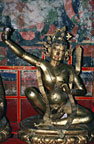
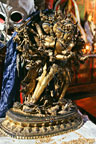
One of the most exceptional loans of the entire exhibition, both for its sheer aesthetic beauty and technical workmanship as well as for its art historical importance, is the large gilt copper statue of the Kalacakra yidam deity from Shalu monastery (no.54, height: 60 cm), an unrivalled masterpiece of a Tibetan yab-yum image. (fig.9) Nowhere else in Tibet or in any public and private collection in China or abroad has been preserved a similar sculptural group of this size and quality. The catalogue text (Gregor Verhufen) however is limited to a general though detailed iconographic description of the Kalacakra yidam without giving any attention to the individual statue and to its art historical or technical aspects. This principal image was no doubt specifically associated with Bu ston’s Kalacakra teachings and praxis at Shalu and thus would probably have been produced there by an atelier from the Kathmandu Valley sometime between 1320 and 1364. [19] The elegant movement of the figure, the dynamic and very decorative scarves, the elaborately worked crowns, and the various inlaid precious stones indicate clearly the Newar artist tradition of that period, stylistic characteristics which can also be recognized in several painted cycles at Shalu. And it must have been this ultimate yidam image representing the highest teaching system of the Yoga Tantras, which in 1919 the famous pilgrim-scholar Kah thog Si tu Chos kyi rGya mtsho had seen on his extensive travels in the Central Regions of Tibet, “as tall as an arrow, of pure gold and adorned with precious stones”. [20] The reviewer being familiar with this monastery since 1980, cannot help adding his personal thanks – certainly in the name of many others who have seen the exhibition – to the monk community of Shalu (and so he did during a visit in October 2006) for having been so generous to let one of their most precious treasures go for some time to the western world.


Fig. 10
 

That significant early paintings are less well represented in the German exhibition depends at least partly on the more limited material which has survived in good condition. And obviously there are now many more pre-16th century thangkas in western properties (most of them more or less extensively restored) than in Tibetan monasteries and other institutions, which have not been ritually used for long or never did undergo a thorough restoration. Although we do not know if there are still hidden treasures among the painted scrolls stored in the Potala Palace, it seems that there is probably only a single painting of the characteristic 12th and 13th century Five Tathagatha sets left in Tibet as they once existed for example at Shalu monastery [21] and from where their sculptural counterparts were lent for this exhibition (no.19a-e; fig.10)


Fig. 11

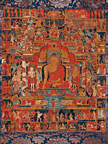
The most significant and beautiful painting shown in the exhibition is a hitherto unpublished 14th century thangka of a Newari artist depicting the crowned Diamond Seat Buddha (fig.11) or, as it is called in the Sadhanamala text of the 12th century, the Vajrasana tathagatha in bhumisparsa mudra seated on the diamond throne, triumphing over Mara (no.16). Like in several earlier 12th and 13th century paintings [22] the Buddha is represented soon after his enlightenment seated in the Mahabodhi temple at Bodhgaya, yet depicted “ahistorically” with a crown like a cakravartin, a “world king” or universal ruler, though “still” dressed in a monk’s robe of the historical Buddha: Shakyamuni in his divine and kingly form. The crowned Buddha, basically referring to his sambhogakaya aspect according to the trikaya concept and a quite rare iconographic form of the Mahabodhi-Vajrasana Shakyamuni, symbolizes “the five transcendental insights (jnanas) that the Buddha attained as part of the enlightenment process” [23], manifested by the five transcendental Buddhas seated in the Mahabodhi shrine in the painting’s upper section. The actual origins and models of the crowned Diamond Seat-bhumisparsa mudra Buddha surrounded by Mara’s attack and many more scenes of Shakyamuni’s life-story can be traced back to the characteristic large Indian stone steles of the Pala period and especially to the popular small votive tablets (see no.15) as they were existing mainly in the Bodhgaya and Nalanda areas to be brought by pious pilgrims and eminent masters to Tibet. The Chinese monk-traveller Xuanzang (Hsien Tsiang) reports from the early 7th century that the principal statue of the Buddha, “eleven feet and five inches high” in the Mahabodhi temple depicted calling the earth as witness whilst subduing Mara. He described it as adorned with “a necklace of precious stones and jewels, whilst on the head they placed a diadem of encircling gems, exceedingly rich”. [24] According to a textual tradition a coronation was part of celestial consecrations bestowed on Shakyamuni after his final meditation stage. [25] And as told by a later Tsongkhapa biography the Jo bo Shakyamuni statue in the Lhasa Jokhang would have been crowned with a diadem (dbu rgyan) “to encourage the devotion of the Indians” [26], which recalls the 10th and 11th century stone steles from Nalanda depicting the Buddha crowned like a king as an universal sovereign.

Beyond the very thorough description and interpretation of the Buddha story around the central composition, nothing is said in the catalogue text on the art historical and stylistic aspects of the painting, which recalls the Newari style murals at Shalu of the first half of the 14th century, though it is not really identical with their specific formal language. While the individual “handwriting” indicates clearly a Nepalese artist (see detail illustr. p.175,176), one cannot label this magnificent Mahabodhi enlightenment Shakyamuni simply as “Kathmandu Valley style”. 30 years after Pratapaditya Pal’s pioneering book on Nepalese painting and so many newly discovered and published painted scrolls and metal images from Nepal and Nepalese style works of art from Tibet one sees the need for a comprehensive modern documentation of Nepalese painting and sculpture and of its “Nepalo-Tibetan” derivatives. And then one may also find a more precise stylistic – and iconographical - identity for the much later but somehow archaistic and hardly less refined painting of the Bodhgaya-Shakyamuni no.17 than just “Tibet, 18th-19th century”. [27]


Fig. 12
 

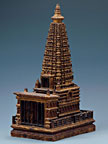
Another excellent selection – especially in the context of the two paintings no.16 and 17 – has been the sandalwood “model” of the Mahabodhi temple at Bodhgaya (fig.12), the largest and most detailed existing miniature copy of this principal Buddhist sanctuary among several other replicas in the Potala Palace collection (no.22, height: 49 cm), with a very informative catalogue text on the history and typology of the Mahabodhi temple by Niels Gutschow. While several other of these temple copies are much smaller in order to serve as portable votive objects for pilgrims, this exceptional shrine in miniature might have been sent with a highranking mission to Tibet, probably during the phyi dar period or at the latest maybe as a sacred gift taken by the Bodhgaya abbot Sariputra on his visit to Tibet in 1414. Beyond its value as an object of veneration, this outstanding reliquary is most important for architectural exactness as an authentic 11th century “model” of the original building as it was before the late 11th century (indicated by some details which no longer exist in the present building). The attribution of this Mahabodhi temple replica to Burmese artisans [28], who had been involved in the reconstruction of the temple architecture around 1098, remains however speculative. This assumption is based on another problematic hypothesis, according to which the so-called “short necked Buddha” type (as illustrated by this replica) would indicate a distinctive Burmese origin, but not, one may add, exclusively, since the early prototypes appear to have their roots in Eastern Bengal. The wooden temple replica, which seems to be made almost exactly on a scale of 1:100 in relation to the early circa 50 metres high Mahabodhi temple of the Gupta period, informs us like no other of these models about the original construction of this foremost shrine of the Buddhist world. Only here we can identify the original stone fence dating to the first century B.C.E. or the contemporary capitals and bases of the pillars. And even the many small Gupta style Buddha statues in the niches of the central tower and of the portico may serve for a reliable reconstruction of the former architecture in composition and style.


Fig. 13

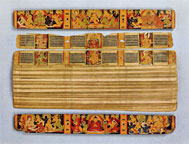
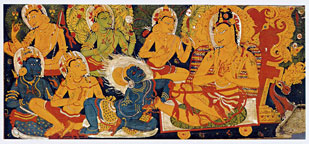
At about the same time when the sandalwood Mahabodhi temple no.22 had been carved, one of the most beautifully illuminated Indian palm leaf manuscripts was written not far away from Bodhgaya, very likely at the Nalanda Buddhist academy in the late 11th century, from where it was apparently brought to ‘On ke ru Lha khang monastery, located some kilometres away from the northern banks of the Tsangpo river opposite Tsethang (no.26). This hitherto unknown manuscript of the Astasahasrika Prajnaparamita Sutra (whose name and content should have been explained briefly in the catalogue) is one of the few illustrated books of the Pala period in complete condition and especially unique because of its superbly painted and well preserved wooden covers (58x7 cm, 139 leaves with total twelve illuminations on four pages, figs.13,14). According to the colophon the Tsethang manuscript was donated by the mother of the great pandita Sri Asoka in the second year of the reign of King Surapala, which corresponds to the very end of the 11th century. With no doubt were those Indian manuscript illuminations of great influence for early Tibetan paintings in the 11th and 12th century. In addition to Eva Allinger’s thorough discussion of this painted treasure in iconography and style, which like many other texts in the catalogue may certainly suit more the special interest of the scholarly reader than it would meet the curiosity and capacity of the “other 95%” of the exhibition’s visitors, at least two approximately contemporary Pala manuscripts in Tibet are adorned with illuminations and painted or carved covers of similar breathtaking quality: another 8000 verses Prajnaparamita text in the Tibet Museum at Lhasa and a manuscript of unknown content at Sakya monastery. [29]


Fig. 14
 

The enormous book treasures at Sakya were so far never investigated, especially the corpus of Sanskrit manuscripts, “one of the last ‘hidden’ treasures of Asia”. [30] When in 1926 the Indian scholar Rahula Sankrtyanana (1893-1963) “discovered 25 bundles of palm-leaf Sanskrit manuscripts” in the “Manuscript chapel” (Phyag dpe lha Khang) on the upper storey of Sakya monastery, “the whole floor was covered with a thick layer of dust about one-third of an inch”. [31] While in 1961 about 250 manuscripts were brought from Tibet to the Minority Palace library in Beijing and in the successive years many more from various monasteries were gathered in Lhasa (Potala and Norbulingka Palaces, of which some are now in the Tibet Museum), Sakya is still by far the largest monastic repository of Tibetan and Indian manuscripts. At present the Tibetan Academy of Social Sciences in Lhasa is working on a project for an inventory of the Tibetan written and xylographed books in Sakya. And only recently all these early manuscripts were moved from the huge 13th century book-shelves in the Lha khang Chen mo to a separate library hall built in the traditional Tibetan Sakya style in 2004 opposite the southern front of the main monastic complex.

From “Prajnaparamita light” to the most heavy 8000 verses edition: no.27 is a 100 cm long and 54,5 cm (!) wide foliant with huge carved wooden covers and usually “on display” at it’s original place in the main assembly hall of Gyantse monastery (Chos rgyal lha khang). Both manuscripts are documenting in the exhibition the wide range of the eminent Buddhist textual tradition from the Indian Sanskrit sources to the great Tibetan Sutra translations in the Kanjur at the time of Tsongkhapa, for the exhibition catalogue a good opportunity to inform extensively about the “Perfection of Wisdom”.


Fig. 15

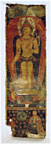
Closely connected with the Indian painting tradition of the Pala period is another hitherto unseen scroll painting of a standing bodhisattva Manjusri from the Yarlung Museum at Tsethang and published here for the first time (no.31; 77,5x23,5cm; fig.15). Formerly kept at Ke ru Lha khang in the opposite ‘On Valley this image is no doubt one of the earliest Tibetan paintings to exist, datable on stylistic grounds to the late 11th century. [32] The long dbU med inscription on the back consists of Sanskrit dharanis and consecration formulas. The iconographic and stylistic identity of this vertically proportioned banner – apparently a very early type of the Tibetan thangka – has been well researched in the catalogue by Bernadette Bröskamp. Quotations from Indian manuscript illuminations of the 11th century such as the trees on top, the lotuses at the bottom, the figural style of the bodhisattva, and the kneeling donors recalling similarly drawn lay worshippers in Tibetan murals of the 11th century, characterise this painting as an early Tibetan interpretation of the Indian Pala style. The Tsethang bodhisattva can be also clearly distinguished from the much earlier Tibetan style found at Dunhuang (London, British Museum) and from the sPu rgyal period bodhisattva statues at Ke ru Lha khang. The safe stylistic profile of an 11th century date for this thangka corresponds to other circa contemporary Pala style paintings outside India like, for example, in Pagan (Abeyadana, Kubyauk gyi Myinkaba, late 11th and early 12th century) and also contributes to confirm the dating of other early painted scrolls such as the large Amitayus thangka in the Metropolitan Museum New York. [33]

Compared with the Indian roots and antecedents, the Chinese connection with Tibetan Buddhist art for wellknown historical and geographical reasons is much more long-lasting and by far more variously interrelated in both directions. While the term “Sino-Tibetan art” refers correctly to all those paintings and statues produced in Tibet but influenced by specific Chinese elements in style and iconography (though often misused for Buddhist or “lamaist” art produced in China in the Tibetan style), “Tibeto-Chinese” should be the right label for all Tibetan style works of art made in China and its bordering areas. All together 10 exhibits belong to this second and indeed more attractive group. All of them were produced in the imperial ateliers, which guaranteed a highly refined quality standard of Tibetan-Buddhist “court art” in China. This foreign esoteric Buddhism, its religious fascination and political function, and its exotic visual world was in fact concentrated and limited to imperial demand and patronage, be it the passionate personal attachment to the Tibetan hierarchs and to their sacred meditational images under the Yongle emperor of the early Ming, be it the much discussed support of Tibetan Buddhism by the Qianlong emperor between political considerations and private interest.


Fig. 16
 

The early chapter of Tibeto-Chinese art during the Mongol-Chinese and Yuan dynasty period (1279-1368 and before) can’t be represented better than by the magnificent and extremely well preserved Acala “silk painting” from the Tibet Museum in Lhasa (fig.16) woven in the costly “imperial” slip tapestry technique (kesi) (no. 49). The much discussed question, where these early fabric thangkas in this especially valued technique were produced, Lhasa or Dadu (Beijing), is usually answered in favour of the Xi Xia Tangut Kingdom, “made in Yuan China”. [34] Yet there is no doubt that the painted models for these highly precious images came from Tibet. [35] In so far as the tapestry is certainly not the original icon, which according to the Tibetan inscription on the Acala was dedicated “to the great ‘Khon (Sa skya) master Grags pa rGyal mtshan (1147-1216) by his disciple Cang brtson ‘grus grags from Kham”. Since the first part of the inscription has been variously interpreted as “commissioned” for Grags pa rGyal mtshan or as “offered” and “presented” to him, the kesi was dated by some scholars before 1216. According to Per K.Sorensen’s highly interesting, though not always feasible and consistent historiographical argumentation, the Acala would have been “executed for and donated to” Grags pa rGyal mtshan by Cang brtson ‘grus grags sometime between 1200 and 1216. [36] According to the most likely interpretation of the inscription the original painting was “presented” (phul) personally to the eminent Sakya hierarch, that means during his lifetime, while its woven reproduction was commissioned at a later time “on imperial command” at the Mongol capital. A later and in my opinion [37] more convincing date of the kesi to the Yuan dynasty period is also suggested by Bernadette Bröskamp’s very informative catalogue text because of some linguistic inconsistencies in the Tibetan inscription caused by the non-Tibetan textile atelier later on and, less strikingly I would say, due to the “sumptuous colourfulness” of the kesi. Another argument for a later dating towards the second half of the 13th century or to the Yuan period may be the former pearls stitched once on the figures in the lower register, of which only a single one is now left (almost invisible) on the forehead of the central Tara. [38] The use of pearls to adorn textiles and fabric images is known as a characteristic Mongolian tradition. Even more supporting an “advanced Mongol period” date is, in my opinion, the elaborate silken border (fortunately reproduced in the catalogue in full size), which after a closer look in the exhibition must be the authentic mounting of the period. The ornamental vocabulary of these golden silks recalls Yuan dynasty patterns. [39] And similarly would the two decorative lan dza (lan tsha) script panels with the Om mani padme hum mantra indicate a Yuan period origin [40]. Although this sacred script originated at the turn of the first millennium in Buddhist Bengal, where it was called in allusion to its calligraphic character “ranjana” or “ranja” (Sanskrit: “delightful, pleasant”), and came with Buddhist manuscripts successively to Nepal, Central Asia and China, the decorational use for prominent Tibetan style works of art like the Acala tapestry does not appear to have been popular before the Yuan dynasty period. “Ranja” was phonetically imitated by the Tibetans as “lan dza” and predominantly used for ornamental mantras and bijas (root syllables). – Whatever the artistic differences in Tibetan “silk painting” of around 1200 or 1300 may be, the figural style of our kesi – for example the Avalokiteshvara and Usnisavijaya at the bottom – goes rather towards the 14th century than back to the 12th century. And a good number of Tibetan painted scrolls, which by stylistic estimation (or speculation) may date “around 1200” were in fact produced some fifty to hundred years later.

Was this fabric image with its illustrated and textual references to the first three Sakya hierarchs manufactured at some time later than the painted Vorlage (model) and sent with Tibetan dignitaries at the Yuan court to Sakya monastery in the late 13th or early 14th century? When between circa 1310 and 1320 the imperial tutor and preceptor Mus chen rGyal mtshan dPal bzang po, the nephew of ‘Phags pa bLa ma, travelled from Dadu (Beijing) to Sakya, he carried “woven images (btags sku)” in his luggage. [41] – The kesi technique was introduced into China by the Uighurs in the early Song dynasty (12th century) and, as we are informed by a historical text, factories for these textiles were established in Hangzhou with “weavers of gold fabrics from the western regions” and “new trends developed”. [42] Hangzhou is well known for its production of silkenware and also as an important administration and art center in southern China, particularly of Tibetan Buddhism during the late Song and early Yuan dynasty. A comprehensive Tripitaka edition was published here in 1269-1285, many Buddhist texts with “Tibeto-Chinese” illustrations xylographed, and the famous Tibetan style statues at the Feilaifeng grottoes carved between 1282 and 1292. It has been argued by the Chinese scholar Su Bai that the Acala kesi was possibly(!) produced in a Hangzhou atelier. [43] Although there is some probability for a Hangzhou origin of such silken images towards the late 13th century, we have so far no textual or other evidence.

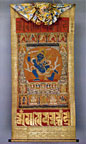
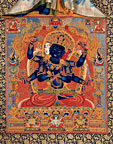
After the first Ming emperor Hongwu (r.1368-1398) had banned the production and use of those luxurious silken images, a grand revival of this Tibeto-Chinese art tradition was patronized by both the third Ming ruler Chengzu, known as the Yongle emperor (r.1403-1424) and especially during the reign of the Xuande emperor (1426-1435). The large blue and golden silk brocade banner of Cakrasamvara in yab-yum from the Yarlung Museum in Tsethang (no.53; 275x210cm without border), probably once kept in a Tsethang monastery, has been so far – quite literally – a hidden treasure, which was not on display in Tibet for the last decades. [44] Sometime after circa 1985 its original fabric border was removed and replaced by modern brocades. By the Chinese six-character mark Da Ming Yongle nian shi in the upper right corner, “made during the Yongle reign of the Great Ming”, it can be dated to the years after 1407, when Ming Chengzu met the Fifth Karmapa at the court in Nanjing the representatives of the Sakyapa and Gelugpa schools in the successive years. Compared with two other large-size embroidered silk thangkas of Cakrasamvara and Vajrabhairava in the Lhasa Jokhang bearing the same Yongle reign mark [45] the Tsethang banner depicts no other deities or monk figures, which would allow an attribution to one of these Tibetan-Buddhist traditions or to a specific hierarch.


Fig. 17

The monochrome gold technique has been associated in the catalogue text (by Juliane Noth) with the originally Central Asian Nasij (“gold cloth”) weaving of the Yuan period. Basically similar gold-and-blue silk lampas weaves with Buddhist design did exist already in the 13th century. [46] Possibly these uni-coloured “silken paintings” on blue or red ground had also some influence on later Tibetan thangkas painted in an equivalent monochrome technique. I cannot see, however, any distinctive drawing style in the “Chinese brush painting manner” (catalogue text). “Chinese” is here the entity of several formal and technical features and the individual “handwriting”: the transformation of a Tibetan iconographic and aesthetic vocabulary into a new Tibeto-Chinese syntax of slightly different figural proportions, facial features, and ornamental design (lotus petals), which appear to have been meticulously copied but were seen through the eyes of a Chinese artist. At least two more Yongle-marked gold-threaded silk thangkas of the same style and from the same atelier exist in Lhasa: a Vajrabhairava on blue ground in the Potala Palace (fig.17) and another one depicting the same yidam protector on red ground in the Jo bo chapel of the Jokhang. [47]


Fig. 18
 

Although the Guhyasamaja-Aksobhyavajra silk embroidery from the Potala Palace (no.55) was previously published in colour [48], it is just breathtaking to see the original image and its fascinating bright colourfulness and brilliant stitching freshly preserved with its original fabric border as if it were made yesterday! (fig.18) The thorough written catalogue text (by Bernadette Bröskamp) presents an interesting and convincing iconographic analysis, especially with regard to the two monks in the upper section. While the lama to the left can be quite safely identified by his black hat with the double vajra and by the small Manjushri figure (alluding to the first Ming emperor, who was declared a reincarnation of the wisdom bodhisattva by his successor) as the Fifth Karmapa bDe bzhin gShegs pa (1384-1415), the other “black hat lama” to the right might be more difficult to determine. Since another Karmapa can be ruled out for sheer chronological reasons, it can be only – as rightly suggested in the catalogue – the Tsongkhapa disciple Shakya Yeshe (Shakya Ye shes, 1352-1435), to whom the Yongle emperor had also bestowed a black hat and the title “Son of the Buddha of Western Heaven” and “Great National Preceptor” (daguoshi) at their meeting in 1415. Shakya Yeshe is represented on various other fabric images in succession of his great master as the supreme teacher and great Gelugpa head displaying the dharmacakra mudra. The figure in bhumisparsa and dhyana mudra on the embroidery – with the blue six-armed Mahakala protector of the Yellow School! – would be interpreted as the Gelugpa hierarch second to Tsongkhapa at a time when the latter was still alive. If so, how can the representatives of these different religious traditions be depicted on one and the same thangka, which usually was dedicated and offered to the head or to the principal monastery of a specific school? This unorthodox iconography can be only explained by an “unusual” yet nevertheless very probable function (in view of our usual understanding of these very images!) of this embroidery, as an apparently personal use of the emperor for his own religious needs at the court. As already mentioned, this silken masterpiece must have been commissioned for iconographic reasons during the reign of the Yongle emperor, whose imperial production of elaborate fabric images and refined gilt copper statues was not primarily associated – at least in the earlier years - with one of the three major Tibetan Buddhist schools like later on with the Gelugpa under the Xuande emperor. Thus in correspondence to Ming Chengzu’s political and diplomatic activities, an iconographic syncretism and “ecumenical” approach equally towards the Karmapa Kagyüpa, Sakyapa, and Gelugpa would characterise the brocaded and embroidered silken thangkas produced during his reign. By iconographic and historical evidence the Potala-Guhyasamaja must be dated after Shakya Yeshe’s first visit at the Ming court in 1415/1416 and before the death of Tsongkhapa in 1419.

The style and the distinctive gold-thread technique can be best compared with the two large Yongle-marked embroidered banners in the Lhasa Jokhang (see above for no.53) and with a third thangka of Raktayamari belonging to the same set, which is now in a private collection. [49] Figural proportions and drapery style, the chiaroscuro shading of the body and the ornamental gold-thread “drawing” of the throne-back and nimbus, particularly of the smaller seated figures, are so similar that both the “Jokhang set” and the Potala Guhyasamaja must have been produced in the same imperial atelier at about the same period. This would confirm a date of the Potala embroidery to 1416-1419. The same ornamental design can be also found among the famous gilt metal statues of the Yongle period. A close affinity exists also between the figural and ornamental style of the embroidery and of the wall-paintings (and statues) at Gyantse monastery and castle (ca. 1390-1430s; figural proportions, garment style, jewellery, torana arch and pillars, lotus throne). And obviously the well-documented regular missions from Gyantse to the Ming court and back in the early 15th century had left some cross-cultural artistic traces in Tibetan painting and statuary in China and in Tibeto-Chinese art in Tibet. Not “Nepalese” art was instrumental for the formation of the new “lamaistic” court style under the Yongle emperor, but the “Nepalo-Tibetan” style of the art at Gyantse of around 1400.

Another extraordinary Tibetan style embroidered thangka depicting Kapaladhara-Hevajra comes from the Potala Palace (no.50). By the rich design around the central figure and the decorative entity of image and ornament, the tantric protector has been transformed into a luxurious tapestry of imperial extravagance. The iconographic relation of the Hevajra yidam to the Sakya tradition does not necessarily associate this perfectly preserved banner with the visit of the 32nd Sakya abbot Kun dga’ bKra shis rGyal mtshan at the Ming court in 1413 (in Nanjing and Beijing), but may also refer to Shakya Ye she’s meetings with the Ming emperor in 1415 or in 1434/35, now being entitled by the Xuande emperor (r.1425-1435) as “Jamchen Chöje” (Byams chen Chos rje, “the Dharma King of Great Mercy” Chin.: daci fawang). Two other silken images of Hevajra, one in kesi technique in the Potala Palace and one embroidery in a private collection include the portrait of this principal Gelugpa hierarch, the first successor of Tsongkhapa. [50] However the total lack of any other related deities and monks on the Potala-Hevajra may also indicate the emperor’s private use of the image or, as in the case of the large Cakrasamvara brocade (no.53), another imperial function at the court. If the thangka was ever dedicated to the Gelugpa, this “minimal iconography” would possibly indicate a date of around 1415: At his first meeting with the Yongle emperor in early 1415, Shakya Yeshe was treated with fewer honours than the representatives of the Karmapa and Sakyapa, receiving at that time only the title of a daguoshi, “Great National Preceptor”, and of a “Son of the Buddha of the Western Heaven”. [51] When at the occasion of his second visit at the Ming capital in 1434/35 Jamchen Chöje had obviously managed to bring the Yellow School into the leading position at the imperial court and had received the title of a “Great Compassionate Dharma King” (daci fawang) or Byams chen chos rje as “variation of his title” (E.Sperling), he was showered with presents by the Xuande emperor. It seems that in fact most of the fabric thangkas can be attributed to the reign period of the Xuande emperor (1425-1435), whose promotion for a revival of the costly Yuan silk tapestries is documented by at least 12 preserved major images in kesi and embroidered brocade technique. And due to the now much higher imperial appreciation of the new Gelugpa hierarch his portrait as the supreme dharma teacher was depicted on most of the textile icons made during the Xuande reign. [52]

However, the maximum span to date the Potala Hevajra would be, in my opinion, on historical, iconographic, and stylistic grounds, between 1415, the year of the Yongle emperor’s first encounters with the Sakyapa and Gelugpa representatives, and 1435, when Jamchen Chöje made his second visit to the Ming court. Although a more precise dating remains speculative, stylistic criteria appear to be rather in favour of the Xuande period than of a Yongle reign date, as suggested in the catalogue. The ornamental decoration can be compared with those thangkas, which must be attributed to 1434/35 such as, for example, the two other Hevajra images mentioned above. [53]

More “popular” or at least the much better known Tibetan style art production under the early Ming are the famous “Yongle bronzes”, of which almost 300 still exist (all with reign mark, about 10-20% of them of the Xuande reign period), nearly a hundred of them in Lhasa (mostly in the Potala Palace), approximately 70 in the Beijing museums, and over hundred in public and private collections worldwide. [54] Compared with the fabric thangkas produced between circa 1407 and 1435, it is quite evident that the Yongle emperor’s Tibetan patronage gave priority to the metal statues, while his successor, the Xuande emperor, apparently prefered the silken images. Thus by far most of the early Ming “bronzes” had been sent with Chinese missions to Tibet or were given to Tibetan dignitaries in the years between circa 1405 and 1425. Only very few statues were brought to Tibet under the Xuande emperor and Buddhist sculptures are hardly mentioned as gifts for Tibet in the official accounts of that later period.


Fig. 19a

Fig. 19b

Fig. 19c

Fig. 19d

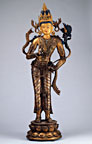
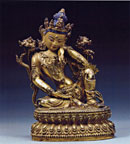
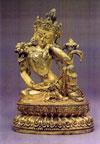
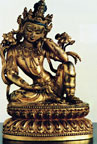
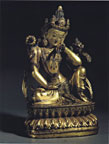
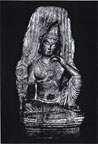
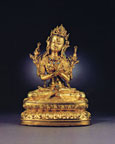
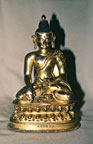
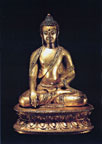
One of the most beautiful Yongle gilt copper images has been selected for this exhibition: the pensive Avalokiteshvara from the Potala Palace collection (no.37). A visual embodiment of this bodhisattva’s compassion, of the divine and the human, this elegant statue is an unsurpassable masterpiece of refined and perfect craftsmanship. (figs.19a,b,c,d) Only two other images of this type “in royal ease” posture (maharajalila) of a lokanatha (“lord of the universe” or “world protector”) exist. [55] The “pensive mudra” and attitude cannot be traced back to any text source. However, prototypes of a bodhisattva with the elbow resting on the raised knee, the right hand lifted towards the cheek slightly inclined in a gesture of contemplation, and the other hand lying on the foot do exist in Wei and Tang dynasty sculpture. A seal of an unidentifiable Dalai Lama fixed to the figure’s left arm proves that this Avalokitshvara was once most probably the personal meditation object of its worldly manifestation. Much has been written and published on the “Yongle bronzes”, but rarely were their Tibetan archetypes properly identified! That a hundred years earlier Nepalo-Chinese metal images of the Yuan period would have served as models (catalogue text by Juliane Noth) is simply on stylistic grounds unlikely. And even closer Yuan sculptures – in terms of period, location and ornamental systems - like at the Juyong Guan gateway north of Beijing (1342-1345) cannot be regarded as prominent forerunners in style and iconography. Among the few more safely identifiable 14th century Tibetan metal statues (or comparable no longer existing images), which predate the characteristic “Yongle bronzes” and which must have served as their models, is a Green Tara in the Museum der Kulturen at Basel. This statue also shows the specific double-lotus base with the elongated petals, a distinctive feature of the “Yongle bronzes” (G.W.Essen/T.T.Thingo, Die Götter des Himalaya. Buddhistische Kunst Tibets. Die Sammlung Gerd-Wolfgang Essen, München 1989, no.48. For two other 14th century Tibetan images see von Schroeder 2001,op.cit., vol.II, 255 E and 257 A). I hesitate to accept the idea that the facial features and proportions of this statue “correspond completely to the Nepalese style” and thus would indicate a Newari artist working in the imperial ateliers. Where are the Yuan period or Nepalese models for this specific type of the pensive bodhisattva? We must give the imperial ateliers the credit of having created new iconographic and compositional types following in some cases much earlier Chinese(!) models as they have been preserved, for example, by a 10th or 11th century stone sculpture of a pensive Avalokiteshvara in the Musée Guimet at Paris. [56] (fig.20) With very few exceptions, all these images were manufactured probably after Tibetan prototypes in an overall “Nepalo-Tibetan” style – as it characterises a major part of the Tibetan metal statuary during the second half of the 14th century - by top Chinese court artists, who had learned to copy foreign models and transform them into a very distinctive and homogeneous Tibeto-Chinese court style of its own. Was it possible that foreign artists could produce statues in the imperial workshops in their own characteristic “home style” without any correspondence to the rather canonic conventions imposed by the specific formal guidelines of that Tibeto-Chinese art production?


Fig. 20

Fig. 21

Fig. 22

Fig. 23

A few statues with the Yongle or Xuande reign mark exist, whose style does not or only partly corresponds to the usual Tibeto-Chinese artistic canon promoted under those emperors. Provided of course the inscriptions are authentic, these images would represent next to the mainstream of the very homogeneous court style some additional though quite exceptional artistic “traditions” or rather specific ways of manufacture in the imperial workshops:
1) an “almost” pure Yongle style image with some distinctive Nepalo-Tibetan elements (garment style), produced by a Chinese court artist, probably during the very early “formative” phase of the Yongle reign period. [57]
2) a very Nepalo-Tibetan style statue (in proportions, garment style, jewelry, inlaid turquoise stones) with some “Yongle elements” (facial features, lotus petal design, Yongle mark!), produced possibly by a Newar artist at the imperial ateliers, which may have also served as a model for the characteristic “Yongle bronzes”. [58] (fig.21)
3) a pure Newar style image without any Chinese features – except a Xuande reign mark, produced by a Nepalese or Tibetan artist in the imperial workshops (?) or brought there with the inscription added afterwards as a kind of imperial “model mark” (?). [59] (figs.22,23)

With reference to the illustrations of the Yongle-Kanjur (around 1410), which were very probably drawn by artists from Nepal or Tibet, von Schroeder rightly credits craftsmen of those countries as having “played an active part in the development of this new Tibeto-Chinese school” [60] but has not been able to identify safely a single Yongle or Xuande period statue as a work of a Tibetan or Newari artist produced in the imperial ateliers. A very difficult problem, indeed, to which my own contributions here may be regarded more as suggestions than as definitive answers.

The gilt copper image of a female deity no.39 may give an idea of those Nepalo-Tibetan models, whose elegant postures and gestures, the design of the double lotus, and even in a way the facial features must have had a formative influence on the Yongle statues. I cannot recognize among the great bulk of the Yongle and Xuande sculptures a different degree of stylistic sinization as it is stated in the catalogue for the Yongle dPal ldan Lha mo image from the Lhasa museum (no.65), which is not “more Tibetan” or less Chinese than other statues bearing the imperial signature. In this case iconography has been misunderstood as style: figures of wrathful deities in Tibetan art present oftenly greater difficulties for stylistic determination than those, whose posture, garment, and various adornments offer better clues for an art historical chronology.

With no doubt the extensive production of Tibetan style art at the early Ming court was partly motivated by political considerations in order to continue Mongol-Tibetan relations under the Yuan. The catalogue text on the Yongle statues however largely excludes emperor Zhu Di’s strong and – with regard to cultural court politics – very effective personal interest in Tibetan Buddhist religion and art. How Buddhist was this Han-Chinese ruler, whose father had been a Buddhist monk in his young age and whose wife, Empress Xu (d.1407), wrote a sutra on the Buddhist great virtues describing her spiritual communication with the bodhisattva Guanyin, who prophesied that Zhu Di would become the next emperor? No doubt were the production of hundreds of Tibetan style images and the publication of a monumental Tripitaka edition (1420ff) and of the so significant first printing of the Tibetan Canon, known as the “Yongle-Kanjur” and completed in 1410 by his own words in the colophon, more personally than politically motivated: “The merit it brings to us cannot be described in words”. And different from Khubilai Khan and from the Qianlong emperor, the tantric initiations bestowed upon Ming Chengzu (Zhu Di’s posthumous honorific title) did not serve to make him a “sacred King” and cakravartin or a bodhisattva-emperor. [61] No mention is made of his fervent conversion to Tibetan Buddhism. A Buddhist monk, Daoyuan (Yao Guangxiao), was his closest adviser throughout his life. And “no Chinese emperor treated any Buddhist eminences with the same degree of deference, amounting to object adulation”. [62]

Early Chinese Buddhist bronzes like the Shakyamuni figure no.12 from the Potala Palace (dated to the year 473) were no doubt brought to Tibet during the 7th and 8th century, be it with the Tang princesses Wencheng Kongjo (Tib. Mun sheng Kong co) in 641 and Jincheng Kongjo (Kim sheng Kong co) in 710, be it with Chinese masters and missions in the successive years. Unlike Buddhist images from Nepal and India and comparable with the occasional “imports” of 8th and 9th century Kashmir style statues, those Chinese sculptures had no influence on contemporary and later Tibetan art. There are at least another twelve Chinese Northern Wei through Tang dynasty bronzes preserved in the Potala Palace and Jokhang collections and seven statuettes dating to the Tang period in Tashi Lhünpo monastery. [63]


Fig. 24a

Fig. 24b

Fig. 24c

Fig. 24d

Fig. 24e

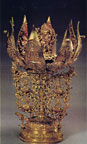
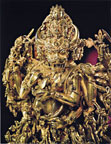
Among the six metal images of the Yongle era shown in this exhibition, an 82 cm high (58 cm when open) gilt copper lotus mandala of Vajrabhairava (as inscribed in Chinese and Tibetan at the top of the lotus, fig.24a,b,c) from the Lhasa museum (formerly kept in the Potala Palace and published in the catalogue under no.75) was supposed to be shown in the exhibition but was withdrawn for unknown reasons. Instead a Cakrasamvara mandala of the same set was given on loan (not recorded in the catalogue), whose original cover of the lotus bud (when closed) is apparently missing a