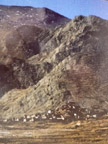
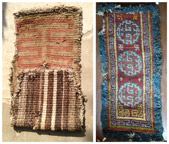
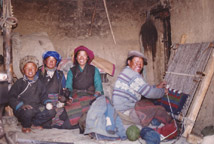
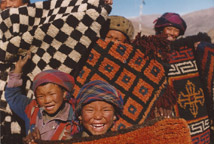
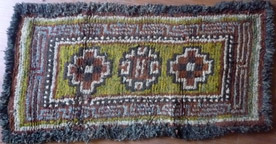
Once famous throughout Tibet, Wangden was unique for its style of carpet weaving practiced nowhere else in Tibet, and was in great demand by monasteries from Lhasa to Amdo to Ladakh. Wangden carpets were used as meditation mats by the Fifth Dalai Lama, and every year a new set of Wangden runners was woven for the use of monks participating in the Great Monlam Prayer Festival in Lhasa, the first and largest religious gathering of the Tibetan Buddhist year.
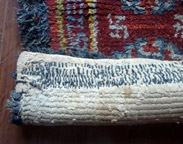
Before Tibet was opened to Westerners in 1984, nothing was published on Wangden carpets, nor were they available in the Kathmandu market. Soon after, some pieces came out from Lhasa to Kathmandu, and their unusual construction was noted by Western carpet enthusiasts. In the late 1980s, Western dealers expressed an interest in these pieces. Therefore, Lhasa carpet dealers started to seek out this type until in 1991 a large group of 40 or 50 pieces came onto the market in Lhasa with prospective buyers searching Lhasa dealers’ houses. Due to this group’s sudden emergence, most likely from a single source, in this case we can presume a monastery. Due to the unusually heavy weight it seemed to be very unlikely that these carpets were carried by nomads.
When we arrived in Gabu there were still examples of recently made bed-size (khaden) carpets which had bright chemical greens and three medallion (mandala) designs. Their designs and making techniques are similar to the later 19th century Wangdens with grey wool warps and light weight weft, making them somewhat like standard cut loop bar system Tibetan rugs. There is a considerably rarer and older group of carpets with predominantly red and yellow palette, though also sometimes indigo blues and greens with natural cream warps which are interspersed with brown warps and have a very low knot count. These pieces have been found in western Tibet more than 1000 km from the Wangden valley and it has been suggested they were made there by weavers who were perhaps trained in the tradition in the Wangden valley. Further research has revealed a still rarer group with hard yak warps and higher knot count with a multitude of well saturated dyes including beautiful light purple (to some eyes strawberry), dark indigo greens and rich madder reds. These are predominantly found around Lhoga, the ancient seat of Tibetan kings in the Yarlung valley. As it is not far from Wangden we could surmise that these pieces are the original form of Wangden drumtse, made during the Chinese Ming Dynasty era (1366-1644). Recently, one carpet was carbon tested to be within this period. Since Tibet is such an old monastic culture, it is likely this kind of rug has been made there as early as during the rule of the kings of Yarlung in the Tang era (before 907 AD).
These mention flat woven wool strips called “nambu” being given as tribute by Tibetan nomads to Chinese officials, proof that weaving was already the specialty of Tibetans at that time. About the author: Rupert Smith is from Derbyshire, England, and bought his first rug in the bazaar in Istanbul over thirty years ago. Following his first visit to Tibet in 1986 he has dedicated himself to the study of Tibetan culture, with particular attention to the unique craft of Tibetan weft and weave. As well as having an eye for the rugs characteristic of daily life on the remote Tibetan plateau, he sponsors a project in Tibet dedicated to making Wangden meditation rugs. With energy and tenacity Rupert has promoted the revival of ancient skills by supplying the weavers with natural dyes from Nepal and India and has brought them to the attention of the outside world. His knowledge of the rarest and most exquisite antique Tibetan rugs is second to none and can be found in his book Secrets of Tibetan Weaving. From November Wangden meditation rugs will be available from the Serindia Gallery ANNEX 4th Floor, Central Embassy (Ploenchit and Chidlom BTS), 1031 Ploenchit Road BANGKOK 10330, Tel: +66 2160 5977 serindiagallery@gmail.com ; www.serindiagallery.com Kathmandu exhibition: Opening party 5-8pm 21st November, 2014 Every day 11am-7pm until 5th December, 2014 Taragoan museum exhibition space next to Hyatt hotel Boudha, Kathmandu Cell no. +977-9813370088 For further enquiries all text & images © Rupert Smith |