|
14. Buddha Sakyamuni Thailand Sukhothai Kingdom, first half 15th century Bronze height 106 cm |
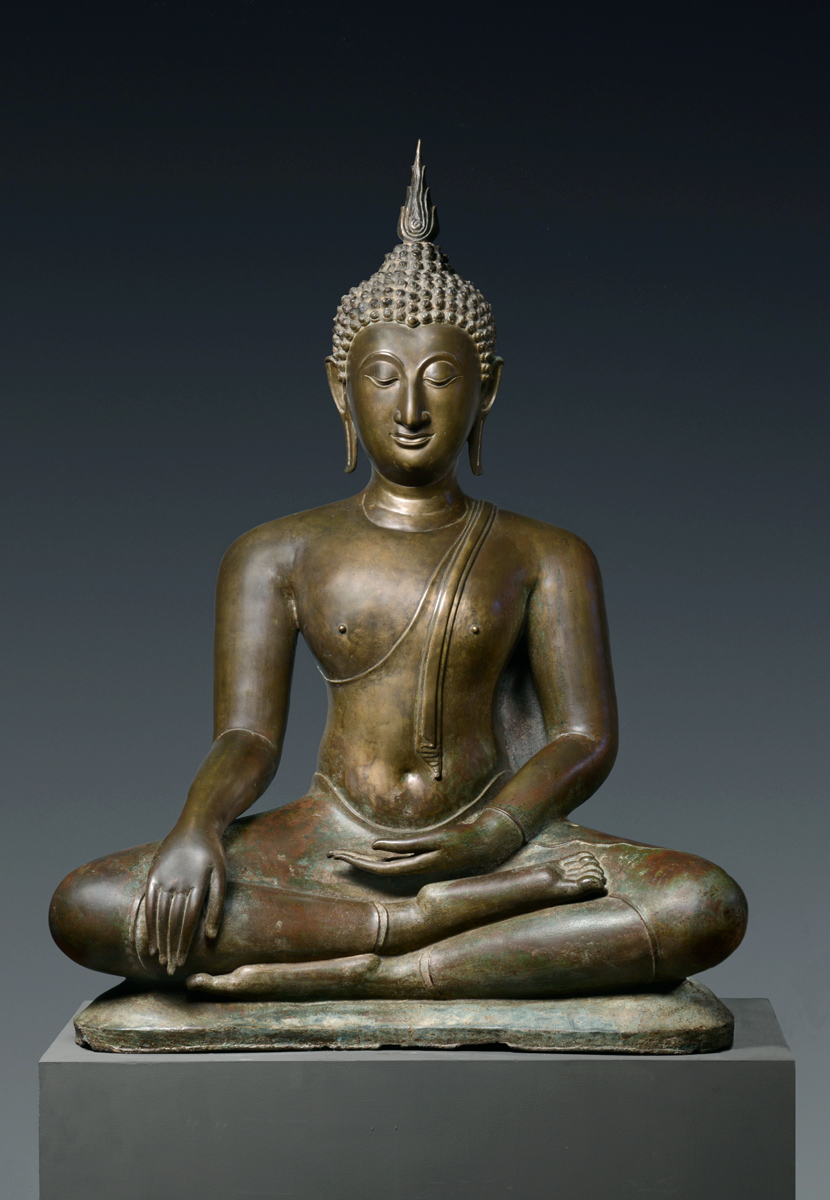
When the young kingdom of Sukhothai broke its dependency from the Cambodian rulers in 1238, it soon expanded its political power, reaching its peak during the reign of King Ramkamhaeng (1279-1299) whose kingdom covered most of present-day Thailand. It developed its own cultural traits and artistic idioms. In terms of Buddhist art, it meant a refreshed canon concerning the presentation of the Buddha. Influenced by visiting Sri Lankan Theravada Buddhists, the features and characteristics of classical Buddhist iconography were brought to the fore again as an ideal presentation of the Buddha, a superhuman being. This resulted in an unprecedented pure and brilliant style, which stood model for the subsequent Thai kingdoms of Ayutthaya, Thonburi and Rattanakosin. This life-size bronze represents Buddha Sakyamuni seated in virasana, with his right leg on top of the left and with the soles of his feet bared upwards. His left hand rests on his lap in the meditation gesture, dhyana mudra. His right hand points downwards from his knee, almost touching the seat below. This gesture, bhumisparsha, is particularly popular in Southeast Asia as it commemorates the victory of the Buddha over the demon Mara (‘Maravijaya’-pose), while touching Mother Earth to solicit her approval of his victory. The genius and beauty of this Sukhothai bronze are both demonstrated in its details as well as in its general appearance. Sakyamuni is wearing a transparent sanghati (monk’s robe), leaving his right shoulder uncovered. Only the thin hems are discretely marked in a sinuous line over the chest, along the belly and on the shins. The narrow pleated flap of his shawl dangles down from his left shoulder, almost touching the navel. It ends in a refined little cascade of folds. Three beauty lines embellish the neck as one of the aesthetic traits of a perfect Buddha. His slightly elongated oval face is marked by the many rounded forms like the little protruding chin and the semi-circular, arched, brows. The eyelids follow the same line delineating the almost closed, downward-facing eyes. His long aquiline nose with small nostrils gives the face its captivating, elongated, features, which is highlighted by the contrasting small, sensuous, mouth with an upturned smile. The long, pierced, earlobes reinforce the dominating vertical feeling, which finds its apex in the high flame on top of the usnisha. The heart-shaped hairline fits perfectly in the linear composition of the face. The well-ordered rows of little snail curls follow the round forms and contrast strongly with the smoothness of the forehead and face. The general impression is one of serenity and fulfillment. The straight back, the palpable, powerful breath inside the swollen chest, the balanced unity of the body, as well as the limbs and the head, are all impeccable. The wonderful patina is epitomized by the diaphanous robe, which appears like a second skin. Both create a sense of abstraction of all the incorporal elements, idealizing the essence of the divine presence of the Buddha. Life-size Buddha images originating from the Sukhothai kingdom are extremely rare in western collections. The name of the capital and dynasty was well chosen. ‘Sukhothai’ derived from the Sanskrit sukha, happiness, and udaya, emergence. In other words ‘The dawn of happiness.’ Provenance: Collection Peng Seng, Bangkok, before December 1979. Private collection, Barcelona, Spain 1979-2019. Report: Thermoluminescence Analysis Report, by Oxford Authentication Ltd, Oxfordshire, 25 June 2019, Sample n°N119g84 is consistent with the period of manufacture. Literature: A.B. Griswold, Dated Buddha Images of Northern Siam, Ascona, 1957, p.23, fig.2. Idem, Towards A History of Sukhodaya Art, Bangkok, 1967, figs.47 &54. C. Stratton & M. McNair Scott, The Art of Sukhothai Thailand’s Golden Age, Oxford, 1987, p.78, fig.69. C. Stratton, Buddhist Sculpture of Northern Thailand, Chicago, 2004, figs. 7.76 & 7.78. Detail: close-up |