
|
2. Head of Bodhisattva Afghanistan Gandhara period 3rd- 4th century Stucco with traces of polychrome height 38,5 cm |
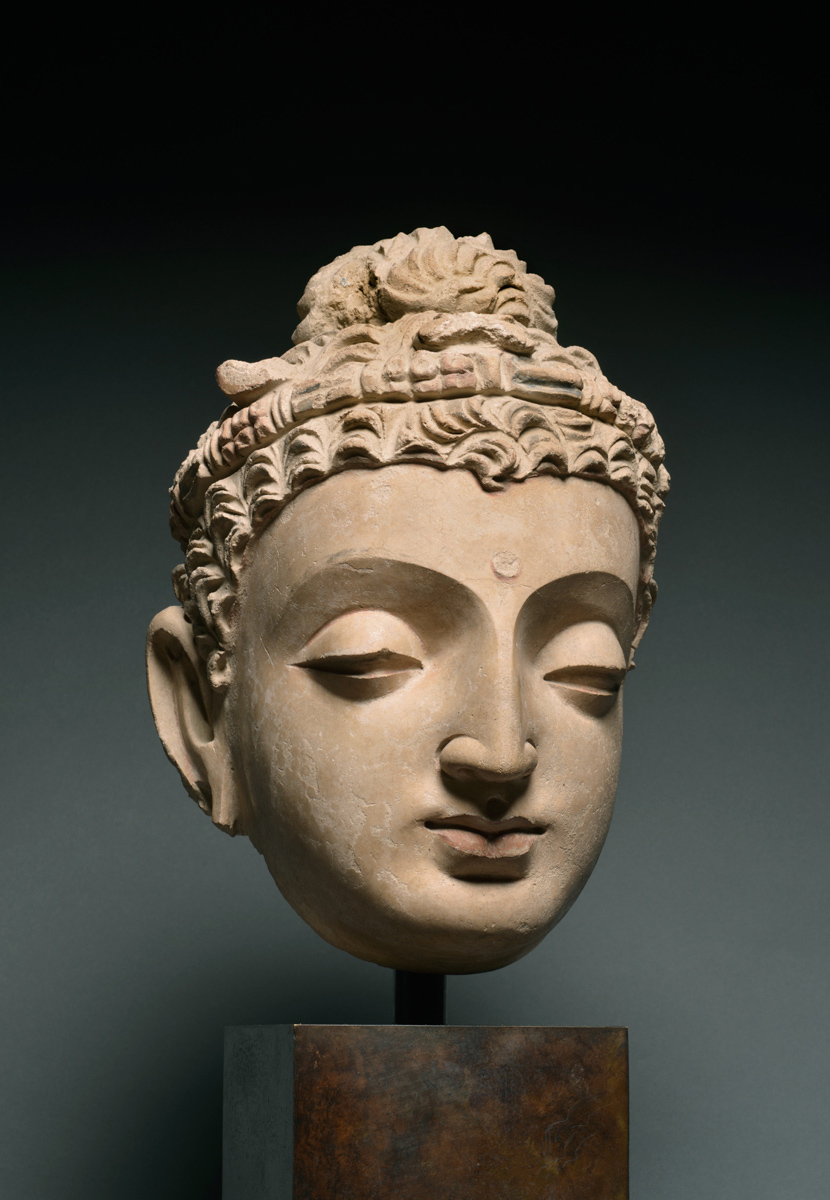
This head of a Bodhisattva is not sculpted in schist as Gandhara sculptures tend to be. It is modeled in stucco, a mixture of gypsum, sand, lime and water. It is very malleable and offers a lot of advantages compared to stone. The artist can work fast and spontaneous and can opt for any size and shape as he is not refrained by the possible limits of the piece of stone. This is especially handy in an area where stone is rare or not available at all. Moreover, the use of moulds and prefashioned parts opens a whole range of possibilities. On first sight stucco might look fragile, but the fine mixture proved to be resistent over time, in particular against oxidation. The polychromes would have, in addition, helped the still remaining stucco art works. Nevertheless, also due to destruction by man, many stucco sculptures are badly damaged or have just dissolved and disappeared in the course of time. Probably the stucco technique originates from Alexandria in Egypt, in order to replace the costly marble. Through the Greco-Roman invasions in Iran and central Asia, it arrived in Gandhara, and then further along the Silk Road, up to China. Archaeological campaigns in the 19th and 20th century, in caves, temple-ruins and stupas in Afghanistan, in sites like Hadda, Taxila and surroundings, revealed the classical examples of Gandhara Buddhist sculpture in stucco. Many were vividly conceived, life-size in high-relief. Even giant Buddha heads measuring one meter or more were found. In this region the stucco works are dated between the 1st and 5th century. When the Chinese Buddhist traveler, Fa Hsien, visited Gandhara around 400 CE, he noted that there was still a lot of activity. The invasion of the Hephthalites or ‘White Huns’ in the middle of the 5th century in Sogdiana, Afghanistan and northern India, has caused the destruction of many artworks. The Gandhara style however lived on further east till the 7th- 8th century. This more than life-size stucco head exemplifies the Bodhisattva image, following the current artistic norms and ideals of Afghanistan in the 3rd- 4th century. This means basically that the original Hellenistic models were modified, from naturalistic into idealized and spiritualized representations of the Bodhisattva. The ‘skin’ of the sculpture is tight and smooth. The slanting eyes are half closed with pronounced lids. The wide arches of the brows dissolve seamlessly into the aquiline nose with well-delineated, fine, nostrils. The sensuous lips end in deep dimples at the corners of the mouth. A little cavity is positioned between the mouth and the nose. The oblong dip under the fleshy lower lip heightens the round chin that matches with the full cheeks of the oval face. A slightly elevated little circle on the forehead marks the urna. The rows of waves of the curly hair are held together with a ribbon or diadem, bejeweled with rectangular stones, ornate beads and rosettes. Part of the wavy hair is tight up in a topknot, usnisha. The head’s right ear is slightly damaged but the remaining parts clearly suggest the shape of the long earlobes. Traces of pigment are still visible on the diadem, the lips, the contours of the eyes, the eyebrows and the ears. Despite the missing left ear, the facial features are still in an unusually good and original condition, placing this stucco head of a Bodhisattva among the finest known images of the period. The Gandhara artists managed to treat the symbolic cognizances of the Bodhisattva in such a way that they are discretely imbedded in the features of an idealized young man’s face. Provenance: Collection Spink & Son Ltd, London, before 1984. Private collection, London, 1984-2017. Rossi & Rossi Ltd., London, 2017-2018. Literature: The Arts of India and Nepal. The Nash and Alice Heeramaneck Collection. Museum of Fine Arts, Boston, 1966, p.17, fig.21. Indian art, The Victoria and Albert Museum, University Press, Oxford, 1977, fig.4b. A.N. Heeramaneck, Masterpieces of Indian Sculpture from the Former Collections of Nasli M. Heeramaneck, Verona, 1979, fig.14. W. Zwalf, A Catalogue of the Gandhara Sculpture in the British Museum, London, 1996, p.313, fig.593. K.A. Behrendt, The Art of Gandhara, The Metropolitan Museum of Art, New York, 2007, p.55, fig.44. Detail: close-up view |