
|
5. Sarasvati Nepal Licchavi period, 8th century Black chlorite Height 78 cm |
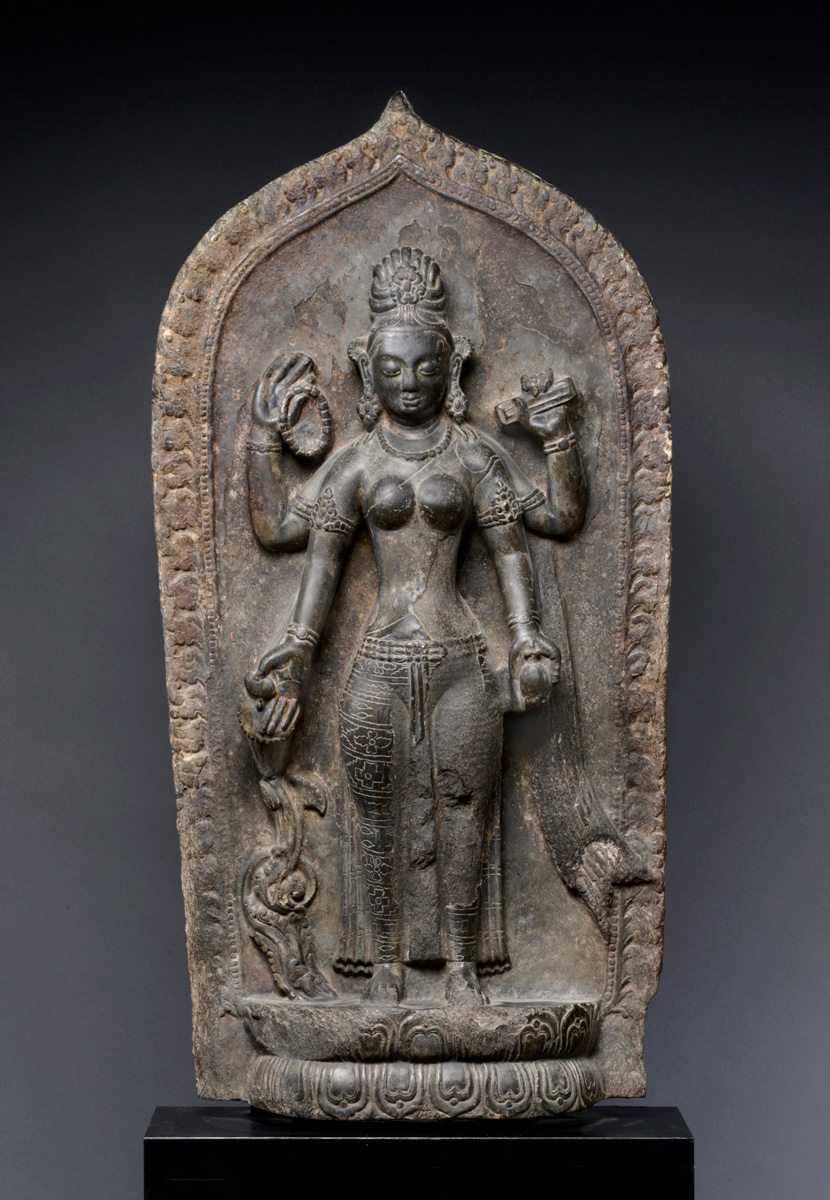
The role and representation of Sarasvati in Indian mythology and iconography are rather complex. In both Hinduism and Buddhism, she is worshipped as the goddess of learning, poetry, music and dance. Her roots go back to the Vedic culture where she is worshipped as a river goddess, her name, Sarasvati, means ‘the flowing one’. Over time, however, the once existing river Sarasvati in northwest India, dried up, so the goddess became the representation of speech, vac in Sanskrit, and was called Vagishvari, goddess-creator of mantras. In the post-Vedic Brahmana texts (ca. 600 BCE) she is called ‘Mother of the Vedas’ and connected with the creator, Prajapati. In mythology she is either the spouse or the daughter of Brahma. Feeling intense desire for her, Brahma then created for himself four faces looking in all cardinal directions but also a fifth one so that he could gaze upwards towards her. This engendered incestuous act by him for which, according to other texts, Shiva cut of the fifth head. The story goes that because of this dubious issue, Brahma left Sarasvati and replaced her with Gayatri. In classical Hindu as well as in Tantric Buddhist iconography, Sarasvati is represented as a young lady, holding a vina, a long stringed instrument, in both hands. Her vehicle is a goose, or sometimes a parrot or a peacock. In Nepal, Sarasvati is venerated by Buddhists and Hindus alike and invoked as the consort of Manjushri, the Bodhisattva of wisdom, a role fitting her status as goddess of learning. In the present sculpture Sarasvati stands on a double lotus, confirming her status of goddess. Her attributes are a mala, a rosary, in her upper right hand, and a pustaka, a book, in her left. The lower right hand, in the gift-bestowing varada mudra, holds an utpala, a blue lotus, while her left hand carries a small kalasa, a vase holding the elixir of immortality. Dating this Nepalese sculpture requires focusing on the different stylistic elements: The slender figure with full hemispherical breasts, the narrow waist and full hips with gracefully curving thighs are representative for the earliest Nepalese stone sculptures. The armbands are worn high on the arms and decorated with a single leaf motif. The long dhoti is incised with distinctive geometrical patterns of an earlier period. The necklace is kept modest and gives more attention to the beautiful face with downcast eyes, broad nose and tiny, though full, lips with dimples at each corner of her mouth, all suggesting a Gupta influence. Her ears with long pierced lobes contain flower motifs with eight petals. Her hair is tucked in a chignon with a simple decorative frontal diadem and with a little flower behind both ears. A spiraling water design fills the space next to her right leg. The long sash falling from her left shoulder ends in a large fishtail form partially covering with its tip the surrounding flaming prabha frame. All these elements lead to a Licchavi period origin (400 – 879 CE), probably 8th century. Provenance: Collection Mr. and Mrs. J. and M. Alsdorf, New York, before 1997. Collection Mr. and Mrs. R. Kukahn, Bonn, 2002-2019. Exhibited: A Collecting Odyssey. Indian, Himalayan and Southeast Asian Art from the James and Marilynn Alsdorf Collection, The Art Institute of Chicago, Chicago, 2 August-26 October 1997. Published: P. Pal, A Collecting Odyssey. Indian, Himalayan and Southeast Asian Art from the James and Marilynn Alsdorf Collection, exhibition catalogue, The Art Institute of Chicago, Chicago, 1997, pp.193 and pp.329, cat. n°252. M. Nies, Immortal Image. Art of India, the Himalayan regions, Indonesia and Southeast Asia, catalogue, Antwerp, 2001, pp.14-15. Literature: E.R.L. Waldschmidt, Nepal, Kunst aus dem Königreich im Himalaja, Recklinghausen, 1967, fig.11. P. Pal, The Arts of Nepal, vol.1, Sculpture, Leiden, 1974, figs.134 &232. Detail: close-up view |