Asianart.com | Associations | Articles | Exhibitions | Galleries
Articles by Jean-Luc Estournel
| Jean-Luc Estournel studied Tibetan at INALCO (National Institute for Oriental Languages and Civilizations) in Paris, and further studied art history with a specialization in Asian arts (double major: "History of Far Eastern Arts" and "Art and Archaeology of India and Indianized Countries of Asia") at the École du Louvre/Musée Guimet in Paris: he obtained a research degree there for his study on "Tibetan ritual objects made from human bone." From 1984 to 1995, he worked as a private art dealer in Paris. Since 1993, he has been working as an expert in Asian art for private collectors and auction houses: he is a member of the CNE. (Compagnie Nationale des Experts en Art). Since 1993, he has been working on compiling a "Catalogue Raisonné" of sculptures from the great tashigomangs of Densatil Monastery. |
|
About the famous Green Tara at the Cleveland Museum |
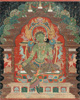
| In 1970, thanks to Sherman Lee's legendary eye, the Cleveland Museum of Art was able to acquire an exceptional Tibetan painting depicting a green Tara. Since then, this small thangka has continued to fascinate enthusiasts and specialists alike, as its perfection combined with atypical features resulting from a remarkable synthesis of different styles make it a unique piece within the corpus of ancient Tibetan paintings catalogued to date. Over the past fifty years, this work has continued to puzzle experts, with no theory ever proving convincing. |
 |
| Published: December 17, 2025 |
| About the portraits of Tibetan masters |
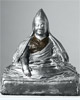 |
It is a commonly accepted convention among scholars that “only deceased monks are usually depicted on a lotus pedestal” since it is only after their death that they acquire a more or less divine character. Which begs the question: are all representations of lamas not resting on lotus pedestals but on cushions then to be considered as having been made during the lifetime of the model? An analysis of the large corpus of masters portraits quickly shows that this is not the case. It is therefore necessary to look elsewhere for potential elements that could provide us with an answer. |
| Published: February 28, 2021 |
| About the 18 stupas and other treasures once at the Densatil monastery |
|
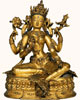
Since the end of the 1960s, public and private collections around the world have housed an important group of Tibetan objects with a very strong typological, iconographic and stylistic unity, constituting a particular group among all those recorded to come from the “land of snows”. Densatil monastery, the origins of which can be traced to ca. 1198, was perhaps first founded by the monk Dorje Gyalpo (rdo rje rgyal po) who, nearly half a decade ealier in 1158, had settled the area of Phagmodru (phag mo gru). |
 |
| Published: May 16, 2025 |
Asianart.com | Associations | Articles | Exhibitions | Galleries